Communication Skills Training: Daily Habits That Work
A practical guide to improving how you speak with 60-second daily reps, simple structures, filler-word fixes, interview prep, and a 30-day challenge.
Communication skills training does not have to mean sitting in a classroom, watching slides, or memorizing scripts that sound nothing like you.
The fastest way to get better at speaking is simple: speak more, on purpose, in short reps, with feedback you can actually use.
Think 60 seconds a day. One random topic. One recording. One small improvement.
That is enough to build clearer thinking, stronger confidence, fewer filler words, sharper interview answers, and better performance in meetings, sales calls, presentations, networking conversations, and everyday life.
This guide gives you a practical, no-fluff system for improving your communication skills without overthinking it. No expensive workshop required. No audience needed. No prep. Just daily practice that compounds.
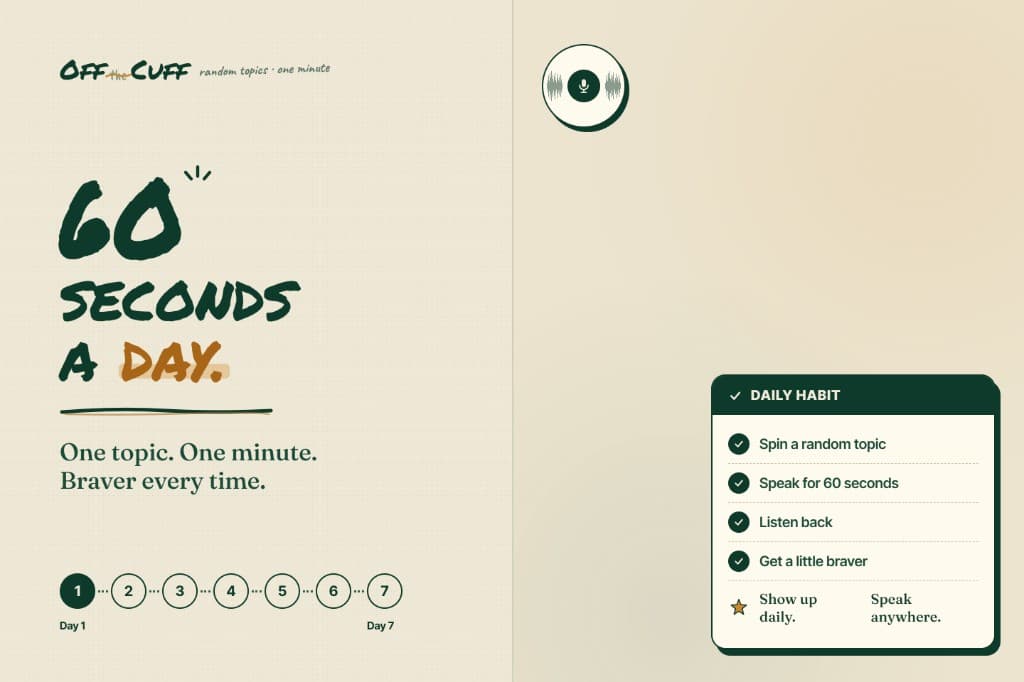
Small daily speaking reps build confidence, clarity, and control.
What Is Communication Skills Training?
Communication skills training is the process of improving how you express ideas, listen, respond, and connect with other people. It can include public speaking, conversation skills, interview prep, storytelling, body language, vocal delivery, active listening, negotiation, and professional communication.
But here is the part most people miss: communication is a performance skill.
You can read about it. You can watch great speakers. You can understand every tip in the world. But you only improve when you practice speaking out loud.
That is why the best communication skills training focuses on repetition, feedback, and real-world scenarios.
The core skills you are training
Strong communicators are not born with magic. They build a set of repeatable skills:
- Clarity: saying what you mean without rambling
- Structure: organizing thoughts quickly
- Confidence: speaking even when you feel pressure
- Conciseness: getting to the point faster
- Vocal control: using pace, pauses, tone, and volume
- Presence: sounding engaged instead of robotic
- Listening: responding to what was actually said
- Adaptability: thinking on your feet
- Persuasion: making ideas easier to accept
- Self-awareness: noticing habits like filler words or rushed speech
The goal is not to sound perfect. The goal is to sound clear, credible, and human.
Why Traditional Communication Training Often Fails
Most people try to improve communication the wrong way.
They wait for a big moment: a presentation, a job interview, a meeting with leadership, a pitch, a difficult conversation. Then they cram. They write notes. They rehearse once or twice. They hope it works.
That is not training. That is panic prep.
Traditional programs can help, but they often fail because they are:
- Too infrequent
- Too theoretical
- Too public for beginners
- Too focused on polished speeches
- Too disconnected from everyday conversations
Real communication happens in messy, unscripted moments. Someone asks, "What do you think?" A hiring manager says, "Tell me about yourself." Your manager asks for an update. A client pushes back. A friend misunderstands you.
You need the ability to respond clearly in real time.
That skill is built through small daily reps.
The Better Approach: Short Daily Speaking Reps
You do not need two hours. You need one focused minute.
A daily 60-second speaking drill trains your brain to organize ideas faster. It also makes speaking feel normal instead of high-stakes.
Here is the basic loop:
- Pick or spin a random topic.
- Speak about it for 60 seconds.
- Record yourself privately.
- Listen back once.
- Track one thing to improve tomorrow.
That is it.
This works because it removes the biggest barrier: preparation. If practice requires a perfect topic, quiet room, notes, and motivation, you will skip it. If practice takes one minute, you can do it every day.
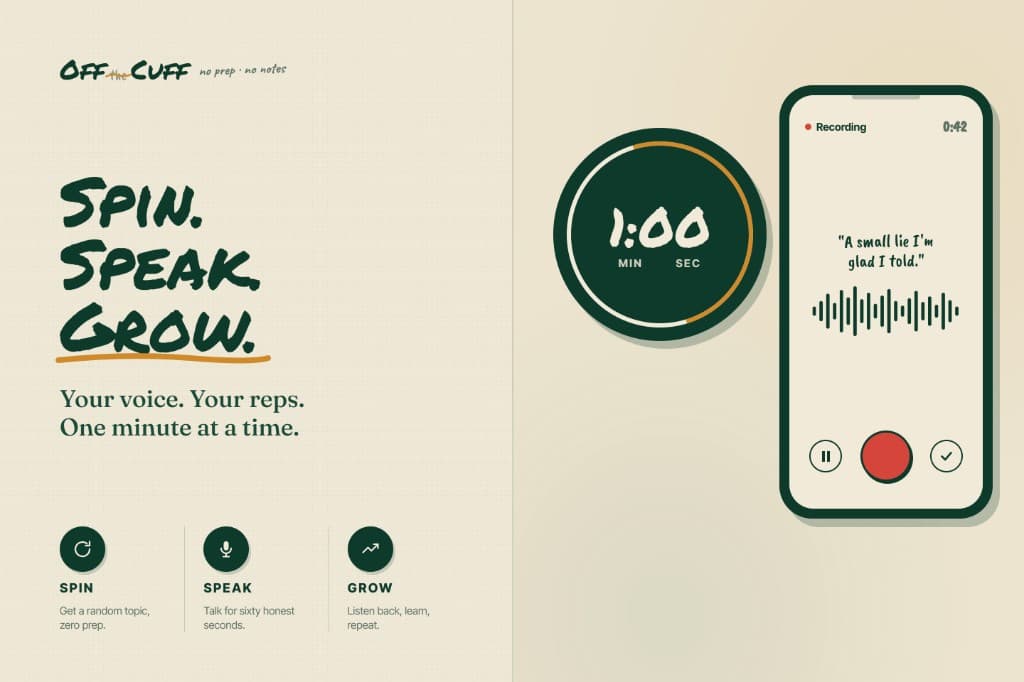
A 60-second drill is short enough to do daily and long enough to reveal speaking habits.
Why 60 seconds is enough
One minute is long enough to expose your habits but short enough to avoid dread.
In 60 seconds, you will notice:
- How quickly you find your point
- Whether you ramble
- How often you use filler words
- Whether you repeat yourself
- If your voice sounds flat or rushed
- Whether you end with confidence or trail off
Do that for 30 days and you create measurable improvement without needing a formal class.
The 5-Part Daily Communication Skills Training Routine
Use this routine when you want a simple system that actually sticks.
1. Spin a topic
Do not waste time choosing the perfect prompt. Randomness is the point. Impromptu speaking builds flexibility.
Try topics like:
- What is one habit that changed your life?
- Should meetings be shorter?
- Explain your job to a 10-year-old.
- What makes a good teammate?
- Describe a time you solved a problem.
- What is something most people overcomplicate?
- Give advice to someone starting your career.
- What is a product you love and why?
- Defend an unpopular opinion.
- Summarize a book, movie, or article in one minute.
The topic does not need to be impressive. You are training your speaking muscles, not writing a TED Talk.
2. Use a simple structure
Most rambling happens because people start talking before they know where they are going.
Use a lightweight structure. Pick one of these:
Point, reason, example, close
This is the easiest structure for clear speaking.
- Point: "I think meetings should be shorter."
- Reason: "Most meetings lose focus after 20 minutes."
- Example: "On my team, shorter check-ins force people to prepare."
- Close: "So I would rather have three focused updates than one long meeting."
Past, present, future
Great for interviews and career stories.
- Past: where things started
- Present: what is happening now
- Future: what you want next
Problem, action, result
Perfect for behavioral interview answers.
- Problem: what was wrong
- Action: what you did
- Result: what changed
You do not need to memorize a script. You just need a mental road map.
3. Record for 60 seconds
Recording is uncomfortable at first. Do it anyway.
You do not need to share it. In fact, private practice is one of the biggest advantages of this method. You can sound awkward, restart, experiment, and improve without an audience.
Press record. Speak. Stop at 60 seconds.
Do not delete the recording immediately. That is where the training happens.
4. Listen for one thing only
Do not critique everything. That turns practice into self-attack.
Pick one focus area:
- Did I have a clear point?
- Did I say "um," "like," or "you know" too often?
- Did I speak too fast?
- Did I pause naturally?
- Did I end strongly?
- Did I give an example?
- Did my answer have structure?
One rep. One focus. One improvement.
5. Track progress
What gets measured gets improved.
Keep a simple log:
| Day | Topic | Focus | Score 1-5 | Note |
|---|---|---|---|---|
| 1 | Explain my job | Filler words | 2 | Said "um" 12 times |
| 7 | Best career advice | Structure | 3 | Clear point, weak ending |
| 15 | Difficult feedback | Pace | 4 | Better pauses |
| 30 | Tell me about yourself | Confidence | 5 | Smooth and concise |
You are not chasing perfection. You are looking for proof that the reps are working.
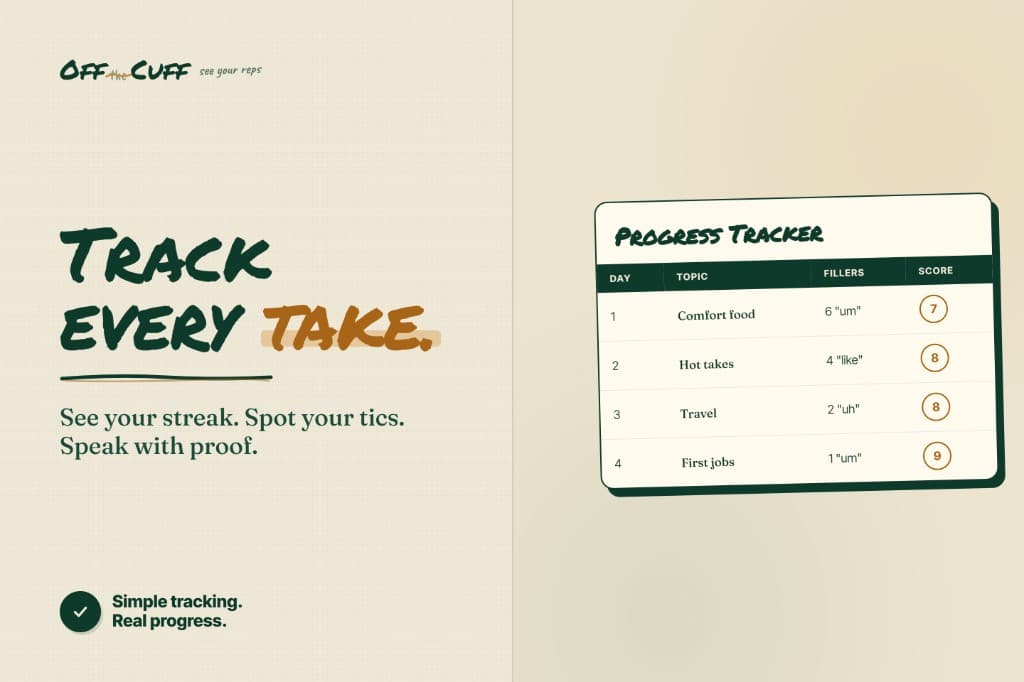
Track one speaking metric at a time so progress stays visible.
How to Reduce Filler Words Without Sounding Robotic
Filler words are normal. Everyone uses them. The problem is when they start weakening your message.
Common fillers include:
- Um
- Uh
- Like
- You know
- Basically
- Actually
- So
- I mean
- Kind of
- Sort of
The fix is not to panic every time you say one. The fix is to replace fillers with pauses.
The pause rule
When your brain needs a second, stop talking.
A pause feels longer to you than it sounds to the listener. Most pauses sound confident. Fillers sound uncertain.
Practice this drill:
- Pick a topic.
- Speak for 60 seconds.
- Every time you feel an "um" coming, pause instead.
- Continue after the pause.
At first, it will feel weird. Then it will feel powerful.
The slow-start drill
Many filler words happen in the first five seconds because you start before you have a point.
Try this:
- Read the topic.
- Take one breath.
- Silently decide your first sentence.
- Start with that sentence.
Example:
Prompt: "What makes a good leader?"
Weak start: "Um, I think, like, a good leader is basically someone who..."
Stronger start: "A good leader creates clarity when things feel uncertain."
That one clean sentence changes the whole answer.
Communication Skills Training for Interviews
Job interviews are communication under pressure. You need to sound prepared without sounding rehearsed.
The best interview prep is not memorizing 40 answers word for word. It is practicing flexible answer structures until they feel natural.
Practice the questions that always show up
Start with these:
- Tell me about yourself.
- Why do you want this role?
- What is your biggest strength?
- What is a weakness you are working on?
- Tell me about a time you handled conflict.
- Describe a time you failed.
- Tell me about a time you led a project.
- Why should we hire you?
- What are you looking for in your next role?
- Do you have any questions for us?
Record 60- to 90-second answers. Listen for clarity, length, and energy.
Use the "headline first" method
Interviewers are busy. Give them the point first.
Instead of:
"I have done a lot of different things in my current role, and one thing that might be relevant is..."
Say:
"My strongest fit for this role is my experience turning messy customer feedback into clear product improvements."
Then explain.
This makes you sound focused and confident.
Build a story bank
Create five stories you can adapt:
- A problem you solved
- A time you worked with a difficult person
- A time you learned quickly
- A mistake you recovered from
- A result you are proud of
For each story, write three bullets only:
- Situation
- Action
- Result
Then practice telling each story in under 90 seconds.
Short, specific, and outcome-focused wins.
How to Improve Clarity in Everyday Conversations
Clarity is not about using fancy words. It is about making your message easy to follow.
If people often ask, "Wait, what do you mean?" or if you finish talking and realize you never made your point, use these habits.
Start with the destination
Tell people where you are going.
- "I have one concern about the timeline."
- "My recommendation is to delay the launch by one week."
- "There are three reasons I think this will work."
- "The short version is we need more data before deciding."
This helps listeners organize what comes next.
Use fewer words
More words do not equal more value.
Try cutting these phrases:
- "I just wanted to say..."
- "This might not make sense, but..."
- "I am not sure if this is right..."
- "Sorry, quick question..."
- "To be completely honest with you..."
Say the thing.
Weak: "I just wanted to ask if maybe we should consider moving the deadline."
Clear: "Can we move the deadline to Friday?"
Check for understanding
Good communication is not a monologue. Add quick checks:
- "Does that match what you are seeing?"
- "Is that clear?"
- "What part should I expand on?"
- "Do you want the short version or the details?"
This makes you easier to work with immediately.
Impromptu Speaking: The Skill That Changes Everything
Impromptu speaking is the ability to respond clearly without much preparation. It is useful everywhere: meetings, interviews, networking events, sales calls, leadership conversations, and difficult discussions.
The key is not having all the answers. The key is staying calm long enough to organize one useful response.
The 10-second reset
When someone asks a tough question, do not rush.
Use one of these lines:
- "Let me think about that for a second."
- "The way I would frame it is..."
- "There are two parts to my answer."
- "My first reaction is..."
- "The short answer is yes, with one caveat."
These phrases buy time and create structure.
Practice random prompts
Set a timer for five minutes. Do five one-minute prompts.
Try these:
- Should everyone learn public speaking?
- What is one skill schools should teach?
- Explain a complex idea from your industry.
- What is a lesson you learned the hard way?
- What is one thing your team could improve?
Your goal is not brilliance. Your goal is reps.
How to Sound More Confident
Confidence is not a personality type. It is often the result of preparation, repetition, and control.
You can sound more confident by changing a few behaviors.
Slow down by 10 percent
Fast speaking can make you sound nervous, even when your ideas are strong.
Try this:
- Speak one sentence.
- Pause.
- Speak the next sentence.
- Pause again.
Pauses give your words weight.
End sentences downward
When every sentence rises at the end, statements can sound like questions.
Weak: "I think this is the best option?"
Strong: "I think this is the best option."
Record yourself and listen to your endings. This tiny change can make a big difference.
Replace disclaimers with direct language
Disclaimers protect you from judgment, but they also weaken your message.
Instead of:
- "This is probably a bad idea, but..."
- "I am no expert, but..."
- "Maybe I am wrong, but..."
Try:
- "One option is..."
- "My recommendation is..."
- "Here is how I see it..."
You do not need to be arrogant. You need to be clear.
Active Listening: The Underrated Half of Communication Training
Speaking gets most of the attention, but listening is what makes communication work.
Active listening means you are not just waiting for your turn. You are tracking meaning, emotion, and context.
Use the repeat-and-build method
When someone says something important, reflect it back and add value.
Example:
They say: "I am worried the deadline is too aggressive."
You say: "You are concerned we may rush quality if we keep the current timeline. I agree that is a risk. We could either reduce scope or add one more review day."
This shows you heard them and moved the conversation forward.
Ask better follow-up questions
Use questions that create clarity:
- "What matters most here?"
- "What would a good outcome look like?"
- "What have you already tried?"
- "Where is the biggest risk?"
- "What decision do we need to make today?"
Better questions make you sound smarter because they help everyone think better.
A 30-Day Communication Skills Training Challenge
If you want measurable improvement, do this for the next 30 days.
No prep. No audience. No excuses.
Week 1: Clarity
Goal: Make one clear point in 60 seconds.
Daily focus:
- Day 1: Introduce yourself clearly
- Day 2: Explain your job
- Day 3: Give one recommendation
- Day 4: Summarize an article
- Day 5: Explain a problem
- Day 6: Teach a simple concept
- Day 7: Review your best recording
Score yourself on: "Did I make a clear point?"
Week 2: Structure
Goal: Stop rambling.
Use one structure per day:
- Point, reason, example, close
- Problem, action, result
- Past, present, future
- Pros, cons, recommendation
- What, why, next step
Score yourself on: "Was my answer easy to follow?"
Week 3: Confidence
Goal: Sound steady and direct.
Focus on:
- Slower pace
- Strong first sentence
- Fewer disclaimers
- Downward sentence endings
- Better pauses
Score yourself on: "Would I trust this speaker?"
Week 4: Real-world scenarios
Goal: Practice moments that matter.
Prompts:
- Tell me about yourself.
- Give a project update.
- Push back on a deadline.
- Ask for a raise.
- Explain a mistake.
- Pitch an idea.
- Answer a tough question.
Score yourself on: "Can I use this in real life?"
Day 30: Compare your first and final recording
Listen to Day 1. Then listen to Day 30.
Notice:
- Are you clearer?
- Do you use fewer filler words?
- Do you sound calmer?
- Do you structure answers faster?
- Do you recover better when you lose your train of thought?
That comparison is your proof.
How to Measure Communication Improvement
Vague goals create vague progress. Track specific metrics.
Metrics that matter
Use these simple measurements:
- Filler words per minute: Count "um," "uh," "like," and similar fillers.
- Answer length: Can you answer in 60-90 seconds without rambling?
- Clear point: Can a listener summarize your message?
- Structure: Did your answer have a beginning, middle, and end?
- Pace: Did you sound rushed, slow, or controlled?
- Confidence score: Rate your delivery from 1 to 5.
- Relevance: Did you answer the prompt directly?
A simple weekly review
Once a week, choose your best recording and answer three questions:
- What improved?
- What still feels messy?
- What is my focus next week?
Keep it simple. Improvement loves consistency.
Common Communication Mistakes to Fix First
If you want quick wins, start here.
Mistake 1: Starting before you think
Fix: Take one breath and decide your first sentence.
Mistake 2: Using too many qualifiers
Fix: Replace "I might be wrong, but" with "My view is."
Mistake 3: Giving too much background
Fix: Start with the answer, then add context.
Mistake 4: Speaking in circles
Fix: Use a structure like point, reason, example, close.
Mistake 5: Avoiding playback
Fix: Listen once. Track one thing. Move on.
Mistake 6: Practicing only when stakes are high
Fix: Practice daily when stakes are low.
Best Communication Skills Exercises
Here are practical drills you can use immediately.
The 60-second explain-it drill
Pick any concept from your work or life. Explain it as if the listener knows nothing.
Focus: clarity and simplicity.
The no-filler challenge
Speak for one minute and replace every filler word with a pause.
Focus: control and awareness.
The headline drill
Answer every prompt with a strong first sentence.
Prompt: "What is your biggest strength?"
Headline: "My biggest strength is turning unclear problems into organized action."
Focus: confidence and directness.
The three-example drill
Make one point and support it with three quick examples.
Focus: persuasive detail.
The tough-question drill
Ask yourself hard questions:
- Why did that project fail?
- What would your manager say you need to improve?
- Why are you the right person for this role?
- What do you do when you disagree with leadership?
Focus: staying calm under pressure.
Communication Skills Training for Teams
Daily speaking reps work for individuals, but teams can use them too.
Try adding a five-minute communication warm-up to team meetings:
- Choose one prompt.
- Each person gives a 30-second answer.
- The group gives one positive note and one clarity suggestion.
Prompts for teams:
- What is one blocker we should remove?
- What is one customer insight from this week?
- What decision needs more clarity?
- What is one process we should simplify?
- What did we learn from the last project?
This builds better updates, sharper thinking, and more confident participation.
Keep feedback lightweight. The goal is practice, not performance review.
Build the Habit: Make Practice Too Easy to Skip
The best communication skills training is the one you actually do.
Make it frictionless:
- Practice at the same time each day
- Keep prompts ready
- Record on your phone
- Limit sessions to 60 seconds
- Track one metric
- Do not aim for perfect
- Never miss twice
Habit beats intensity.
One huge practice session will not change much. Thirty tiny reps will.
Final Takeaway: Speak More, Improve Faster
Communication skills are built through action.
Not someday. Not when you feel ready. Not only before interviews or presentations.
Today.
Spin a topic. Record for 60 seconds. Listen once. Pick one thing to improve tomorrow.
That is the whole game.
Small daily reps make you clearer. Clearer makes you more confident. Confidence helps you speak up when it matters.
Start the 30-day challenge today. Your future self will sound sharper because of the minute you practice now.
Ready to practice?
Spin a random topic, speak for 60 seconds, and listen back - free while we're in early access.