Impromptu Speaking Practice: Daily Drills That Work
Build impromptu speaking confidence with one-minute drills, PREP frameworks, filler-word fixes, interview prep, a 7-day plan, and 50 prompts.
You do not need to be born quick on your feet.
You need reps.
Impromptu speaking practice is the fastest way to build real-world speaking confidence because it trains the exact moment most people fear: being asked a question, having no script, and needing to sound clear anyway.
That moment shows up everywhere.
In meetings. Interviews. Sales calls. Class discussions. Team updates. Networking events. Tough conversations. Even casual introductions.
The goal is not to become a perfect speaker. Perfect sounds fake. The goal is to become steady. Clear. Useful. Human.
This guide gives you a practical system you can use every day. No stage required. No audience required. No pressure. Just one minute, a prompt, your voice, and a habit of recording, reviewing, and repeating.
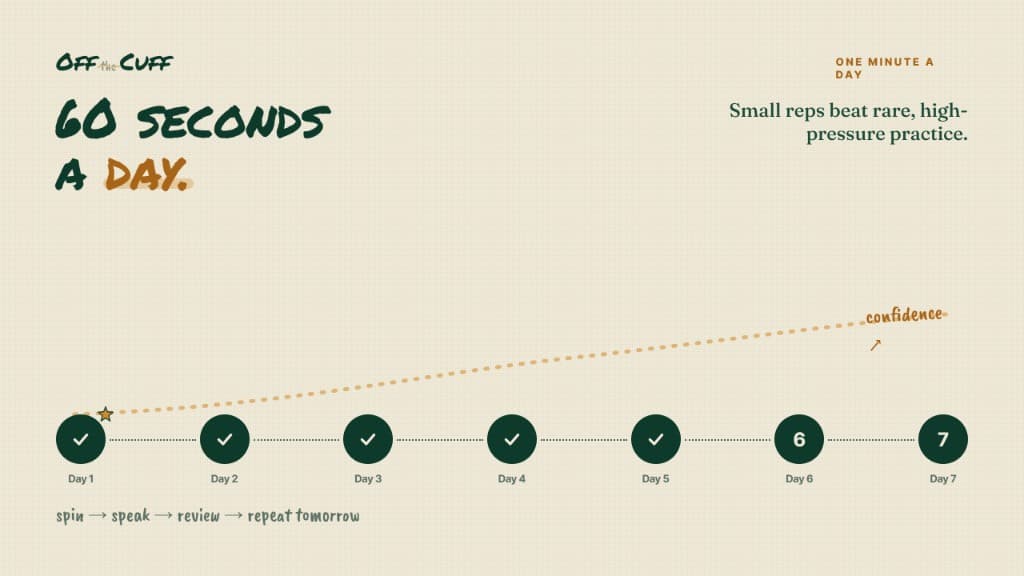
One minute a day can build real speaking confidence.
What Is Impromptu Speaking Practice?
Impromptu speaking practice is the act of answering unexpected prompts out loud with little or no preparation.
You pick a topic. You speak for 30 to 90 seconds. You record it. You review one thing. Then you do it again.
That is it.
Simple does not mean easy. The first few sessions may feel awkward. You may ramble. You may freeze. You may say um every five seconds. Good. That is the point. Practice gives you a safe place to make those mistakes before they happen in public.
Impromptu practice improves five core skills:
- Thinking clearly under pressure
- Structuring answers quickly
- Reducing filler words
- Speaking with calm pace and vocal control
- Building confidence through proof, not hype
Most people try to improve speaking by reading tips. Tips help, but they do not change your default behavior. Reps do.
If you want to get better at speaking, speak.
Why Impromptu Speaking Feels So Hard
Impromptu speaking is hard because your brain is doing too many jobs at once.
You are trying to think of an answer, organize it, choose words, manage nerves, read the room, and sound confident. That is a lot.
When pressure rises, your brain grabs the easiest option. That may be rambling. Or rushing. Or going blank. Or filling silence with words like um, like, you know, basically, and so.
This does not mean you are bad at speaking. It means you have not built a reliable response system yet.
A strong speaker does not magically know what to say. They use patterns. They buy time. They structure fast. They stay calm long enough to make a point.
That is trainable.
The One-Minute Rule: Your Best Starting Point
Do not start with a 10-minute speech.
Start with one minute.
One minute is long enough to build skill and short enough to do daily. It removes excuses. You can practice before a meeting, after lunch, in your car, or at the end of your workday.
A one-minute drill forces clarity. You cannot hide inside a long ramble. You need a point, support, and a close.
Use this basic format:
- Pick a prompt.
- Think for 10 seconds.
- Speak for 60 seconds.
- Record it.
- Review one thing.
- Repeat once.
That is a complete practice session in under five minutes.
Small practice done daily beats big practice done once a month.
The Best Framework for Impromptu Answers
When you do not know what to say, use structure before you search for perfect words.
Structure reduces panic. It gives your brain a track to run on.
Here are the best frameworks for impromptu speaking practice.
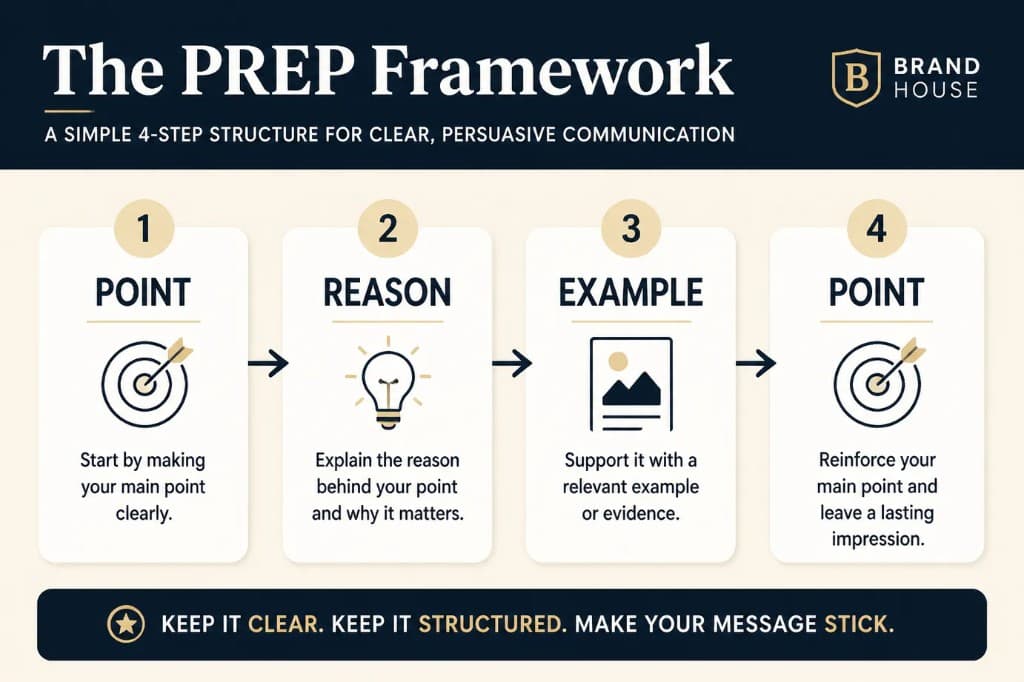
Use structure first. Better words follow.
1. Point, Reason, Example, Point
This is the most useful everyday framework.
Use it for opinions, meeting answers, interview questions, and quick explanations.
Point: State your answer.
Reason: Explain why.
Example: Add a concrete detail.
Point: Repeat or sharpen the main idea.
Example prompt: What makes a good teammate?
Answer:
A good teammate is reliable. Reliability matters because teams move faster when people trust each other to follow through. For example, if someone says they will send notes after a client call and they do it every time, the whole team can act with confidence. So for me, a good teammate is someone who makes work easier by being consistent.
Notice how simple that is. No fancy words. No performance. Just clarity.
2. Past, Present, Future
Use this when you need to explain progress, career growth, lessons learned, or plans.
Example prompt: Tell me about your communication skills.
Answer:
In the past, I was comfortable writing but less confident speaking off the cuff. Right now, I am practicing short recorded answers every day so I can get clearer and reduce filler words. Going forward, I want to be the person who can give concise updates and handle questions without overthinking.
This framework works because time gives you order.
3. Problem, Action, Result
Use this for interview answers and workplace examples.
Example prompt: Describe a time you handled pressure.
Answer:
The problem was that our team had to prepare a client update with very little notice. I took action by organizing the key points, assigning owners, and creating a simple three-part agenda. The result was a clearer meeting, fewer repeated questions, and a client who felt informed.
This is also great for behavioral interviews.
4. Yes, And, Because
Use this when you need to respond quickly to a question or build on someone else's idea.
Example prompt: Should teams use more asynchronous communication?
Answer:
Yes, and I think the key is deciding what belongs async and what needs a live conversation. Async communication works because it gives people time to think and reduces unnecessary meetings. But sensitive topics or unclear decisions still need real-time discussion.
This framework helps you sound balanced instead of reactive.
A Daily Impromptu Speaking Practice Routine
You do not need a complicated plan. You need a repeatable one.
Here is a 10-minute routine that works.
Minute 1: Choose a prompt
Pick one question. Do not hunt for the perfect one. The topic matters less than the rep.
Good prompts include:
- What is one habit that changed your life?
- Should meetings be shorter?
- What makes someone trustworthy?
- Tell me about a challenge you solved.
- What is a skill everyone should learn?
- Why do people avoid difficult conversations?
- Describe a product you love and why.
Minute 2: Prepare silently
Take 10 to 20 seconds. Choose a framework.
Do not write a script. Just decide your structure.
For example:
- Point, Reason, Example, Point
- Problem, Action, Result
- Past, Present, Future
Minutes 3-4: Record your answer
Speak out loud. Record on your phone or computer.
Privacy matters. You do not need to post it. You do not need to show anyone. The recording is for you.
Aim for 60 seconds. If you stop early, close the answer. If you run long, practice landing the plane.
Minutes 5-6: Review one thing
Do not judge your entire personality.
Review one behavior.
Pick one:
- Did I have a clear opening?
- Did I answer the question directly?
- Did I use too many filler words?
- Did I rush?
- Did I end with a strong final sentence?
- Did I give a specific example?
Keep it objective. You are not asking, Do I sound amazing? You are asking, What is the next small fix?
Minutes 7-8: Repeat the same prompt
This is where improvement happens.
Repeat the same answer, but fix one thing.
Shorter opening. Better example. Slower pace. Cleaner ending. Fewer filler words.
The second take will almost always be better. That gives your brain proof that improvement is possible.
Minutes 9-10: Log your score
Track one metric.
Keep it simple:
- Filler words: 12, 8, 5
- Answer length: 1:34, 1:08, 0:59
- Clarity score: 2/5, 3/5, 4/5
- Pace: too fast, better, steady
Measurable improvement builds confidence faster than positive thinking.
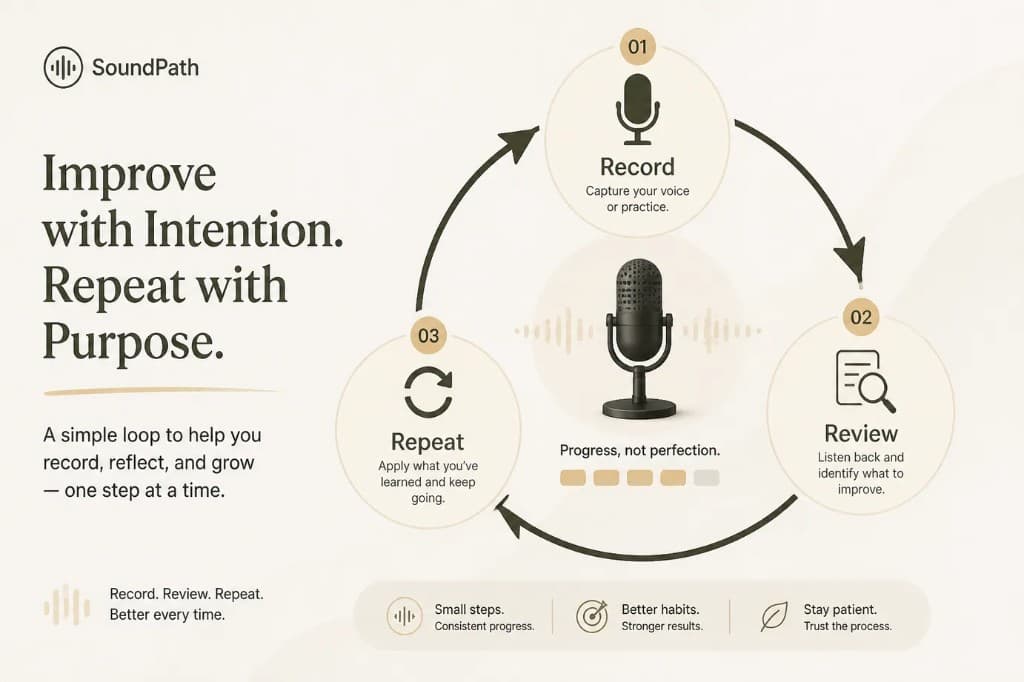
Record. Review one thing. Repeat with purpose.
How to Reduce Filler Words Without Sounding Robotic
Filler words are not evil. Everyone uses them.
The problem starts when they weaken your message or make you sound unsure.
The goal is not zero filler words. The goal is control.
Step 1: Find your personal fillers
Record one minute. Listen once. Write down every filler.
Common fillers include:
- Um
- Uh
- Like
- You know
- So
- Basically
- Actually
- I mean
- Kind of
- Sort of
Most people have two or three favorites. Find yours.
Step 2: Replace fillers with pauses
A pause feels long to you. It sounds confident to everyone else.
Practice this:
Ask yourself a prompt. Start answering. When you feel a filler coming, close your mouth and pause for one beat.
Then continue.
At first, this will feel unnatural. Good. You are rewiring a habit.
Step 3: Slow the first sentence
Most filler words appear when your mouth outruns your thinking.
Slow down your first sentence. Give your brain a clean start.
Instead of rushing into an answer, say:
That is a useful question. I would look at it in three parts.
Or:
My short answer is yes, but with one condition.
These opening lines buy time and create structure.
Step 4: Practice the silent reset
When you lose your place, do not panic.
Pause. Breathe. Restart with one of these lines:
- Let me put that more simply.
- The main point is this.
- A better example is...
- What matters most is...
- To bring it back to the question...
A reset is not failure. It is control.
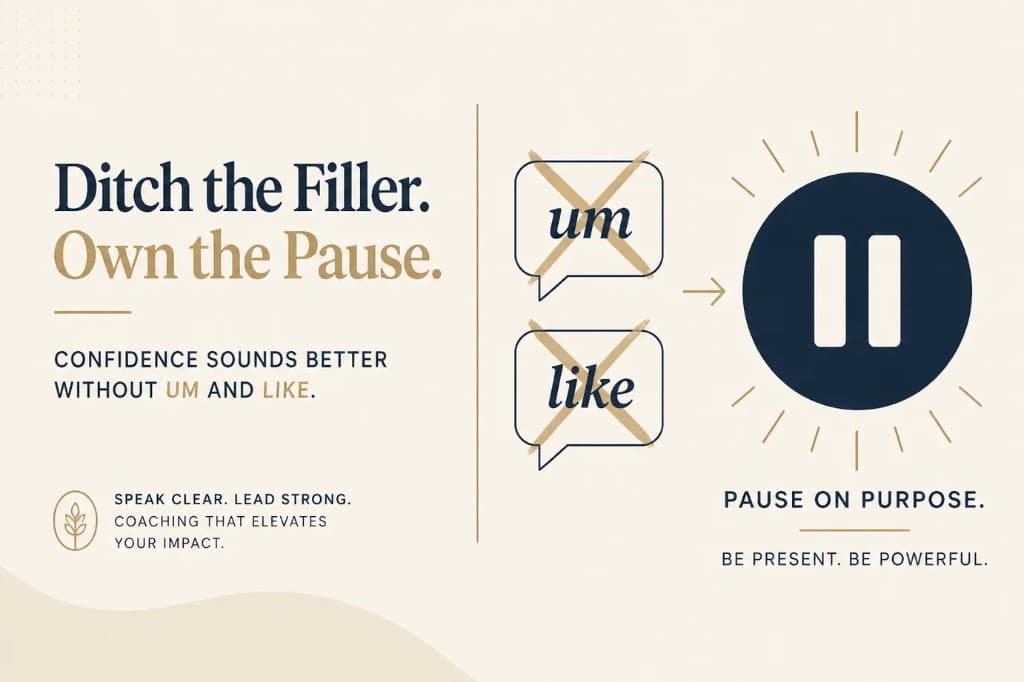
Replace filler words with pauses that sound confident.
Impromptu Speaking Practice for Interviews
Interviews are impromptu speaking with consequences.
You can prepare stories, but you cannot predict every question. That is why daily speaking practice helps. It trains you to shape answers quickly when the wording changes.
Use a bank of core stories
Prepare five stories from your experience:
- A challenge you solved
- A time you worked with a team
- A mistake and what you learned
- A result you are proud of
- A time you handled conflict or pressure
Then practice answering different prompts with the same story.
One story can answer many questions.
For example, a project under a tight deadline can answer:
- Tell me about a time you handled pressure.
- Describe a challenge you solved.
- How do you prioritize?
- Tell me about teamwork.
- Give an example of leadership.
This reduces panic because you are not inventing from scratch.
Use the answer map
For interview answers, use this structure:
- Direct answer
- Brief context
- Action you took
- Result
- Lesson or connection to the role
Example prompt: Tell me about a time you improved a process.
Answer:
One example is when I improved our weekly reporting process. The team was spending too much time collecting updates manually, and the final report still had gaps. I created a shared template, clarified who owned each section, and set a deadline before the meeting. As a result, the report was faster to complete and easier to discuss. It taught me that small communication systems can save a lot of time.
Clear. Specific. Calm.
Practice the first 15 seconds
The opening of an interview answer matters. It sets the tone.
Drill your first sentence.
Weak opening:
Um, yeah, I guess there was this one time where maybe I helped with a project.
Strong opening:
One strong example is a reporting project where I helped the team reduce confusion and save time.
You do not need a memorized script. You need a confident entry point.
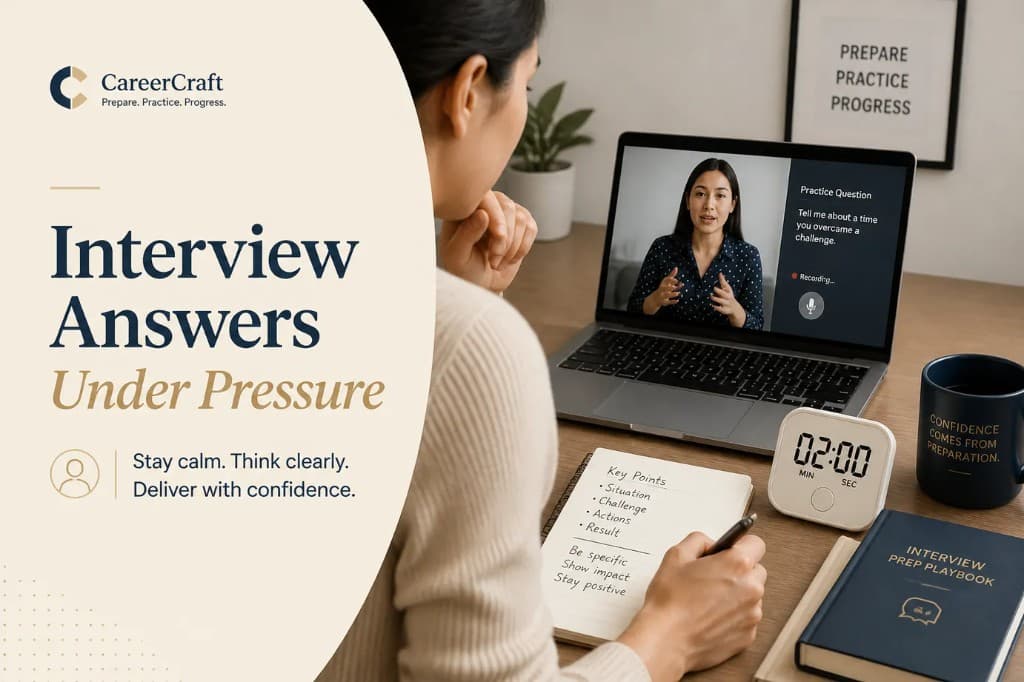
Flexible frameworks beat memorized interview scripts.
Impromptu Speaking Practice for Meetings
Meetings reward concise speakers.
If you can make your point in 30 seconds, people listen. If you ramble for three minutes, they drift.
Use this meeting update format:
- Status: Where things stand
- Signal: What matters most
- Support: What you need or recommend
Example:
The project is on track. The main signal is that design is finished, but development needs final copy by Thursday. My recommendation is that we approve the copy today so the team can keep moving.
That is a strong update.
For opinions, use this format:
- I recommend...
- Because...
- The tradeoff is...
- Next step...
Example:
I recommend we test the shorter onboarding flow first. It will help us learn faster without rebuilding the whole experience. The tradeoff is that we may miss a few edge cases. The next step is to run it with a small group and review completion rates.
Practice these out loud. Meetings are not the place to discover your structure for the first time.
Confidence Comes From Evidence
You cannot think your way into speaking confidence.
You earn it.
Every recorded rep gives you evidence:
- I can answer a question.
- I can recover after a pause.
- I can reduce filler words.
- I can speak for one minute.
- I can improve on a second take.
That evidence matters. It replaces vague fear with real data.
Confidence is not believing you will be perfect. Confidence is knowing you can handle the moment.
The 7-Day Impromptu Speaking Practice Plan
Use this plan if you want a simple starting sprint.
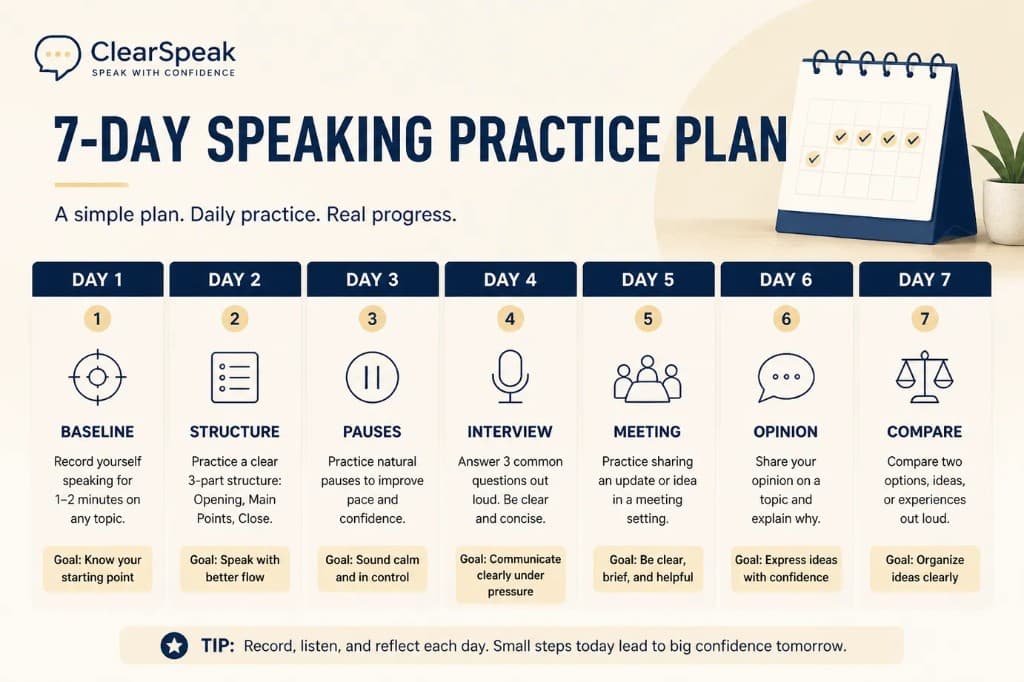
Seven days. Seven focused reps. Real progress.
Day 1: Baseline
Record one answer to this prompt:
What is one skill you want to improve and why?
Do not redo it. Just record and review. Count filler words. Note your pace. Save the file.
Day 2: Structure
Use Point, Reason, Example, Point.
Prompt:
Should people practice public speaking even if their job does not require presentations?
Focus on a clear opening and closing.
Day 3: Pauses
Prompt:
What makes communication clear?
Use silent pauses instead of filler words. Your only goal is to pause cleanly.
Day 4: Interview answer
Prompt:
Tell me about a time you solved a problem.
Use Problem, Action, Result. Keep it under 90 seconds.
Day 5: Meeting update
Prompt:
Give a quick update on a project you are working on or recently completed.
Use Status, Signal, Support. Aim for 30 to 45 seconds.
Day 6: Opinion under pressure
Prompt:
Is it better to move fast or be careful?
Use a balanced answer. State your view, explain the tradeoff, and give an example.
Day 7: Compare and repeat
Repeat the Day 1 prompt.
Then compare both recordings.
Do not look for perfection. Look for progress:
- Fewer fillers
- Better structure
- Stronger ending
- Slower pace
- More specific examples
That is the win.
50 Impromptu Speaking Prompts You Can Use Today
Use these when you do not know what to practice.
Personal prompts
- What is a habit you want to build?
- What is one lesson you learned the hard way?
- What makes you feel prepared?
- What is something you changed your mind about?
- What does confidence mean to you?
- Describe a time you had to adapt.
- What is a goal you are working toward?
- What is one strength you bring to a team?
- What is one weakness you are improving?
- What advice would you give your younger self?
Work and interview prompts
- Tell me about yourself.
- Why are you interested in this role?
- Describe a challenge you solved.
- Tell me about a time you worked with a difficult person.
- What is your communication style?
- How do you handle feedback?
- What project are you proud of?
- How do you prioritize tasks?
- Describe a time you made a mistake.
- What does leadership mean to you?
Opinion prompts
- Should meetings be shorter?
- Is remote work better than office work?
- Should everyone learn public speaking?
- Is confidence more important than competence?
- Should schools teach communication skills?
- Is speed or quality more important?
- Are people too dependent on technology?
- Should professionals build a personal brand?
- Is listening more important than speaking?
- Should teams use fewer tools?
Quick explanation prompts
- Explain your job to a teenager.
- Explain how to prepare for an interview.
- Explain why feedback matters.
- Explain how to build a habit.
- Explain what makes a good presentation.
- Explain how to reduce stress before speaking.
- Explain the value of clear writing.
- Explain how to make a decision.
- Explain why trust matters at work.
- Explain how to run a better meeting.
Creative prompts
- Pitch a new app for busy professionals.
- Sell me a notebook.
- Describe the perfect morning routine.
- Invent a rule every workplace should follow.
- Give a one-minute toast to a teammate.
- Explain why your favorite food is underrated.
- Create a short pep talk for someone nervous.
- Describe a city you would design.
- Pitch a course everyone should take.
- Give a closing statement for a debate on focus.
Common Mistakes That Slow Your Progress
Mistake 1: Practicing only in your head
Thinking is not speaking.
You need to say the words out loud. Your mouth, breath, and pace are part of the skill.
Mistake 2: Trying to fix everything at once
Do not work on structure, pace, vocal tone, gestures, eye contact, and filler words in the same rep.
Pick one focus. Improve it. Then move on.
Mistake 3: Avoiding recordings
Recording yourself can feel uncomfortable. Do it anyway.
The camera does not lie, but it also does not hate you. It gives feedback. Use it.
If video feels like too much, start with audio. Build up later.
Mistake 4: Quitting after one awkward session
Awkward is not a sign to stop. Awkward is the first layer.
Keep going.
The skill gets smoother when your nervous system learns that speaking is survivable.
Mistake 5: Memorizing full answers
Memorized answers break when the question changes.
Practice flexible structures instead. Frameworks travel. Scripts crack.
How to Measure Improvement
Track simple numbers. You do not need a complex dashboard.
Use a small practice log with these fields:
| Date | Prompt | Time | Focus | Filler Count | Score |
|---|---|---|---|---|---|
| Monday | What makes a good teammate? | 1:04 | Structure | 11 | 2/5 |
| Tuesday | What makes a good teammate? | 0:58 | Pauses | 6 | 3/5 |
| Wednesday | How do you handle feedback? | 1:12 | Examples | 7 | 4/5 |
Score yourself on one question:
Did I make a clear point?
That is the heart of strong speaking.
Over time, you should see:
- Shorter rambles
- Fewer filler words
- Faster starts
- Cleaner endings
- More examples
- Less dread before speaking
That last one matters most.
A Simple Warm-Up Before High-Stakes Speaking
Use this before interviews, presentations, meetings, or important calls.
1. Breathe low for 30 seconds
Inhale through your nose. Let your belly expand. Exhale slowly.
This tells your body you are not in danger.
2. Read one paragraph out loud
Pick anything. A note. An article. Your resume.
Wake up your voice.
3. Answer one easy prompt
Use a low-pressure question:
What is one thing I want this person to understand?
Speak for 30 seconds.
4. Say your first sentence
If you know you will introduce yourself, practice the first line.
A clean start calms the rest of the answer.
Your Next Practice Session
Do it now if you can.
Pick this prompt:
What is one communication skill that would make my life easier?
Use Point, Reason, Example, Point.
Record for one minute.
Then listen for one thing: did you make a clear point?
If yes, repeat and make it sharper.
If no, repeat and start with the point.
That is impromptu speaking practice. Not theory. Not waiting. Not hoping you feel ready someday.
One prompt. One minute. One review. One repeat.
Do that daily, and you will change how you speak. You will answer faster. You will ramble less. You will trust your pauses. You will walk into interviews and meetings with proof that you can handle pressure.
Start small.
Speak today.
Repeat tomorrow.
Ready to practice?
Spin a random topic, speak for 60 seconds, and listen back - free while we're in early access.