Impromptu Speaking: How to Think Fast, Speak Clearly, and Build Confidence
Train impromptu speaking with PREP, daily 60-second reps, recording and review, interview prep, and a 7-day practice plan.
Impromptu speaking is the skill of giving a clear, useful answer without much time to prepare.
It shows up everywhere.
A teacher calls on you. A manager asks for your take in a meeting. An interviewer says, "Tell me about a time you handled pressure." A friend asks you to make a quick toast. Your brain goes blank. Your heart jumps. You search for words.
Good news: impromptu speaking is not a talent reserved for "natural speakers." It is a trainable skill. You improve it the same way you improve fitness: small reps, done consistently.
One prompt. One recording. One self-review. One improvement at a time.
This guide gives you a practical system to get better at thinking on your feet, structuring ideas fast, and speaking with more confidence in class, interviews, presentations, meetings, and everyday conversations.
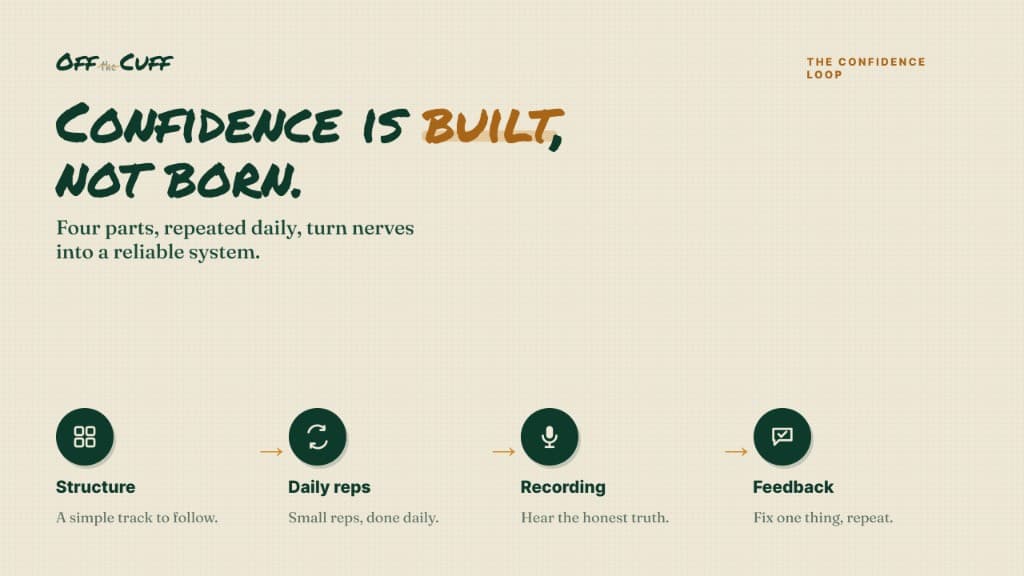
Impromptu speaking improves when you combine structure, daily reps, recording, and feedback.
What Is Impromptu Speaking?
Impromptu speaking means speaking with little or no formal preparation. You may get a topic seconds before you speak. You may need to answer a question on the spot. You may need to explain, persuade, summarize, or react in real time.
Examples include:
- Answering an unexpected interview question
- Speaking up during a meeting
- Giving a quick class response
- Introducing yourself at an event
- Responding to a client objection
- Making a short toast
- Handling a Q&A after a presentation
- Recording a short video response
The goal is not perfection. The goal is clarity.
A strong impromptu speaker can take a messy thought and turn it into a useful message. They do not say everything. They say the next right thing.
Why Impromptu Speaking Matters
Prepared speeches are important. But real life is full of unscripted moments.
Impromptu speaking helps you:
- Share ideas before the moment passes
- Sound more confident in interviews
- Participate more in meetings and classes
- Handle pressure without freezing
- Build trust with clients, peers, and leaders
- Communicate clearly when the stakes are high
It also changes how you feel about speaking. When you know you can handle an unexpected question, you stop fearing the room. You start engaging with it.
That confidence compounds.
The Biggest Myth: "I Need to Know Exactly What to Say"
You do not need the perfect answer.
You need a simple structure.
Most nervous speakers try to build the whole response in their head before they begin. That creates pressure. It also causes long pauses, rambling, and overthinking.
Better move: start with a structure that gives your brain a track to run on.
Think of structure as a handrail. You still have to walk. But you are less likely to fall.
The 5 Core Skills of Impromptu Speaking
Great impromptu speaking is built from five smaller skills.
1. Fast Thinking
Fast thinking is not about being brilliant. It is about choosing an angle quickly.
If the prompt is, "Should students use AI tools for homework?" you could take many angles:
- Learning impact
- Ethics
- Time management
- Teacher expectations
- Future workplace skills
Pick one. Move.
2. Clear Structure
Structure turns scattered thoughts into a message people can follow.
A simple structure beats a clever mess every time.
3. Vocal Control
Your voice carries confidence. Pace, pauses, volume, and tone matter.
If you speak too fast, listeners work harder. If you pause too little, your ideas blur together. If your tone is flat, even strong content feels weak.
4. Concise Language
Impromptu speaking rewards clean sentences.
Short beats long. Specific beats vague. Active beats passive.
Instead of: "I think there are a number of different factors that could potentially contribute to that situation."
Say: "Three things drive that problem: time, trust, and unclear goals."
5. Recovery
Everyone gets stuck.
Strong speakers recover quickly. They pause. They reset. They use a bridge phrase. They continue.
Recovery is a skill. Practice it.
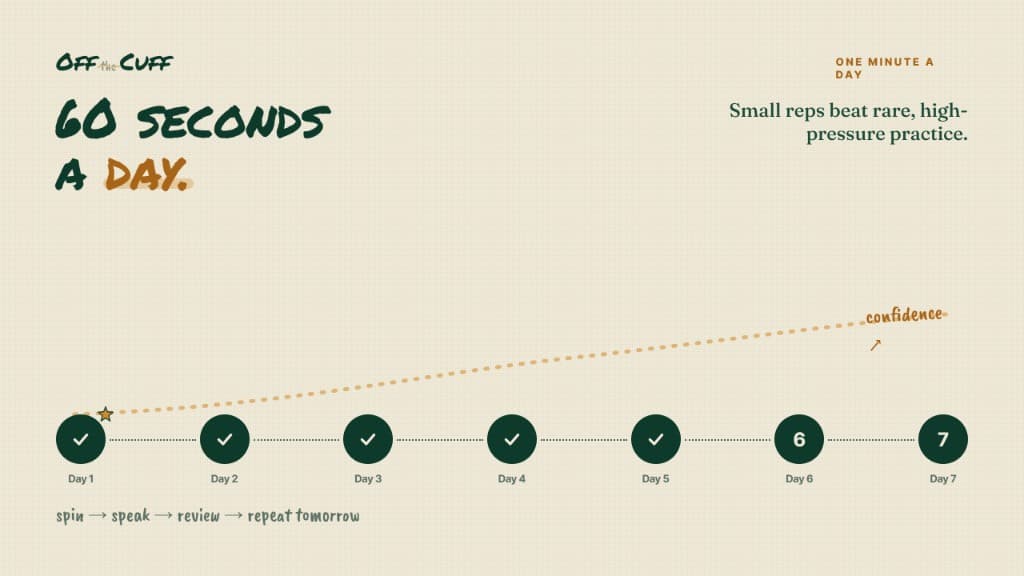
Small daily speaking reps build confidence faster than occasional high-pressure practice.
A Simple Impromptu Speaking Framework: PREP
The PREP framework is one of the easiest ways to answer on the spot.
PREP stands for:
- Point
- Reason
- Example
- Point
Use it when you need a short, direct answer.
How PREP Works
Prompt: "Should remote work continue?"
Point: "Yes, remote work should continue when teams have clear goals."
Reason: "It gives people flexibility and can reduce wasted commute time."
Example: "For example, a marketing team can use weekly planning, daily check-ins, and shared dashboards to stay aligned without being in the same office every day."
Point: "So I would keep remote work, but pair it with strong communication habits."
That answer is clear. It has a beginning, middle, and end. It does not ramble.
When to Use PREP
Use PREP for:
- Interview answers
- Classroom responses
- Meeting opinions
- Debate practice
- Quick persuasive answers
PREP is your default. When in doubt, use it.
Another Fast Framework: Past, Present, Future
This structure works well for reflective or strategic questions.
Prompt: "How has public speaking changed for you?"
Past: "I used to avoid speaking because I worried about making mistakes."
Present: "Now I practice with short prompts and record myself for one minute a day."
Future: "My goal is to speak with more calm and structure in meetings and interviews."
This framework is great because it creates natural movement. It feels like a story.
Use it for:
- Personal growth questions
- Career questions
- Project updates
- Lessons learned
- Goal-setting responses
The 3-Part Answer for Any Question
If your mind goes blank, use this:
- Answer the question directly
- Give one reason or example
- End with a takeaway
That is enough.
Prompt: "What makes a good leader?"
Answer: "A good leader creates clarity. People do better work when they know what matters, what success looks like, and where they have ownership. For example, a team lead who sets weekly priorities and removes blockers can help everyone move faster. So to me, leadership starts with clarity."
Simple. Strong. Done.
How to Practice Impromptu Speaking Daily
You do not need a stage. You need a prompt and a timer.
Practice can take three minutes.
The 3-Minute Daily Drill
- Pick one prompt.
- Think for 15 seconds.
- Speak for 60 seconds.
- Record it.
- Review one thing.
- Repeat tomorrow.
That is it.
Do not turn practice into a huge event. Huge events are easy to skip. Small reps are easy to repeat.
Consistency wins.
Why Recording Matters
Recording practice is powerful because it shows the truth.
You hear:
- Filler words
- Rushed pacing
- Long pauses
- Repeated phrases
- Unclear endings
- Strong moments you did not notice
Most people are not as bad as they think. They are just untrained at watching themselves.
Record. Review. Improve.
Keep your recordings private if that helps you practice more freely. You do not need to post your practice online. You need honest feedback and a safe place to improve.
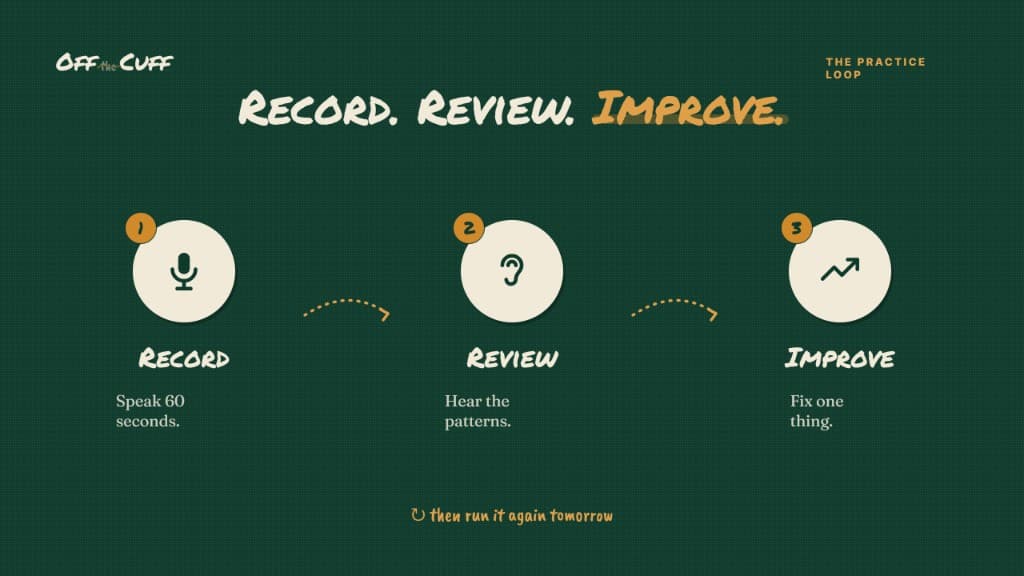
Recording your answers helps you hear patterns and improve one skill at a time.
A Self-Review Checklist for Impromptu Speaking
After each recording, do not judge the whole performance. That is too vague.
Score one or two items.
Use this quick checklist:
- Did I answer the prompt directly?
- Did I use a clear structure?
- Did I include a specific example?
- Did I speak at a steady pace?
- Did I pause instead of filling every gap?
- Did I end cleanly?
- Did I sound like myself?
Choose one improvement for the next rep.
Not ten. One.
Example: "Tomorrow I will end with a clearer final sentence."
That is measurable. That is progress.
How AI Feedback Can Help You Improve Faster
AI feedback can make impromptu speaking practice more focused.
Instead of wondering, "Was that good?" you can get specific notes on structure, clarity, pacing, filler words, and confidence signals.
AI can help you:
- Generate fresh impromptu prompts
- Analyze your answer structure
- Identify repeated filler words
- Suggest stronger openings and closings
- Track improvement over time
- Practice interviews, debates, and meeting responses
The key is to use AI as a coach, not a crutch.
You still need to speak. You still need reps. AI helps you see patterns faster.
What to Ask AI After a Practice Response
Try prompts like:
- "Give me three ways to make this answer more concise."
- "Did I answer the question directly?"
- "What structure did I use, and how could it be clearer?"
- "Rewrite my closing sentence to sound more confident."
- "What is one thing I should improve in my next recording?"
Keep it practical. Keep it focused.
Privacy Matters
Speaking practice can feel personal. You may be practicing interviews, school responses, work updates, or sensitive topics.
Use tools that respect privacy. Avoid uploading confidential company information, private client details, or personal data you would not want stored. If you are practicing with AI, choose platforms with clear privacy policies and safe recording controls.
The best practice environment is honest, low-pressure, and secure.
30 Impromptu Speaking Prompts to Use Today
Use these prompts for daily practice. Set a timer for one minute and go.
Easy Prompts
- What is one habit everyone should build?
- Describe your favorite place in three details.
- Should students have less homework?
- What makes a good friend?
- Is it better to wake up early or stay up late?
- What is one app you use often and why?
- If you could learn any skill quickly, what would it be?
- What is one thing people misunderstand about you?
- Should people spend less time on social media?
- What is a small decision that changed your day?
Interview-Style Prompts
- Tell me about yourself.
- Why are you interested in this role?
- Describe a time you solved a problem.
- What is one strength you bring to a team?
- Tell me about a time you received feedback.
- How do you handle pressure?
- What would you do if you disagreed with a teammate?
- Describe a project you are proud of.
- What is one skill you are working to improve?
- Where do you see yourself in three years?
Challenging Prompts
- Should AI be allowed in schools?
- Is failure necessary for success?
- What is more important: speed or quality?
- Should companies require employees to work in the office?
- Does technology make people more connected or less connected?
- What responsibility do leaders have during uncertainty?
- Should public speaking be taught in every school?
- What does confidence mean?
- Is competition good for creativity?
- What is one problem in your community and how would you solve it?
Pick one. Speak. Record. Review.
That is the loop.
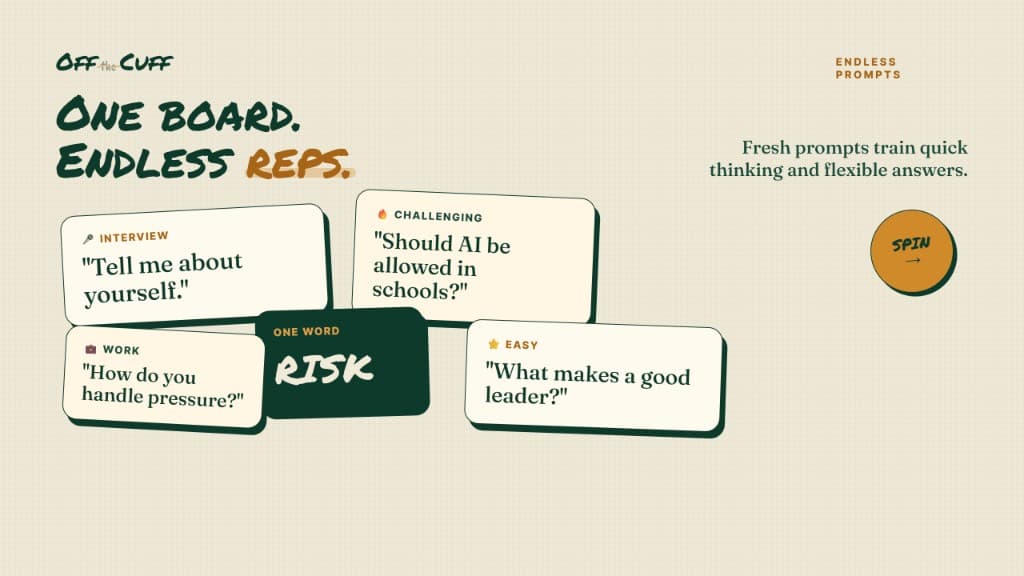
Use fresh prompts to train quick thinking and flexible communication.
How to Stop Rambling
Rambling happens when your mouth keeps moving after your message is done.
It usually comes from fear. You worry the answer is too short, so you add more. Then more. Then the point disappears.
Use these tactics.
Start With the Answer
Do not warm up for 30 seconds.
If the question is, "Do you think public speaking can be learned?" start with:
"Yes. Public speaking can be learned through repeated practice and feedback."
Now the listener knows where you stand.
Use One Example Only
One strong example beats three weak ones.
Example: "When I practiced one-minute answers every morning for two weeks, I noticed I paused less and finished more clearly."
That example is specific. It proves the point.
Land the Plane
End with a short closing line.
Try:
- "That is why I would focus on consistency."
- "So my answer is yes, with clear limits."
- "The main takeaway is that practice reduces pressure."
- "In short, confidence comes from reps."
When you reach the ending, stop.
How to Handle Brain Freeze
Brain freeze is normal. It does not mean you failed.
Use a reset phrase.
Helpful Reset Phrases
- "Let me think about that for a second."
- "The first thing that comes to mind is…"
- "I would look at this in two parts."
- "A simple way to answer that is…"
- "My short answer is…"
These phrases buy time and create structure.
Avoid apologizing too much. Do not say, "Sorry, this is probably a bad answer." That weakens your message before it starts.
Pause. Breathe. Begin.
How to Sound More Confident When Speaking Off the Cuff
Confidence is not just how you feel. It is also how you deliver.
Slow Down by 10%
Nervous speakers rush. Slow down slightly. You will sound calmer and give your brain more time.
Use Pauses on Purpose
A pause is not a failure. It is punctuation.
Pause after your main point. Pause before an example. Pause before your final takeaway.
Drop Filler Words
Filler words like "um," "like," "you know," and "basically" are common. Do not obsess over removing every one. Focus on replacing fillers with silence.
Silence sounds stronger than panic words.
Finish Sentences Downward
When every sentence rises like a question, you may sound unsure.
Practice ending key points with a steady downward tone.
Say: "That is the main reason I support it."
Let it land.
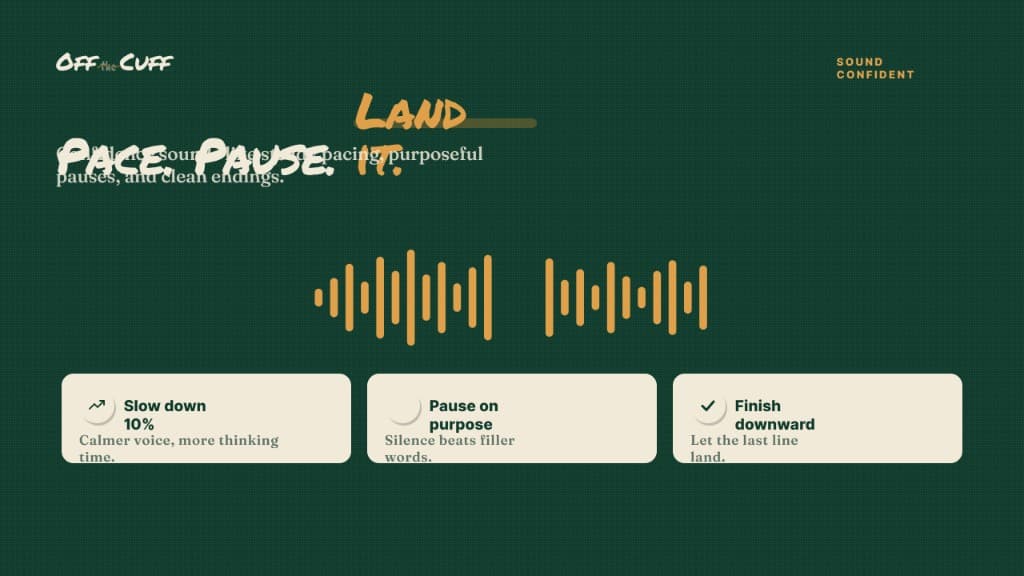
Confidence sounds like steady pacing, purposeful pauses, and clean endings.
Impromptu Speaking for Students
Students use impromptu speaking in class discussions, presentations, debates, oral exams, group projects, and interviews.
A simple student practice plan:
- Pick one school-related prompt each day
- Speak for 45 seconds
- Use PREP
- Include one class example
- Record once per week and review progress
Student prompt examples:
- "Should grades matter less?"
- "What is the most useful subject in school?"
- "How should students manage stress?"
- "Should group projects be graded individually?"
The goal is to get comfortable organizing ideas quickly. Better speaking also improves writing, discussion, and critical thinking.
Impromptu Speaking for Professionals
At work, impromptu speaking often happens in high-pressure moments.
You may need to:
- Give a project update
- Explain a delay
- Share a recommendation
- Respond to leadership
- Push back respectfully
- Summarize a meeting
- Answer a client question
Use this workplace structure:
- Context: "Here is where we are."
- Point: "The main issue is…"
- Next step: "I recommend we…"
Example:
"Here is where we are: the launch timeline is still possible, but design feedback is taking longer than expected. The main issue is that approvals are happening too late in the week. I recommend we set a 24-hour feedback window and make Friday the final decision point."
Clear. Direct. Useful.
Impromptu Speaking for Interview Candidates
Interviews are full of impromptu moments. Even common questions can feel unexpected when nerves hit.
Practice answering with structure, not memorized scripts.
For behavioral questions, use STAR:
- Situation
- Task
- Action
- Result
Prompt: "Tell me about a time you handled a difficult deadline."
Answer:
"During a group project last semester, our final report was behind schedule because two sections were incomplete. My role was to organize the final draft and make sure we submitted on time. I created a shared checklist, divided the remaining work, and scheduled a quick review call. We submitted before the deadline and received strong feedback on the organization. The lesson for me was that clear next steps reduce stress."
That answer is specific and controlled.
Do not memorize every word. Memorize the path.
Games and Exercises for Better Impromptu Speaking
Practice should feel simple enough to repeat. Try these exercises.
The One-Word Prompt
Choose one word: "risk," "focus," "coffee," "change," "teamwork."
Speak for one minute. Build a point from the word.
The Random Object Drill
Pick an object near you. Explain why it matters.
Example: "This notebook matters because it turns vague goals into visible commitments."
This trains creativity and quick connections.
The Two-Side Drill
Argue both sides of a topic.
Prompt: "Should phones be banned in class?"
Speak 45 seconds for yes. Then 45 seconds for no.
This builds flexibility.
The 10-Second Outline
Take any prompt. Give yourself 10 seconds to plan three words:
- Point
- Example
- Ending
Then speak.
This trains fast structure.
The Bad First Take
Give yourself permission to do one messy response.
Then do a second take immediately.
The second take is usually much better. You learn faster when you stop trying to be perfect on take one.
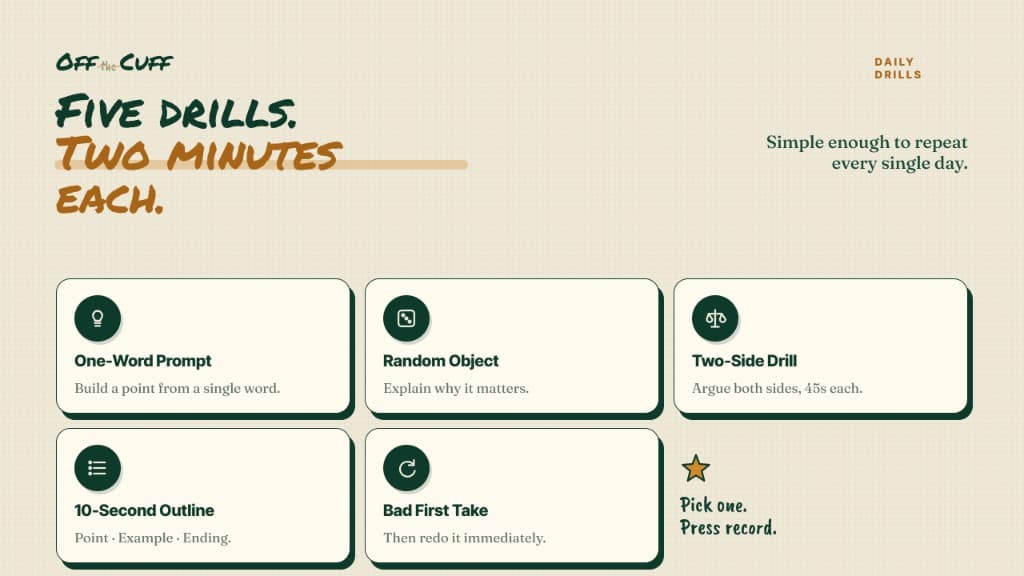
Simple exercises make speaking practice easier to repeat every day.
How to Measure Your Progress
If you want confidence, track proof.
Use simple metrics:
- Number of practice reps per week
- Average response length
- Filler words per minute
- Number of clear endings
- Self-rated confidence from 1 to 5
- Number of prompts answered without restarting
Do not track everything forever. Pick two metrics for two weeks.
Example goal:
"For the next 14 days, I will record one 60-second response per day and reduce filler words from 12 per minute to 6 per minute."
That is clear. That is measurable.
Small wins make confidence real.
Common Impromptu Speaking Mistakes
Avoid these traps.
Mistake 1: Trying to Sound Smart
Do not perform intelligence. Communicate value.
Use plain language. Make the idea easy to follow.
Mistake 2: Starting Without a Point
If you start with background, you may never reach the answer.
Lead with your point.
Mistake 3: Using Too Many Examples
Too many examples create clutter. Use one strong example.
Mistake 4: Talking Until Someone Stops You
End on purpose. A clean ending makes the whole answer feel stronger.
Mistake 5: Practicing Only in Your Head
Thinking is not speaking. You need out-loud reps.
Your mouth, breath, pace, and nerves need practice too.
A 7-Day Impromptu Speaking Practice Plan
Here is a simple plan you can start today.
Day 1: Baseline Recording
Answer: "What is one skill you want to improve?" Speak for 60 seconds. Record it. Do not judge it. Save it.
Day 2: PREP Practice
Answer three easy prompts using Point, Reason, Example, Point.
Day 3: Pause Practice
Answer one prompt and force yourself to pause after your first sentence and before your final sentence.
Day 4: Interview Practice
Answer: "Tell me about a time you solved a problem." Use STAR.
Day 5: Concision Practice
Answer a prompt in 60 seconds. Then answer the same prompt in 30 seconds. Keep only the strongest ideas.
Day 6: Recovery Practice
Choose a hard prompt. If you freeze, use a reset phrase and continue.
Day 7: Review and Repeat
Watch your Day 1 and Day 7 recordings. Notice one improvement. Set one goal for next week.
Do not wait until you feel confident. Practice creates confidence.
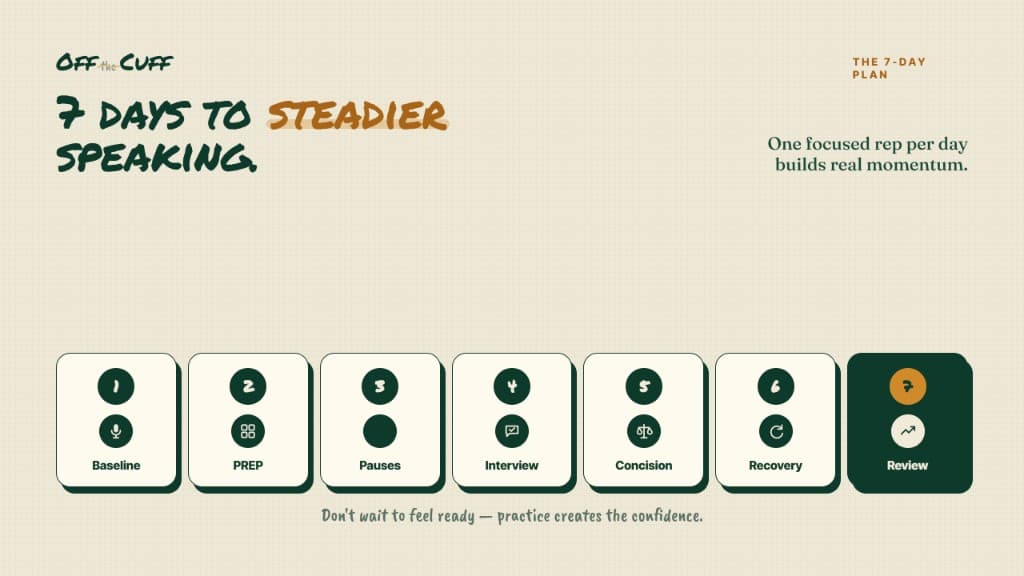
Follow a 7-day plan to build momentum and see measurable speaking improvement.
Final Takeaway: Confidence Comes From Reps
Impromptu speaking is not about having perfect thoughts on demand.
It is about building a reliable response system.
Use simple frameworks. Practice with prompts. Record yourself. Review one thing. Get feedback. Repeat.
One minute a day can change how you speak in meetings, interviews, classrooms, and everyday conversations.
You do not need a bigger personality.
You need more reps.
Start with one prompt today. Press record. Speak for 60 seconds. Then do it again tomorrow.
Ready to practice?
Spin a random topic, speak for 60 seconds, and listen back - free while we're in early access.