Off the Cuff Speech: How to Speak Clearly When You Have No Time to Prepare
Learn off the cuff speaking with the 4P framework, daily 10-minute practice, 50 prompts, recording review, AI feedback, and a 7-day plan.
An off the cuff speech is the speaking skill everyone needs and almost nobody practices.
You get called on in a meeting. A teacher asks for your opinion. An interviewer says, tell me about a time when you solved a problem. A client asks a question you did not expect. Your brain goes blank for two seconds, then starts sprinting.
Good news: you do not need to be born quick on your feet. You can train it.
Off the cuff speaking is not magic. It is a set of small, repeatable habits: pause, choose a point, give one example, land the plane. Practice that for a few minutes a day and you will sound calmer, clearer, and more confident in real life.
This guide shows you exactly how to build that skill with simple frameworks, daily prompts, recording practice, self-review, and AI feedback.
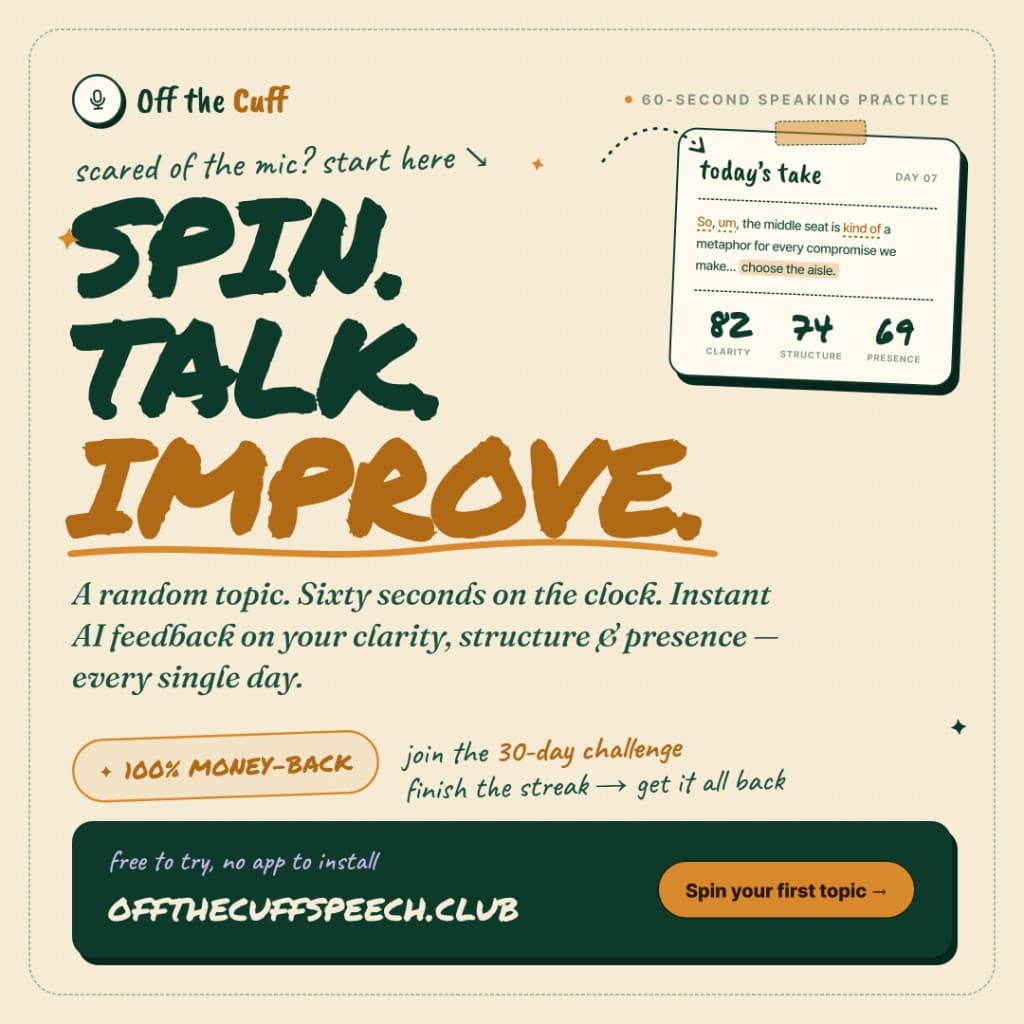
Spin a topic, speak for 60 seconds, get AI feedback, and build confidence one rep at a time.
What Is an Off the Cuff Speech?
An off the cuff speech is a short, spontaneous response delivered with little or no preparation. It can be formal, like answering an interview question. It can also be casual, like sharing your view in a team discussion.
The phrase comes from the idea of speaking without written notes. You are not reading. You are thinking and speaking in real time.
Common off the cuff speaking moments include:
- Answering unexpected questions in class
- Giving a quick update in a work meeting
- Introducing yourself at a networking event
- Responding during a job interview
- Explaining a decision to your team
- Making a toast or short tribute
- Handling a difficult customer question
- Sharing your opinion in a group conversation
The goal is not perfection. The goal is useful clarity.
A strong off the cuff speech usually does three things:
- Gives a clear answer
- Supports it with a simple reason or example
- Ends with confidence instead of trailing off
That is it. Clear beats clever.
Why Off the Cuff Speaking Matters
Prepared speeches matter. But life tests your speaking when you do not have slides, notes, or ten quiet minutes to plan.
Off the cuff speaking helps you:
- Think faster under pressure
- Reduce filler words like um, like, and you know
- Sound more confident in interviews
- Participate more in meetings
- Handle tough questions without panic
- Build trust as a leader or teammate
- Speak up instead of staying silent
For students, it helps with class participation, presentations, and oral exams.
For professionals, it helps with meetings, pitches, leadership conversations, and client calls.
For interview candidates, it helps you answer behavioral questions without rambling.
For nervous speakers, it proves something powerful: you can speak before you feel ready.
Confidence comes after reps. Not before.
The Mindset Shift: Do Not Try to Sound Brilliant
The biggest mistake is trying to sound impressive.
When you try to be brilliant, your brain searches for the perfect sentence. That creates pressure. Pressure creates silence. Silence creates panic.
Instead, aim to be useful.
Useful sounds like:
- Here is my main point.
- Here is one reason.
- Here is an example.
- Here is what I would do next.
That is strong speaking.
A great off the cuff speech is often simple. It is organized enough for people to follow and human enough for people to trust.
Use this rule:
One idea. One example. One ending.
If you remember nothing else, remember that.
The 5-Second Reset Before You Speak
You do not have to answer instantly. A short pause makes you look thoughtful, not weak.
Use this reset:
- Breathe in through your nose
- Plant your feet or sit tall
- Look at one person or one point in the room
- Say a simple opener
- Start with your main point
Simple openers buy you time without sounding nervous:
- That is a great question.
- My short answer is yes, and here is why.
- I would look at it in two ways.
- The first thing that comes to mind is this.
- If I had to choose one priority, it would be this.
Do not overuse these lines. Use them as a bridge. The pause is your friend.
The Best Framework for an Off the Cuff Speech
When your mind goes blank, structure saves you.
Use the 4P framework:
1. Pause
Take one breath. Give your brain a second to choose a direction.
2. Point
State your answer in one sentence.
Example: I think the most important skill for a new manager is clear communication.
3. Proof
Add a reason, example, or quick story.
Example: When expectations are unclear, good people waste time guessing. A manager who explains the goal, deadline, and definition of success removes friction.
4. Payoff
End with a takeaway.
Example: So for me, communication is not soft. It is the system that helps a team move faster.
Put together:
I think the most important skill for a new manager is clear communication. When expectations are unclear, good people waste time guessing. A manager who explains the goal, deadline, and definition of success removes friction. So for me, communication is not soft. It is the system that helps a team move faster.
That is a complete off the cuff answer. Short. Clear. Strong.
5 Simple Structures You Can Use Anytime
Different questions need different shapes. Here are five structures you can practice until they feel automatic.
1. PREP: Point, Reason, Example, Point
Best for opinions.
Prompt: Should remote work stay common?
Answer shape:
- Point: Yes, remote work should stay common.
- Reason: It gives people more control over focused work.
- Example: On my team, deep tasks are easier without office interruptions.
- Point: So I think hybrid or remote options make teams more productive when managed well.
2. Past, Present, Future
Best for updates, introductions, and progress reports.
Prompt: Tell us about your project.
Answer shape:
- Past: We started by researching the main customer problem.
- Present: Right now, we are testing two possible solutions.
- Future: Next, we will choose one direction and prepare the launch plan.
3. Problem, Action, Result
Best for interviews and work examples.
Prompt: Tell me about a time you handled pressure.
Answer shape:
- Problem: Our deadline moved up by one week.
- Action: I cut the project into must-have tasks and optional tasks.
- Result: We delivered the core work on time and saved the extra ideas for phase two.
4. First, Second, Finally
Best when you need to sound organized fast.
Prompt: What would you change about this process?
Answer shape:
- First, I would remove duplicate approvals.
- Second, I would clarify who owns each step.
- Finally, I would measure turnaround time weekly.
5. The One Thing
Best when you are nervous or short on time.
Prompt: What advice would you give a first-year student?
Answer shape:
- The one thing I would say is this: ask for help early.
- A lot of students wait until they are overwhelmed.
- If you ask early, you have more options and less stress.
Simple structures reduce mental load. You stop building the road while driving.
How to Practice Off the Cuff Speaking in 10 Minutes a Day
You do not need a stage. You need reps.
Here is a daily 10-minute routine.
Minute 1: Warm Up Your Voice
Say these out loud:
- Today I will speak clearly and keep going.
- I do not need perfect words. I need a clear message.
- Pause. Point. Proof. Payoff.
Then read any paragraph out loud for 30 seconds. Wake up your mouth.
Minutes 2-4: Answer One Easy Prompt
Pick a low-pressure topic:
- What is your favorite meal and why?
- What app do you use the most?
- What is one habit that helps you?
- What is a movie you would recommend?
Speak for 60 seconds. Record it.
Minutes 5-7: Answer One Real-Life Prompt
Pick a practical topic:
- Give a quick project update.
- Explain why you are a good fit for a role.
- Share one thing your team should improve.
- Answer: What is your biggest strength?
Speak for 60 to 90 seconds. Record it.
Minutes 8-9: Review One Thing
Do not review everything. That is how people quit.
Pick one focus:
- Did I have a clear point?
- Did I give an example?
- Did I end cleanly?
- Did I use too many fillers?
- Did I speak too fast?
Write one note.
Minute 10: Repeat the Best Line
Choose your strongest sentence and say it again with more confidence.
This matters. You are teaching your brain what good sounds like.
50 Off the Cuff Speech Prompts for Practice
Use these prompts when you do not know what to practice. Set a timer for 60 seconds. Record. Speak. Review. Repeat.
Easy Personal Prompts
- What is one small habit that improved your life?
- What is a book, show, or podcast you recommend?
- What is your favorite way to spend a free hour?
- What is a skill you want to learn?
- What is one thing you wish more people understood?
- What food could you eat every week?
- What is a place you would like to visit?
- What is one lesson you learned the hard way?
- What makes a good friend?
- What is a recent win you are proud of?
Student Prompts
- Should homework be graded or just reviewed?
- What makes a class interesting?
- Should students work in groups more often?
- What is the best way to prepare for exams?
- Should schools teach public speaking earlier?
- What is one campus problem you would fix?
- Is participation more important than attendance?
- What makes feedback helpful?
- How should students handle stress?
- What is one club or activity worth joining?
Work and Leadership Prompts
- What makes a meeting useful?
- How would you improve team communication?
- What does good leadership look like?
- Should teams move faster or plan more carefully?
- How do you handle a missed deadline?
- What is one process your team could simplify?
- How should managers give feedback?
- What makes a project successful?
- How do you build trust at work?
- What is one trend affecting your industry?
Interview Prompts
- Tell me about yourself.
- Why do you want this role?
- What is your biggest strength?
- What is a weakness you are improving?
- Tell me about a time you solved a problem.
- Tell me about a time you disagreed with someone.
- Describe a time you learned quickly.
- Why should we hire you?
- What motivates you?
- Where do you want to grow next?
Challenge Prompts
- Is AI good or bad for learning?
- Should people use social media less?
- What is more important: talent or consistency?
- Should everyone learn to code?
- Is failure necessary for success?
- Should companies be fully remote?
- What does confidence mean to you?
- How do you make hard decisions?
- What is a rule you would change?
- What advice would you give your future self?
Do not just read the list. Use it. One prompt a day is 365 reps a year.
How to Record and Review Your Speech Without Cringing
Recording yourself can feel uncomfortable. Do it anyway.
The camera does not judge you. It gives you data.
Here is a simple self-review method.
Step 1: Record One Short Answer
Keep it short. 60 to 90 seconds is enough.
Use your phone, laptop, or a speaking practice app. If privacy matters, choose a tool that lets you control what you save, delete, and share.
Step 2: Watch Once for Message
Ask:
- Did I answer the question?
- Could someone repeat my main point?
- Did I include a real example?
- Did I stop with a clear ending?
Step 3: Watch Once for Delivery
Ask:
- Was my pace easy to follow?
- Did I pause or rush?
- Did my face match my message?
- Did I look engaged?
- Did filler words distract from my point?
Step 4: Score Yourself From 1 to 5
Use this quick scorecard:
| Skill | 1 | 3 | 5 |
|---|---|---|---|
| Clarity | Hard to follow | Mostly clear | Very clear |
| Structure | Rambling | Some order | Strong flow |
| Examples | No support | Basic support | Specific example |
| Delivery | Distracting | Understandable | Confident |
| Ending | Trails off | Acceptable | Clean finish |
Do not aim for 5 every time. Aim for one point better.
Step 5: Choose One Fix
Bad review: I am terrible at speaking.
Good review: Tomorrow I will pause before answering and give one example.
Specific fixes create measurable improvement.
How AI Feedback Can Speed Up Your Progress
AI feedback can help because it gives you fast, objective notes. You practice. You record. You get suggestions. You repeat.
It can help you spot:
- Filler words
- Rambling sections
- Weak structure
- Unclear main points
- Repeated phrases
- Speaking pace issues
- Missing examples
- Strong moments worth repeating
The key is using AI as a coach, not a crutch.
Ask for feedback like this:
- What was my main point?
- Where did I ramble?
- Which sentence sounded strongest?
- Give me one way to improve my structure.
- Rewrite my answer using the PREP framework.
- Suggest three follow-up prompts at a harder level.
This turns practice into a loop:
Speak. Record. Review. Improve. Repeat.
That loop builds confidence because you can see progress. You are not guessing anymore.
Privacy Matters When You Practice
Speaking practice can be personal. You might be preparing for an interview, working on anxiety, or practicing sensitive work topics.
Use tools that respect your privacy. Look for clear controls around recordings, deletion, storage, and sharing. Avoid uploading confidential company information, private student data, or personal details you would not want stored.
You can still get strong practice with safe topics. Replace real names with roles. Say client instead of the company name. Practice the structure without exposing private information.
Confidence grows faster when you feel safe enough to be honest.
How to Stop Rambling During an Off the Cuff Speech
Rambling happens when you do not know where the answer ends.
Fix it with a finish line.
Before you speak, decide your shape:
- I will give one reason.
- I will share one example.
- I will make two points.
- I will explain the past, present, and future.
Then end on purpose.
Use closing lines like:
- That is why I would focus on communication first.
- So my recommendation is to simplify the process.
- That experience taught me to ask questions earlier.
- In short, consistency matters more than intensity.
- That is the main reason I would choose option two.
A strong ending makes the whole answer sound stronger.
If you feel yourself drifting, use this rescue line:
The main point is this...
Then say the point and stop.
How to Reduce Filler Words Without Freezing
Filler words are not evil. Everyone uses them. The problem is when they crowd out your message.
Do not try to remove every um overnight. That creates more tension.
Instead, replace fillers with pauses.
Practice this drill:
- Pick a prompt.
- Speak for 45 seconds.
- Every time you need to think, pause silently.
- Keep your face calm during the pause.
- Continue with your next sentence.
At first, silent pauses feel huge. On video, they look normal.
You can also slow your first sentence. Most people rush at the start because they want the pressure to end. Start slower and the rest gets easier.
Try this:
Prompt: What makes a good teammate?
Slow first sentence: A good teammate is someone who makes the work easier for the people around them.
Now you have control.
Off the Cuff Speaking Tips for Different Situations
In a Meeting
Be brief. Add value quickly.
Use:
- My recommendation is...
- The risk I see is...
- One thing we should clarify is...
- I agree with that, and I would add...
Example:
My recommendation is to test the new process with one team before rolling it out company-wide. That gives us feedback without creating confusion for everyone. If the pilot works, we can scale it with more confidence.
In a Job Interview
Use examples. Interviewers trust specifics.
Use Problem, Action, Result.
Example:
In my last role, our support queue grew after a product update. I grouped the most common issues, wrote short response templates, and shared them with the team. We reduced repeat typing and improved response time by the end of the week.
In Class
Do not wait for the perfect thought. Build on what you know.
Use:
- I see it a little differently because...
- One example from the reading is...
- My question is about...
- The part I found most important was...
At Networking Events
Keep your introduction short and memorable.
Use:
- I am a marketing student interested in consumer behavior.
- I work in operations, mostly helping teams make processes faster.
- I am transitioning into data analytics and building projects to practice.
Then ask a question. Conversation is not a monologue.
During a Q&A
Answer the question first. Then explain.
Weak: Well, there are a lot of factors, and it depends...
Stronger: Yes, I think it is worth trying as a pilot. The reason is...
Direct answers sound confident.
Common Mistakes to Avoid
Mistake 1: Starting Before You Have a Point
Pause first. Choose your point. Then speak.
Mistake 2: Giving Too Much Background
Context helps. Too much context buries the answer.
Use only the background people need.
Mistake 3: Apologizing for Speaking
Avoid starting with:
- This might be wrong, but...
- I am not good at this, but...
- Sorry, I did not prepare...
Replace with:
- My first thought is...
- I would approach it this way...
- The key issue seems to be...
Mistake 4: Chasing Perfect Grammar
Spoken language is not an essay. Clear and natural wins.
Mistake 5: Ending With So... Yeah
Plan your landing.
Say your takeaway and stop.
A 7-Day Off the Cuff Speech Practice Plan
Use this plan to build momentum fast.
Day 1: Baseline
Record a 60-second answer to: Tell me about yourself.
Do not judge it. Save it as your starting point.
Day 2: Practice PREP
Prompt: Should people set daily goals?
Use Point, Reason, Example, Point.
Day 3: Practice Pausing
Prompt: What makes a good leader?
Focus only on replacing fillers with silent pauses.
Day 4: Practice Examples
Prompt: Tell me about a time you solved a problem.
Use one specific story.
Day 5: Practice Concision
Prompt: What is one thing your team or school could improve?
Keep it under 45 seconds.
Day 6: Practice Pressure
Pick a random prompt. Give yourself only five seconds before speaking.
This builds real-world readiness.
Day 7: Compare and Review
Record Tell me about yourself again.
Compare it with Day 1. Look for:
- Clearer structure
- Fewer fillers
- Better pace
- Stronger ending
- More confident tone
Small improvement is the win. Keep going.
How to Measure Real Improvement
If you want confidence, track proof.
Measure these weekly:
- Number of practice reps completed
- Average speech length
- Filler words per minute
- Number of clear endings
- Self-score for structure
- Self-score for confidence
- One real-world speaking moment you handled better
You can use a notes app, spreadsheet, journal, or AI speaking tool.
A simple weekly review might look like this:
- Reps completed: 5
- Best prompt: What makes a good teammate?
- Main improvement: I paused more instead of saying um
- Next focus: Stronger endings
- Confidence score: 3.5 out of 5
What gets measured gets trained.
Frequently Asked Questions About Off the Cuff Speech
How long should an off the cuff speech be?
Most off the cuff answers should be 30 seconds to 2 minutes. In meetings or interviews, shorter is often better. Answer clearly, give one example, and stop.
What if my mind goes blank?
Pause, breathe, and use a structure. Say: My first thought is... or I would look at it in two ways. Then make one clear point. You do not need the perfect answer. You need a starting line.
Is it okay to pause while speaking?
Yes. Pauses make you sound thoughtful and controlled. Silent pauses are better than filler words. Practice them until they feel normal.
How can I practice if I am shy?
Start alone. Record audio before video. Use easy prompts first. Practice for one minute a day. Privacy helps you build courage without an audience.
Can AI really help me become a better speaker?
Yes, if you use it for feedback and repetition. AI can identify patterns, suggest stronger structure, and give new prompts. The speaking still has to come from you.
What is the fastest way to improve?
Daily reps. Record one answer every day for two weeks. Review one thing. Fix one thing. Repeat. Consistency beats long, random practice sessions.
Final Takeaway: Build the Rep, Build the Confidence
An off the cuff speech is not about having perfect words ready at all times. It is about trusting yourself to create a clear message in the moment.
You get there by practicing the moment before it matters.
One prompt. One recording. One review. One improvement.
Do that daily and you will notice the shift. You will pause instead of panic. You will choose a point instead of rambling. You will give examples instead of vague thoughts. You will end cleanly instead of fading out.
That is confidence you can measure.
Start today. Pick one prompt. Set a timer for 60 seconds. Press record. Speak before you feel ready.
Ready to practice?
Spin a random topic, speak for 60 seconds, and listen back - free while we're in early access.