OffTheCuff Website: Build Clear Speaking Skills Daily
How to use the OffTheCuff website for daily speaking practice: one-minute takes, random topics, filler-word drills, simple frameworks, streaks, and no-prep confidence.
If you want to sound clearer, calmer, and more confident without signing up for another heavy course, the OffTheCuff website is built around a simple idea: do one small speaking rep today.
Not someday. Not after you feel ready. Today.
Because speaking well is not a personality trait. It is a practice habit.
You get a prompt. You record a short take. You notice what worked. You do it again tomorrow. That is the loop. Low friction. Private. Measurable. Surprisingly fun.
This guide breaks down how to use an OffTheCuff-style speaking practice site to improve no-prep communication, reduce filler words, build structure, and speak with more presence in real life. Whether you are preparing for meetings, interviews, sales calls, leadership moments, podcasts, or everyday conversations, the daily-rep approach can help you stop overthinking and start speaking.
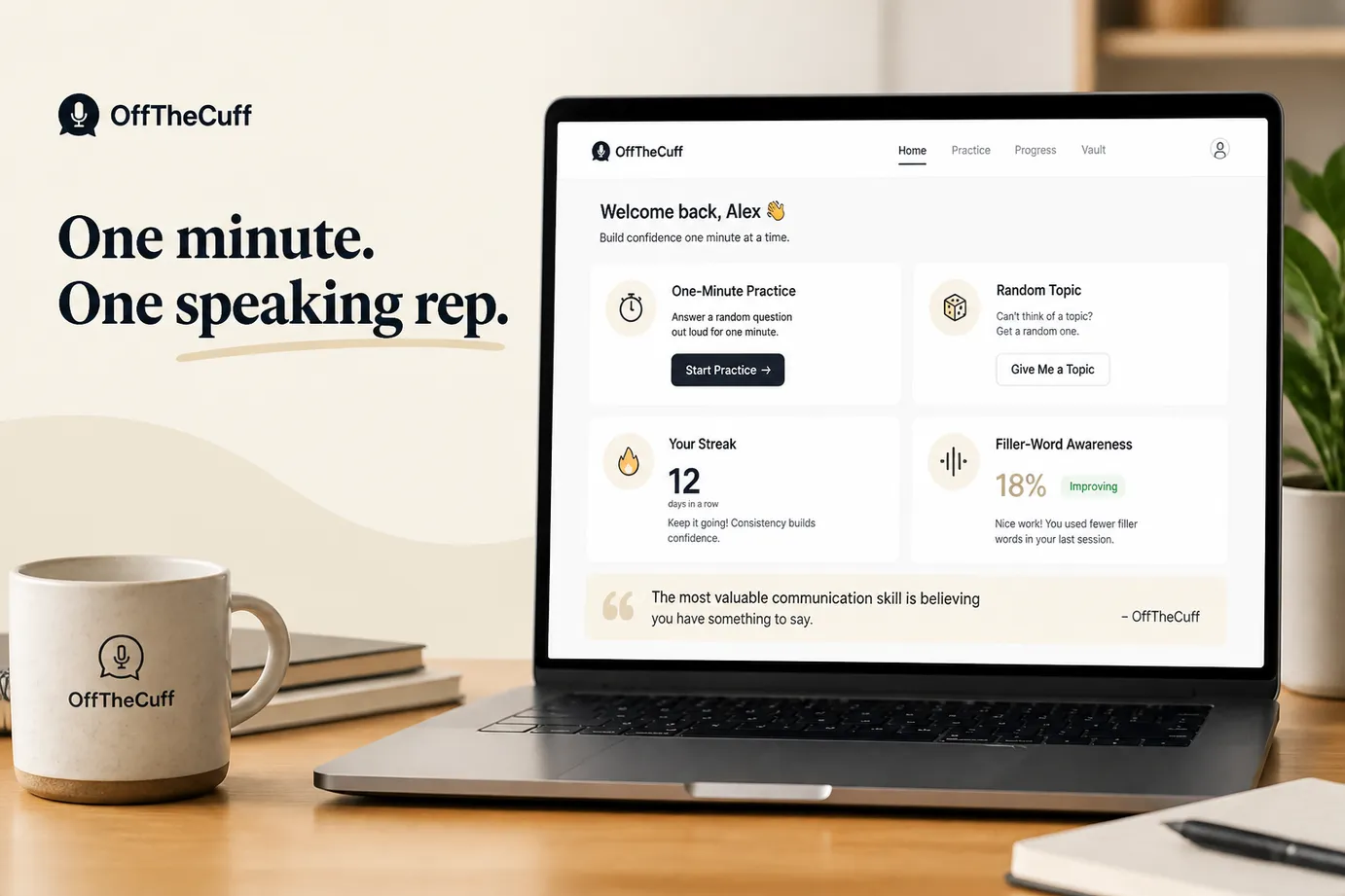
A low-friction speaking practice dashboard makes it easier to start your daily rep.
What Is the OffTheCuff Website?
The OffTheCuff website is a practice environment for spontaneous speaking. Think of it as a tiny gym for your voice, ideas, and confidence.
Instead of reading about communication theory for an hour, you practice for one minute. Instead of memorizing a script, you respond to a random topic. Instead of waiting for a high-stakes meeting to find out how you sound, you get reps in a safe space first.
The core promise is simple:
- Practice speaking without preparation.
- Build clarity through short daily takes.
- Notice filler words and wandering thoughts.
- Improve structure, confidence, and presence over time.
- Keep the process private and low pressure.
That matters because most speaking problems are not knowledge problems. They are repetition problems.
You probably already know enough. The gap is turning thoughts into words quickly, calmly, and clearly.
That is where daily no-prep practice shines.
Why No-Prep Speaking Practice Works
Most people prepare for speaking by writing too much.
They draft long notes. They rehearse perfect lines. They try to remove every possible mistake.
Then real life happens.
A manager asks, “What do you think?” A client wants a quick explanation. A colleague pushes back. A friend asks for a toast. A podcast host asks a follow-up question you did not expect.
No-prep speaking practice trains the exact moment that matters: the gap between the prompt and your response.
When you practice that gap, you build three useful muscles.
1. You Learn to Start Faster
Many people freeze because they are trying to craft the perfect opening sentence.
A one-minute speaking rep teaches you to begin with a simple frame:
- “My take is…”
- “There are two reasons…”
- “The short answer is…”
- “I would look at it this way…”
Starting is a skill. The more you start, the less scary it feels.
2. You Learn to Think While Talking
Clear speakers are not always thinking faster. They are using better structures.
They know how to organize ideas in motion.
For example:
- Point, reason, example.
- Past, present, future.
- Problem, insight, next step.
- What, why, how.
These structures act like rails. Your thoughts still move, but they stop flying off the track.
3. You Build Comfort With Imperfection
A great speaking practice website should not make you chase flawless performance. It should help you build usable confidence.
That means you can pause. You can restart a sentence. You can say something simply instead of brilliantly.
The goal is not to sound like a keynote speaker every time.
The goal is to become someone who can speak when called on.
The One-Minute Take: The Smallest Useful Speaking Rep
The one-minute take is the heart of the habit.
One minute is long enough to reveal patterns. It is short enough that you can do it on a busy day.
That is the sweet spot.
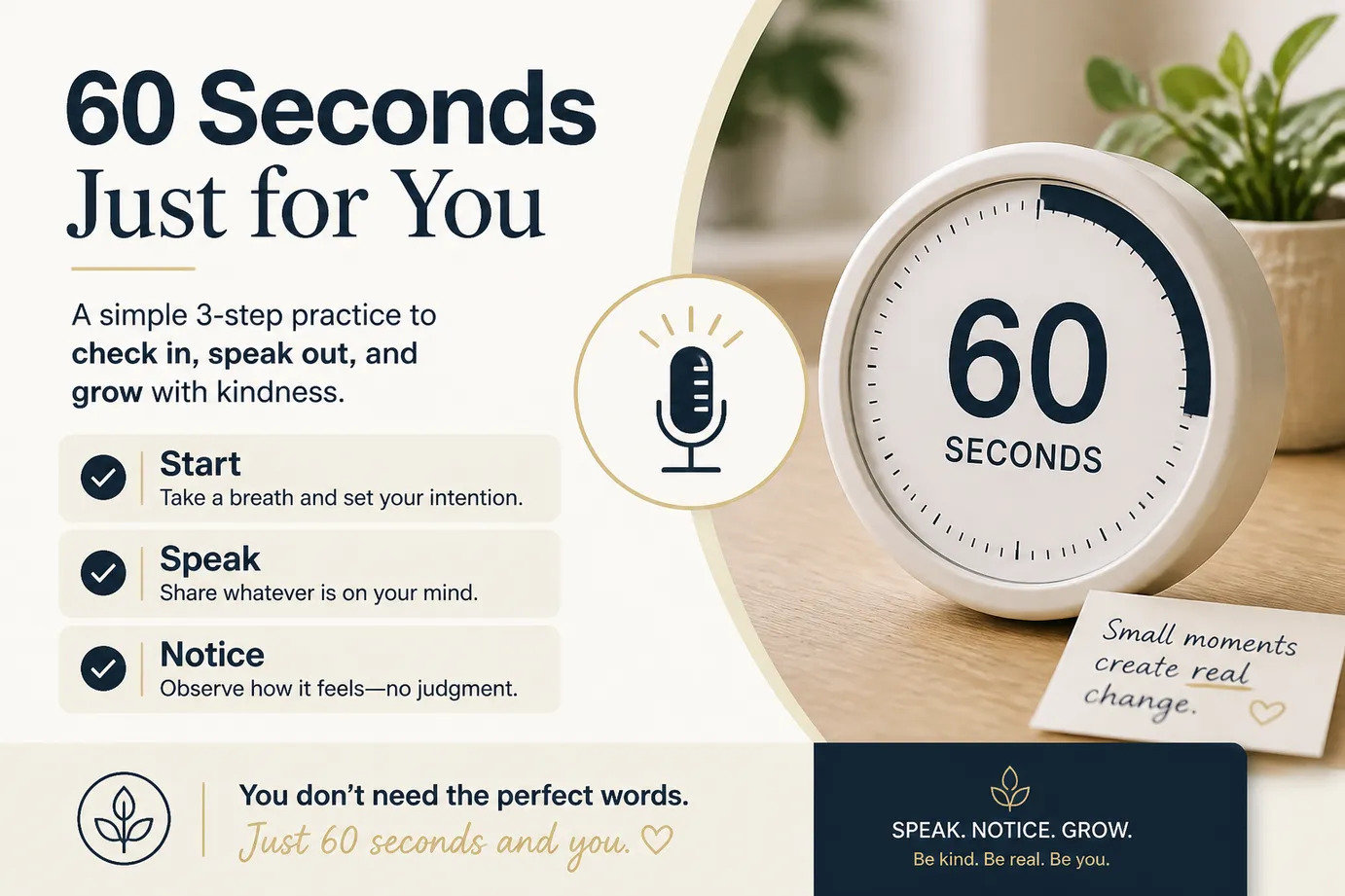
The one-minute take is short enough to do daily and long enough to build real skill.
Here is how a one-minute take works:
- Get a topic.
- Take a breath.
- Speak for 60 seconds.
- Listen back if you want.
- Notice one improvement.
- Repeat tomorrow.
That is it.
No studio. No audience. No elaborate setup.
If you can spare 60 seconds, you can practice.
A Simple One-Minute Formula
Use this when you do not know what to say:
Opening: “I think the key idea is…”
Point: State your main answer in one sentence.
Reason: Explain why it matters.
Example: Give a quick real-world example.
Close: End with a takeaway.
Example topic: “Should teams have more meetings or fewer meetings?”
Sample one-minute answer:
“I think the key idea is not more or fewer meetings. It is better meetings. Teams need enough time to align, but too many meetings create drag. The best meetings have a clear purpose, the right people, and a decision or next step. For example, a 15-minute check-in can be useful if everyone knows what they are solving. But a 60-minute meeting with no owner usually wastes energy. My takeaway is this: do not ask whether you need a meeting. Ask what the meeting is meant to change.”
That answer is not fancy. Good.
It is clear. It has a point. It has structure. It lands.
Use Random Topics to Build Real Flexibility
Random topics are powerful because they remove your ability to over-prepare.
That is the point.
If you only practice topics you already love, you may sound confident in a narrow lane. But real communication is messy. You get surprise questions. You need to explain unfamiliar ideas. You need to find a point quickly.
A random topic practice flow trains mental agility.

Random topics train you to organize ideas quickly without over-preparing.
Try prompts like:
- What is one habit everyone should try for a week?
- Should remote teams meet in person more often?
- What makes feedback useful?
- Is boredom underrated?
- What is a skill schools should teach earlier?
- How do you define confidence?
- What makes a good apology?
Do not search for the perfect answer. That defeats the rep.
Your job is to make a usable answer.
The 5-Second Setup
When a random topic appears, give yourself five seconds.
Ask:
- What is my opinion?
- What is one reason?
- What is one example?
Then speak.
This builds the exact habit you need in meetings and interviews. You stop waiting for perfect clarity before you begin. You find clarity by speaking with structure.
Reduce Filler Words Without Becoming Robotic
Filler words are normal.
Everyone says “um,” “like,” “you know,” and “sort of.” The goal is not to delete every filler word from your life. That would make you sound stiff.
The goal is awareness and control.
If filler words appear because you are thinking, use a pause instead. If they appear because you are rushing, slow down. If they appear because your sentence has no destination, choose a structure.
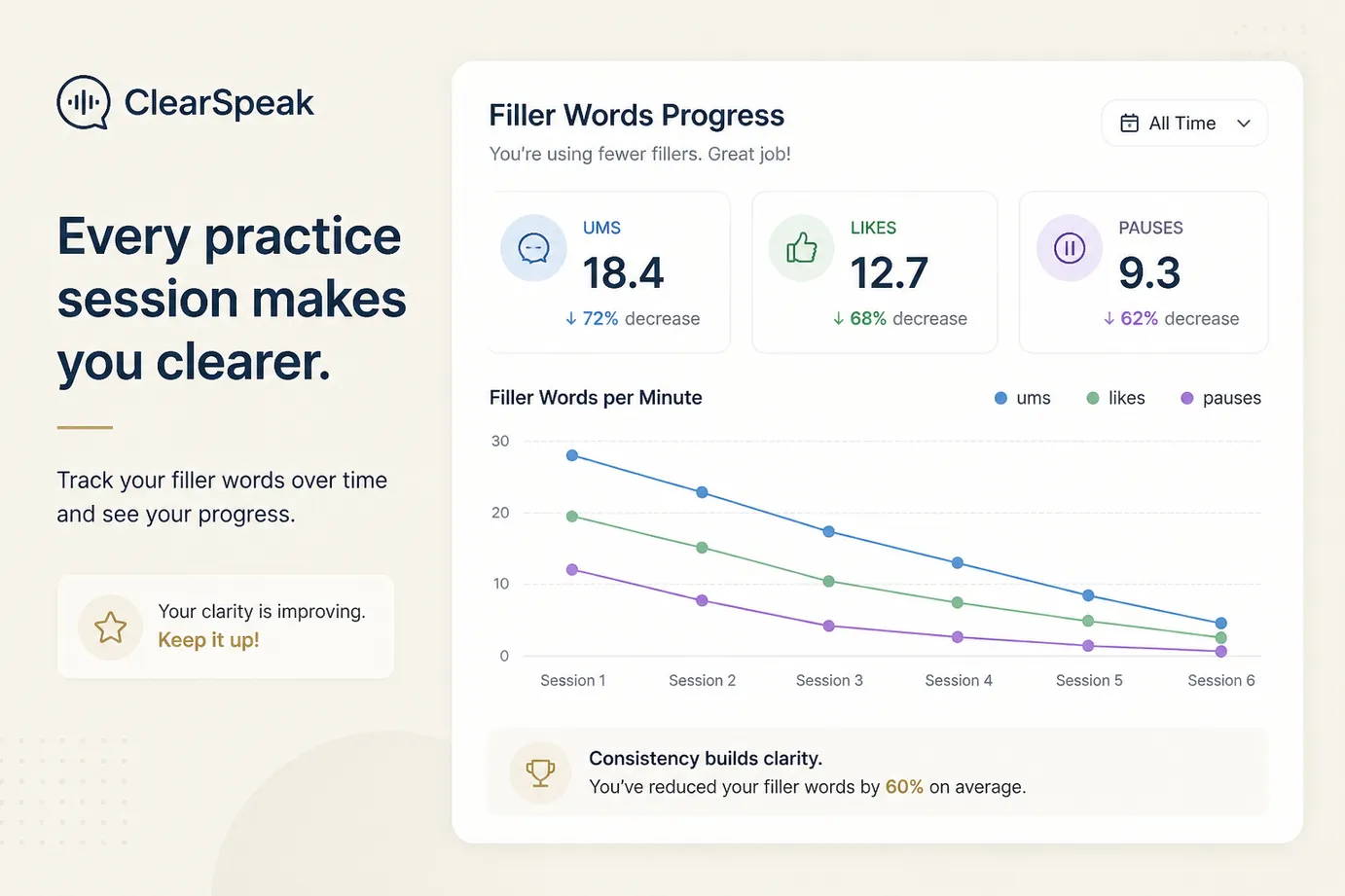
Track one filler word at a time. Awareness creates cleaner speech.
A Practical Filler-Word Drill
Try this for one week:
- Record a one-minute take.
- Listen for only one filler word type.
- Count it.
- Do the same prompt again.
- Replace the filler with a silent pause.
Do not fix everything at once.
Pick one target. Maybe “um.” Maybe “like.” Maybe “kind of.”
Small target. Daily reps. Better results.
The Pause Is Your Friend
Many speakers fear silence. But a pause can make you sound more confident.
Compare these two lines:
“Um, I think we should, like, probably wait because the data is kind of incomplete.”
“I think we should wait. The data is incomplete.”
The second version is shorter. Stronger. Easier to trust.
That is the win.
Not perfect speech. Cleaner speech.
Build Clearer Structure With Simple Frameworks
If your speaking feels scattered, you do not need more vocabulary. You need better containers.
A structure helps listeners follow you. It also helps you think.
Here are four frameworks that work beautifully for no-prep speaking practice.
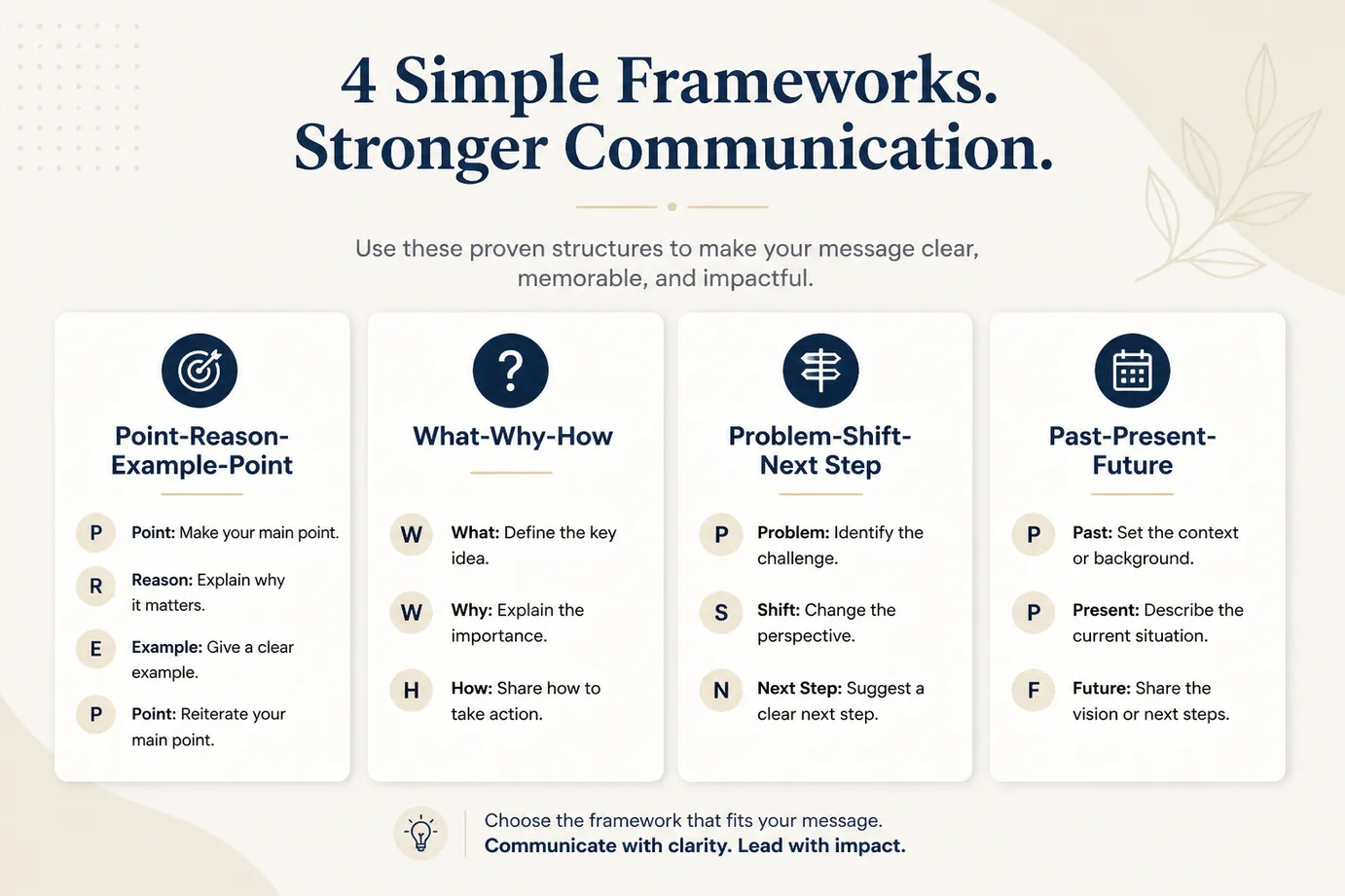
Simple frameworks help you think while you speak.
Framework 1: Point, Reason, Example, Point
Best for opinions.
- Point: Say what you think.
- Reason: Explain why.
- Example: Make it concrete.
- Point: Repeat the takeaway.
Prompt: “Is consistency more important than talent?”
Answer shape:
“My point is yes, consistency usually beats talent. The reason is that most useful skills grow through repetition, not occasional brilliance. For example, a person who practices speaking for one minute daily will usually improve faster than someone who waits for a big presentation once a quarter. So yes, talent helps, but consistency compounds.”
Framework 2: What, Why, How
Best for explaining ideas.
- What is it?
- Why does it matter?
- How do you use it?
Prompt: “What is active listening?”
Answer shape:
“Active listening means listening to understand, not just to reply. It matters because people can tell when you are only waiting for your turn. You can practice it by summarizing what someone said before adding your view.”
Framework 3: Problem, Shift, Next Step
Best for coaching or leadership moments.
- Problem: Name the issue.
- Shift: Reframe the issue.
- Next step: Offer one action.
Prompt: “How should someone handle procrastination?”
Answer shape:
“The problem is that procrastination often looks like laziness, but it is usually friction. The shift is to make the task smaller. The next step is to commit to two minutes, not two hours.”
Framework 4: Past, Present, Future
Best for stories and updates.
- Past: Where things started.
- Present: Where things are now.
- Future: What happens next.
Prompt: “Tell us about a project you are working on.”
Answer shape:
“Last month, we were trying to reduce support response time. Right now, we have a new triage system that is cutting down repeat questions. Next, we are going to review the top issues and turn them into help content.”
Keep these frameworks handy. But do not overthink them.
Pick one. Run the rep.
Presence: How to Sound Calm and Grounded
Presence is not about having a deep voice or dramatic gestures.
Presence means people feel you are here.
You are not rushing away from your own words. You are not apologizing for every thought. You are not hiding behind filler.
You are steady.
That can be practiced.
The Presence Checklist
Before a one-minute take, do this:
- Sit or stand tall.
- Plant your feet.
- Relax your jaw.
- Take one slow breath.
- Look at one fixed point.
- Start with a simple sentence.
This takes less than ten seconds.
It changes the whole rep.
Slow Down the First Sentence
Your first sentence sets the pace.
If you sprint out of the gate, you will spend the rest of the answer trying to catch your breath.
Try this:
“The main thing I would say is…”
Say it slowly.
Then continue.
A calm opening gives your brain time to organize. It also tells the listener, “I have this.”
Even if you are still figuring it out.
Privacy Makes Practice Easier to Start
Speaking practice can feel vulnerable.
That is why privacy matters.
A useful OffTheCuff website experience should make practice feel safe. You should be able to record a take without feeling like you are publishing it to the world. You should be able to experiment, sound awkward, try again, and improve quietly.
That privacy lowers the emotional cost of starting.
And starting is the whole game.
When practice is private, you are more likely to:
- Try difficult topics.
- Listen honestly.
- Repeat a messy take.
- Notice patterns without shame.
- Build confidence before high-stakes moments.
Confidence grows faster when the practice room feels safe.
How to Start a Daily Speaking Streak
A streak is not magic. It is just a visible promise.
But visible promises work.
When you see that you have practiced three days in a row, you want day four. When you hit ten days, you start to identify as someone who practices speaking. That identity matters.
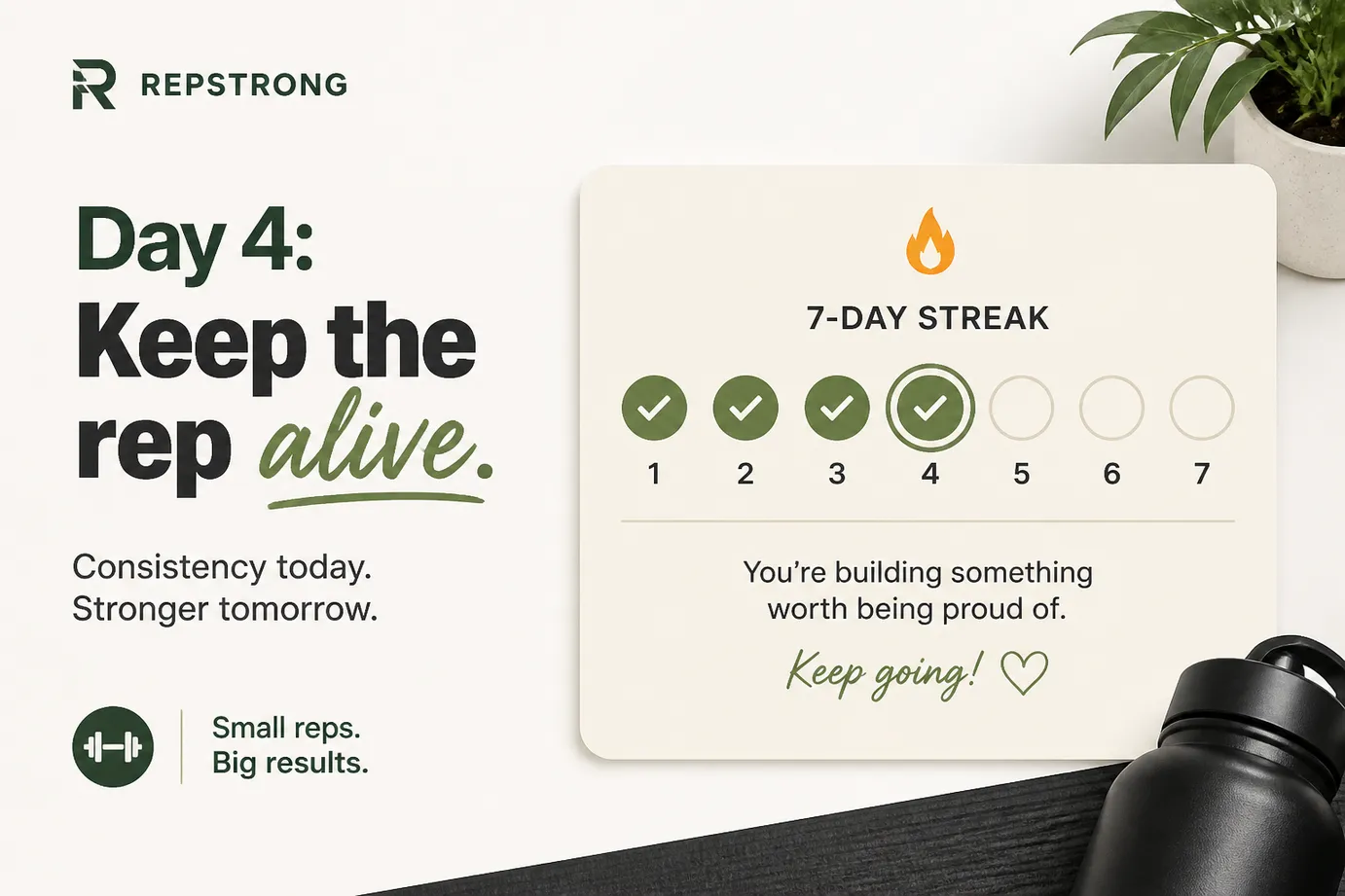
A streak turns speaking practice into a habit you can see.
Here is a simple 7-day starter plan.
Day 1: Baseline Take
Record one random topic. Do not judge it. Just finish.
Notice one thing: Did you ramble, rush, freeze, or use fillers?
Day 2: Slower Start
Use the same one-minute format. Focus only on your first sentence.
Make it calm.
Day 3: One Framework
Pick Point, Reason, Example, Point.
Use it even if the topic is weird.
Day 4: Filler Awareness
Listen for one filler word. Count it. No shame.
Awareness is a win.
Day 5: Stronger Ending
End with a clear takeaway:
- “So the main point is…”
- “That is why I would…”
- “The takeaway for me is…”
Day 6: Random Topic Challenge
Take the first topic you get. No skipping.
This builds flexibility.
Day 7: Compare and Repeat
Listen to Day 1 and Day 7.
Ask:
- Am I starting faster?
- Am I clearer?
- Do I sound calmer?
- Is my answer easier to follow?
Do not expect perfection. Look for signal.
Small improvements count.
Practical Use Cases for the OffTheCuff Website
Daily speaking practice helps in more places than you might expect.
Meetings
You can practice giving concise updates, responding to pushback, and explaining tradeoffs.
Try prompts like:
- What is the biggest risk in this project?
- What decision do we need to make next?
- How would you explain this to a new teammate?
Meeting confidence often comes from being able to speak before your thoughts feel fully polished.
Interviews
Interview answers need structure. Random practice helps you answer without sounding memorized.
Try prompts like:
- Tell me about a time you handled conflict.
- What is your biggest strength?
- Why are you interested in this role?
Use Past, Present, Future or Problem, Action, Result.
Keep it human. Not robotic.
Sales and Client Calls
Clear speech builds trust. If you can explain a product simply, handle objections calmly, and summarize next steps, you are easier to buy from.
Try prompts like:
- Why should a customer care about this?
- What problem does this solve?
- How would you explain the value in 30 seconds?
Leadership
Leaders speak in moments of uncertainty. They need to align, reassure, and clarify.
Try prompts like:
- What should the team focus on this week?
- How do we handle a missed goal?
- What does success look like?
A strong leader does not always have the perfect answer. But they can create clarity.
Social Confidence
Speaking practice is not only professional.
It helps you tell better stories, answer questions more easily, and stop replaying conversations later.
Try prompts like:
- What is a movie you recommend?
- What is a lesson you learned recently?
- What is something you changed your mind about?
Everyday confidence is built in small moments.
How to Measure Improvement Without Overcomplicating It
You do not need a giant analytics dashboard to know if you are improving.
Track a few simple signals.
Signal 1: Time to Start
How long do you wait before speaking?
If you used to freeze for 20 seconds and now you start in five, that is progress.
Signal 2: Filler Word Count
Pick one filler. Count it once or twice a week.
Do not obsess. Just observe the trend.
Signal 3: Clear Ending
Can you land the plane?
A clear ending makes you sound more confident immediately.
Signal 4: Structure
Can a listener repeat your main point?
If yes, you were clear.
Signal 5: Comfort
Do you feel less dread when a topic appears?
That matters. Confidence is not only how you sound. It is how willing you are to try.
Common Mistakes to Avoid
Let’s keep this simple.
Mistake 1: Practicing Too Long
If you make practice a 45-minute project, you will skip it.
Start with one minute.
Earn the habit first.
Mistake 2: Fixing Everything at Once
Do not try to improve pacing, structure, eye contact, filler words, storytelling, and vocal tone in one take.
Pick one focus.
One rep. One focus.
Mistake 3: Re-Recording Until It Is Perfect
A second take is useful. A twelfth take is avoidance wearing a fancy hat.
Practice. Notice. Move on.
Mistake 4: Sounding “Professional” Instead of Clear
Clear beats corporate.
Use normal words. Short sentences. Real examples.
The goal is not to impress people with complexity. The goal is to be understood.
Mistake 5: Skipping Playback Forever
You do not need to listen to every take. But listen sometimes.
Your memory of how you sounded is not always accurate. Playback gives you data.
Be kind. Be specific. Improve one thing.
A 10-Minute Weekly Routine
If you want more than daily one-minute reps, try this once a week.
- Do three random one-minute takes.
- Choose the best one.
- Listen back.
- Write down one strength.
- Write down one improvement.
- Repeat the same topic once.
- Save the takeaway.
This gives you a weekly feedback loop without turning practice into homework.
Example notes:
- Strength: Started quickly and used a clear example.
- Improvement: Ending was weak.
- Next rep focus: Close with one takeaway sentence.
That is enough.
The Best Way to Use OffTheCuff: Tiny Reps, Real Consistency
The best speaking practice is the practice you actually do.
Not the perfect routine. Not the longest session. Not the most dramatic transformation plan.
Just the rep you complete today.
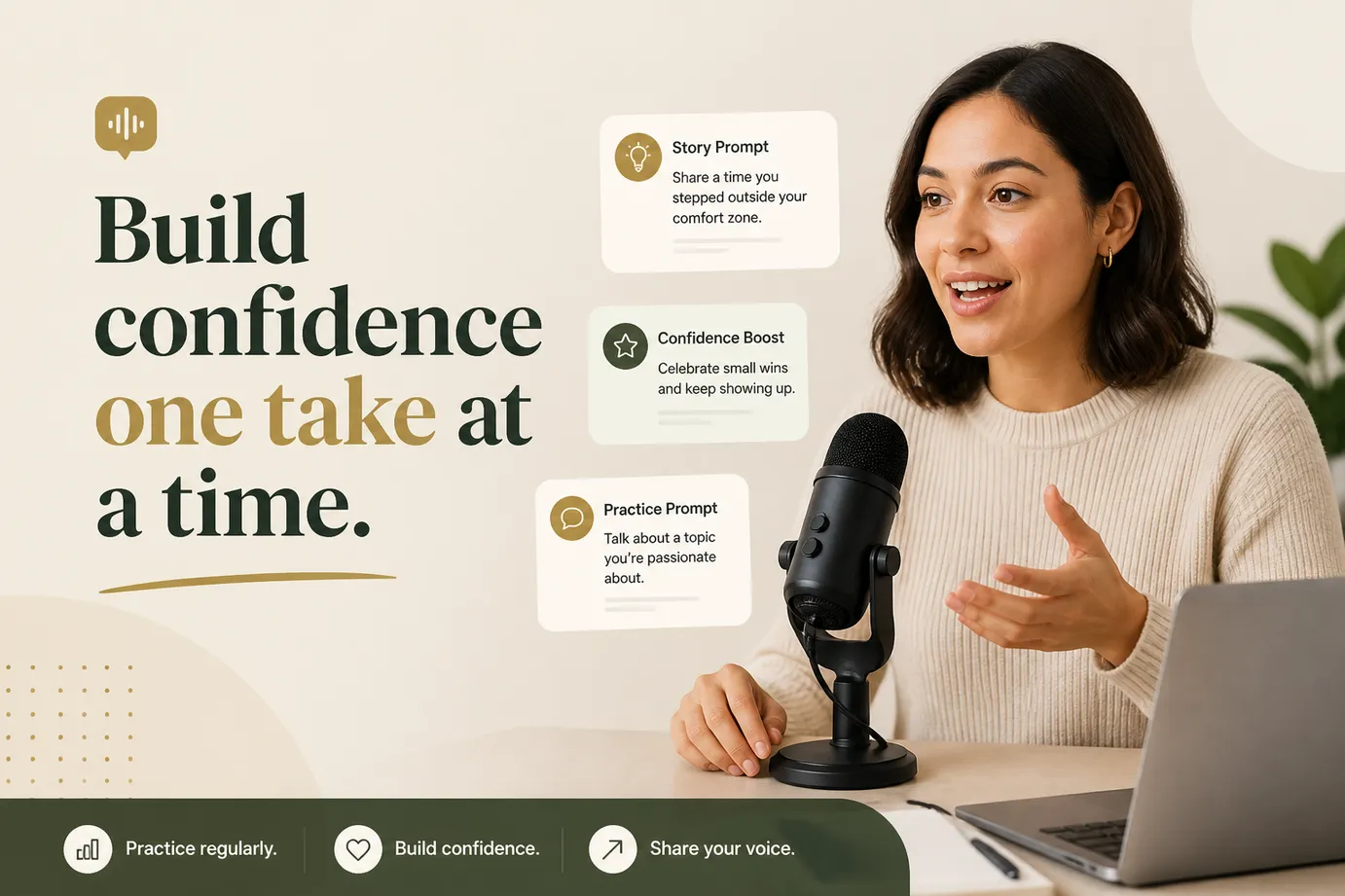
Confidence grows from tiny reps repeated consistently.
So make it easy:
- Practice at the same time each day.
- Use random topics when you feel stuck.
- Keep takes short.
- Track your streak.
- Focus on one skill at a time.
- Celebrate cleaner starts, fewer fillers, and stronger endings.
If you miss a day, no drama.
Start again.
Speaking confidence is not built by waiting until you feel confident. It is built by proving to yourself that you can speak, adjust, and improve.
One minute at a time.
Try This Right Now
Here is your first rep.
Topic: What is one small habit that can change someone’s life?
Use this structure:
- “One small habit I recommend is…”
- “It matters because…”
- “For example…”
- “The takeaway is…”
Set a timer for one minute.
Speak out loud.
That is the whole move.
Then do it again tomorrow.
Visit the OffTheCuff website, try a one-minute take, start a streak, or hit a random topic and see what comes out. Keep it light. Keep it honest. Keep showing up.
Your future confident self is built by today’s tiny rep.
Ready to practice?
Spin a random topic, speak for 60 seconds, and listen back - free while we're in early access.