OffTheCuffSpeech.com: Daily Reps for Impromptu Confidence
What OffTheCuffSpeech.com is for: one-minute impromptu speaking reps, random prompts, filler-word drills, PREC structure, streaks, and a 7-day challenge for everyday confidence.
You do not need another 12-step speaking course.
You need reps.
Small ones. Fast ones. Slightly uncomfortable ones. The kind you can do before coffee, between meetings, or while your lunch is heating up.
That is the promise behind Off the Cuff and the reason people search for offthecuffspeech com: they want a simple way to get better at speaking without prep, scripts, or a giant time commitment.
One minute. One random topic. One clear improvement.
Do that daily and speaking starts to feel less like a performance and more like a skill you actually own.
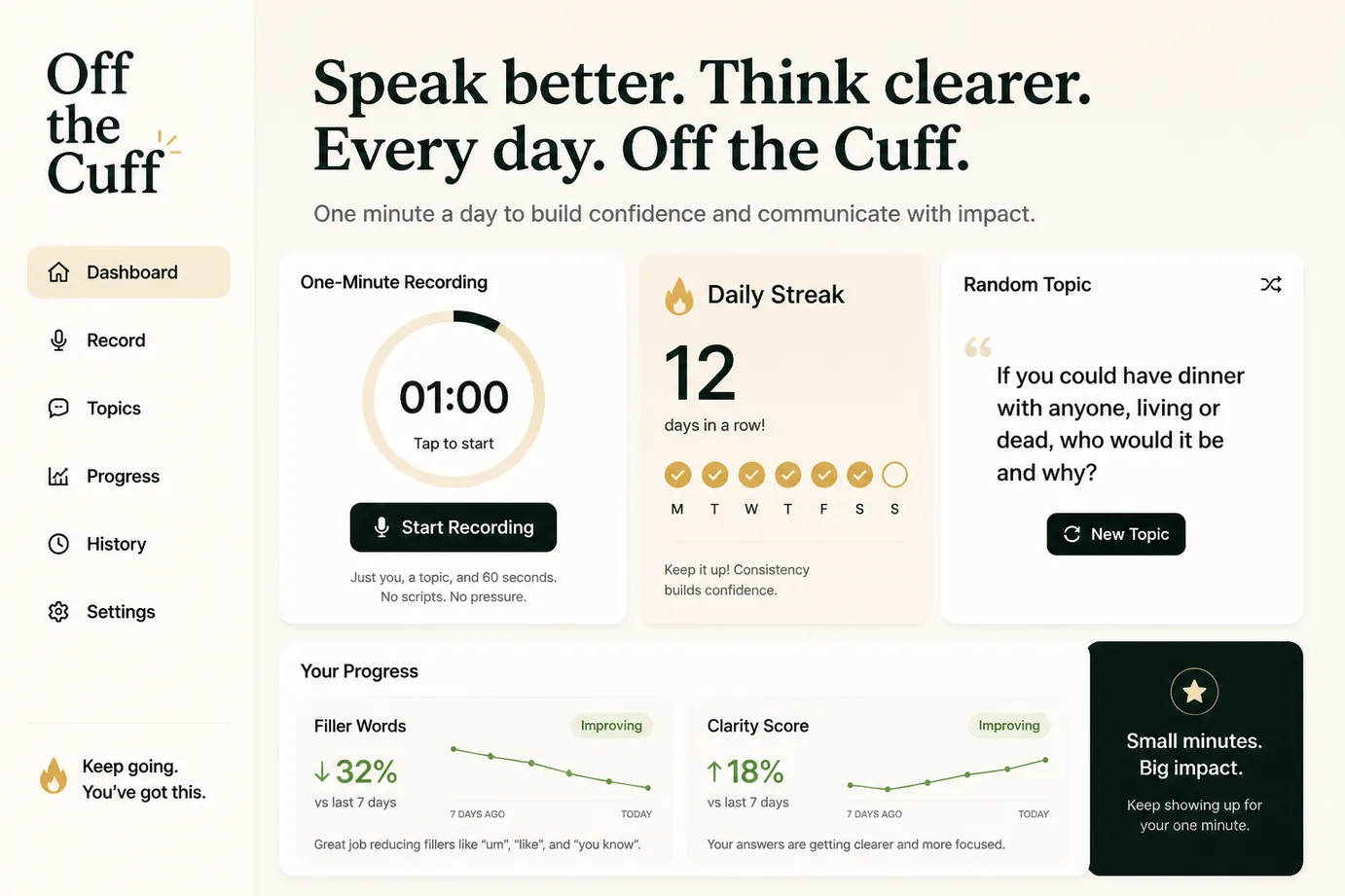
Daily reps turn speaking confidence into a habit.
The quick answer
OffTheCuffSpeech.com is for practicing impromptu speaking in short daily sessions. Think random prompts, one-minute recordings, filler-word awareness, streaks, and measurable progress.
It is built for the moments you cannot fully prepare for:
- Answering a surprise question in a meeting
- Introducing yourself without rambling
- Giving a quick update to your team
- Speaking up in class
- Practicing for interviews
- Recording sharper videos
- Building presence when your brain goes blank
The goal is not to turn you into a robotic keynote machine.
The goal is better everyday speaking.
Clearer. Tighter. Calmer. More you.
Why no-prep speaking matters
Prepared speaking is useful. Slides, notes, scripts, outlines. Great.
But real life loves ambushes.
Someone asks what you think. Your manager wants a quick summary. A client says, can you walk me through that? A networking call turns into a mini pitch. Your answer matters, and you have about two seconds to find your brain.
That is impromptu speaking.
And most people practice it exactly never.
They wait for pressure, hope they sound smart, then replay the moment later and think of the perfect answer in the shower. Classic. Painful. Avoidable.
Daily off-the-cuff practice trains the muscle before the moment arrives.
You learn how to:
- Start without panic
- Organize thoughts quickly
- Reduce filler words like um, uh, like, and you know
- Stop over-explaining
- Finish with a point
- Sound present instead of rushed
- Recover when you lose your place
You are not chasing perfection. You are building access.
Access to your thoughts under pressure.
The one-minute advantage
Long practice sounds impressive. It also gets skipped.
One minute gets done.
That is why a one-minute speaking rep works so well. It is short enough to start and long enough to reveal your patterns.
In sixty seconds, you can hear:
- Whether you opened clearly
- Where filler words creep in
- Whether your answer had structure
- Whether you wandered
- Whether you landed the plane
- Whether your energy dropped halfway through
A one-minute recording is honest. It does not care what you meant to say. It shows what came out.
That is useful.
Not always flattering. Useful.
The magic is the loop
The practice loop is simple:
- Get a random topic.
- Record for one minute.
- Review one thing.
- Improve one thing tomorrow.
That is it.
No binder. No ceremony. No speaking persona named Chad.
Just a rep.
Then another.
Who Off the Cuff is for
Off the Cuff is for anyone who wants to speak better when the script disappears.
Professionals
You need clean updates, confident answers, and concise explanations. Your job may not be public speaking, but communication is still part of the work.
Use daily prompts to practice status updates, decision explanations, meeting contributions, and quick summaries.
Students
Class discussions, presentations, interviews, club meetings, office hours. Speaking up gets easier when you practice before you are graded, judged, or cold-called.
Founders and creators
You need to explain what you do without sounding like a maze. Random topic practice helps you sharpen your message and stop hiding behind jargon.
Job seekers
Interview answers often fail because they are either too vague or too long. One-minute practice helps you get to the point, show structure, and sound human.
ESL and language learners
Impromptu speaking builds fluency because it forces retrieval. You learn to express ideas quickly, not just recognize vocabulary passively.
Quiet high performers
You know your stuff. You just want your voice to show up faster in the room.
Good. That is trainable.
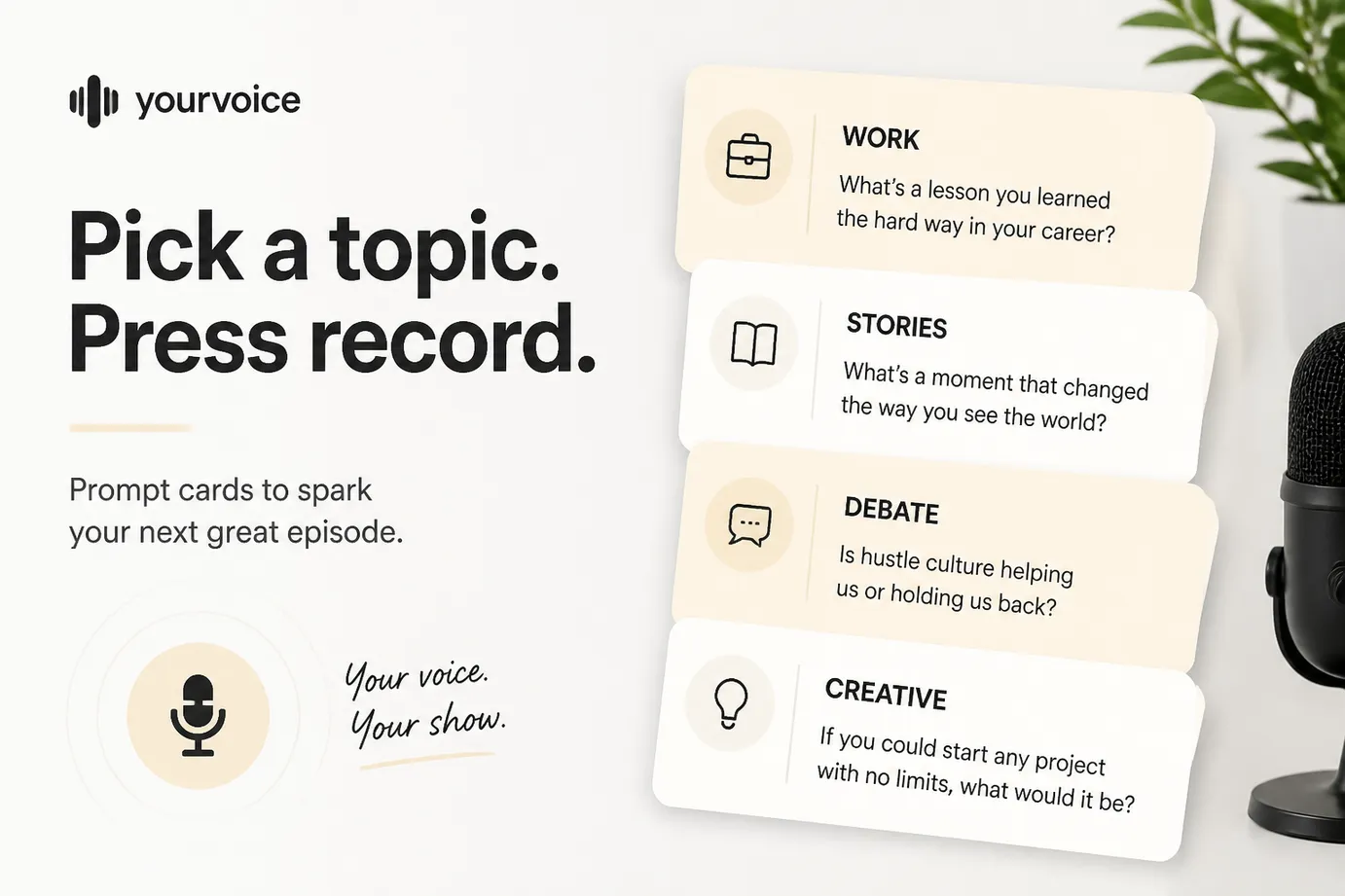
Random prompts train flexible thinking under pressure.
How to start with OffTheCuffSpeech.com
If you found this by searching offthecuffspeech com, start simple.
Do not optimize. Do not set up a productivity shrine. Do not watch six videos about confidence first.
Take the first rep on Off the Cuff.
Step 1: Pick a random topic
The topic does not need to be profound.
Actually, odd topics are better. They stop you from memorizing and force you to think in real time.
Try prompts like:
- Should meetings have expiration dates?
- What is one skill schools should teach?
- Explain your favorite app to a grandparent.
- Is remote work better for creativity?
- What is the best bad advice you have heard?
- Defend pineapple on pizza. Bravely.
- Describe a time you changed your mind.
The point is not the topic.
The point is how you handle not knowing exactly what to say.
Step 2: Record for one minute
Hit record. Speak until the timer ends.
Do not restart because the opening was awkward. Awkward openings are data.
Do not stop because you said um. Filler words are data.
Do not quit because your point got messy. Mess is data.
Your only job is to finish the minute.
Step 3: Listen once
Just once.
You are not here to become your own worst critic in HD audio.
Listen for one thing:
- Did I have a clear point?
- Did I use too many filler words?
- Did I start strong?
- Did I ramble?
- Did I sound rushed?
- Did I end cleanly?
Pick one.
Step 4: Name tomorrow’s focus
Tomorrow, improve one tiny thing.
Examples:
- Pause instead of saying um
- Start with the answer first
- Use three points only
- Slow down the first sentence
- End with a one-line takeaway
- Cut one repeated phrase
That is how progress becomes visible.
Small. Daily. Trackable.
The best one-minute speech structure
When your brain goes blank, structure saves you.
You do not need a fancy framework. You need something you can remember while mildly panicking.
Use this:
Point. Reason. Example. Close.
That is the whole thing.
Point
Start with your main answer.
Not background. Not apology. Not a scenic route.
Example:
I think remote work improves focus, but only when teams are intentional about communication.
Great. The listener knows where you stand.
Reason
Give one reason.
Example:
The biggest benefit is control over deep work. People can plan their day around the tasks that need real concentration.
Example
Make it concrete.
Example:
For example, a designer might do better work with two quiet morning hours than in an office full of interruptions.
Close
Land the plane.
Example:
So remote work is not magic, but with clear norms, it can protect the kind of focus most offices accidentally destroy.
Done.
Clean. Short. Human.
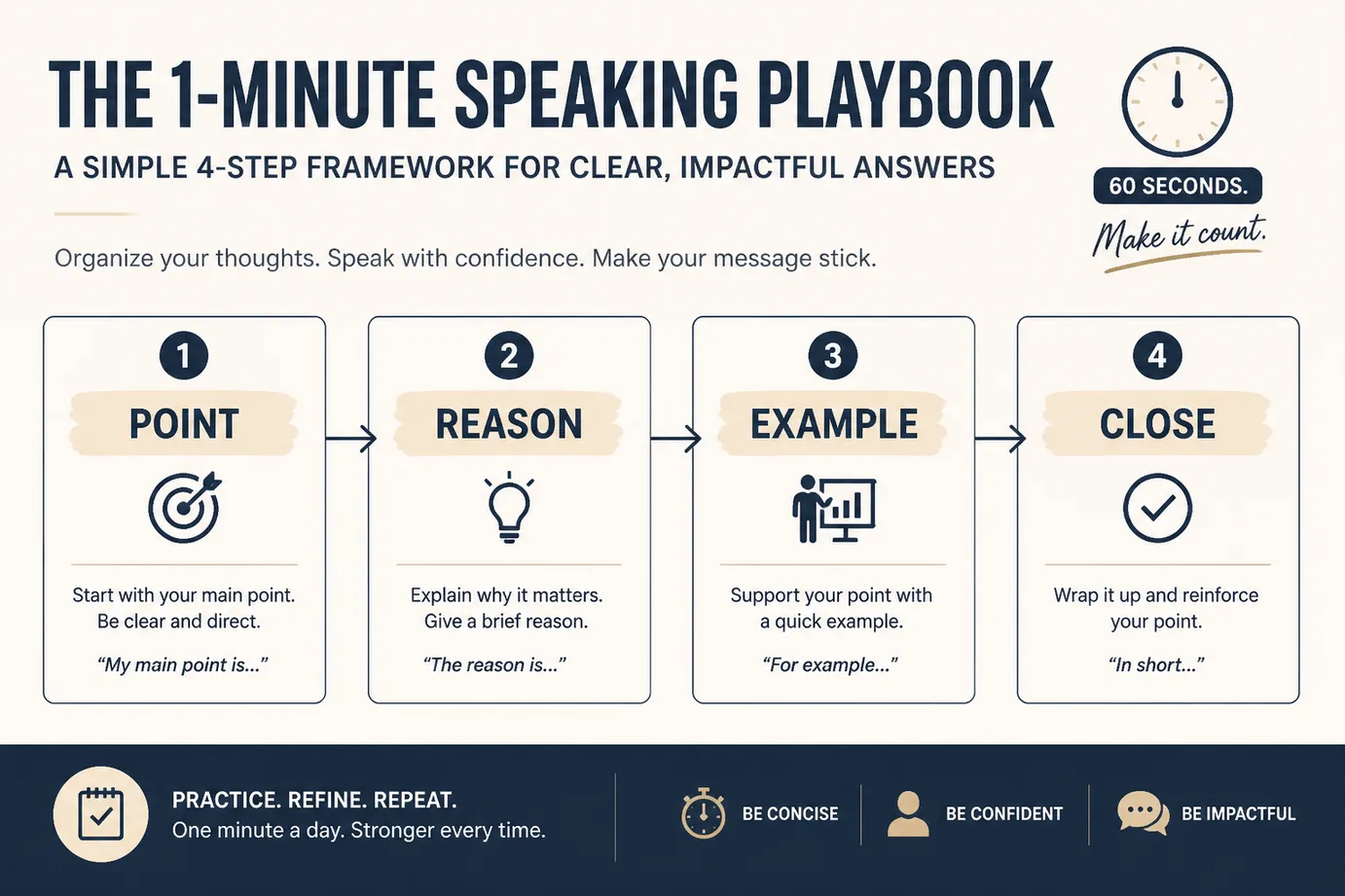
When your brain blanks, structure saves the rep.
How to reduce filler words without sounding stiff
Filler words are not evil.
Everyone uses them. A few can sound natural. Too many make your ideas harder to follow.
The goal is not zero filler words.
The goal is control.
First, notice your default filler
Most people have a favorite.
Maybe it is um. Maybe it is like. Maybe it is kind of, basically, so yeah, or you know.
Your filler word is usually a placeholder. It appears when your mouth wants to keep moving but your brain needs a second.
Good news: there is a better placeholder.
It is called a pause.
Wild technology.
Practice the pause
Try this drill:
- Pick a prompt.
- Record for one minute.
- Every time you feel a filler word coming, pause instead.
- Keep going.
At first, the pauses will feel huge.
They are not.
To listeners, a pause often sounds thoughtful. To speakers, it feels like falling down an elevator shaft.
Trust the listener.
Use shorter sentences
Filler words often pile up in long sentences.
Short sentences give you more reset points.
Instead of:
I think the reason this is important is because when people are trying to communicate in a way that is more effective, they really need to sort of understand what they are trying to say first.
Say:
Clear speaking starts with clear thinking. If you know the point, the sentence gets shorter. The listener has less work to do.
Sharper. Cleaner. Less fog.
Track one filler at a time
Do not try to fix every habit at once.
For one week, track your biggest filler.
Count it. Notice when it appears. Try again tomorrow.
Measurement removes the mystery.
Clarity beats cleverness
A lot of people try to sound impressive when they speak.
That usually makes them less clear.
Clarity wins because listeners are busy. They do not want to decode your answer. They want the point.
Here is a quick clarity checklist for every one-minute recording:
- Did I answer the prompt directly?
- Could someone summarize my point in one sentence?
- Did I use plain words?
- Did I avoid stacking too many ideas?
- Did I close with a takeaway?
If the answer is yes, you are doing well.
If not, good. You found tomorrow’s rep.
Say the headline first
A strong off-the-cuff answer often starts with the headline.
Weak opening:
There are a lot of different ways to think about this, and I guess it depends on the situation.
Stronger opening:
I would choose speed over perfection when the decision is reversible.
Now people lean in.
You sound decisive because you gave them a handle.
You can add nuance after.
Presence is a practice, too
Presence sounds mystical. It is not.
Presence is what happens when your attention is in the room instead of trapped in your self-monitoring loop.
You know the loop:
How do I sound? Was that weird? Why did I say basically? Are they bored? What do I do with my hands? Did my voice just crack like a haunted door?
Presence interrupts that spiral.
Try the first-breath reset
Before you speak:
- Inhale slowly.
- Drop your shoulders.
- Look at one point in front of you.
- Say your first sentence slower than normal.
That is it.
Your first sentence sets the pace. If you sprint at the start, you will chase yourself for the rest of the answer.
Practice with your face on
When you record, do not only listen to audio. Sometimes use video.
Notice:
- Are you looking down the whole time?
- Do you look tense before you start?
- Are your expressions matching your message?
- Are you rushing because silence feels awkward?
You do not need to become theatrical.
Just present.
Present beats polished most days.
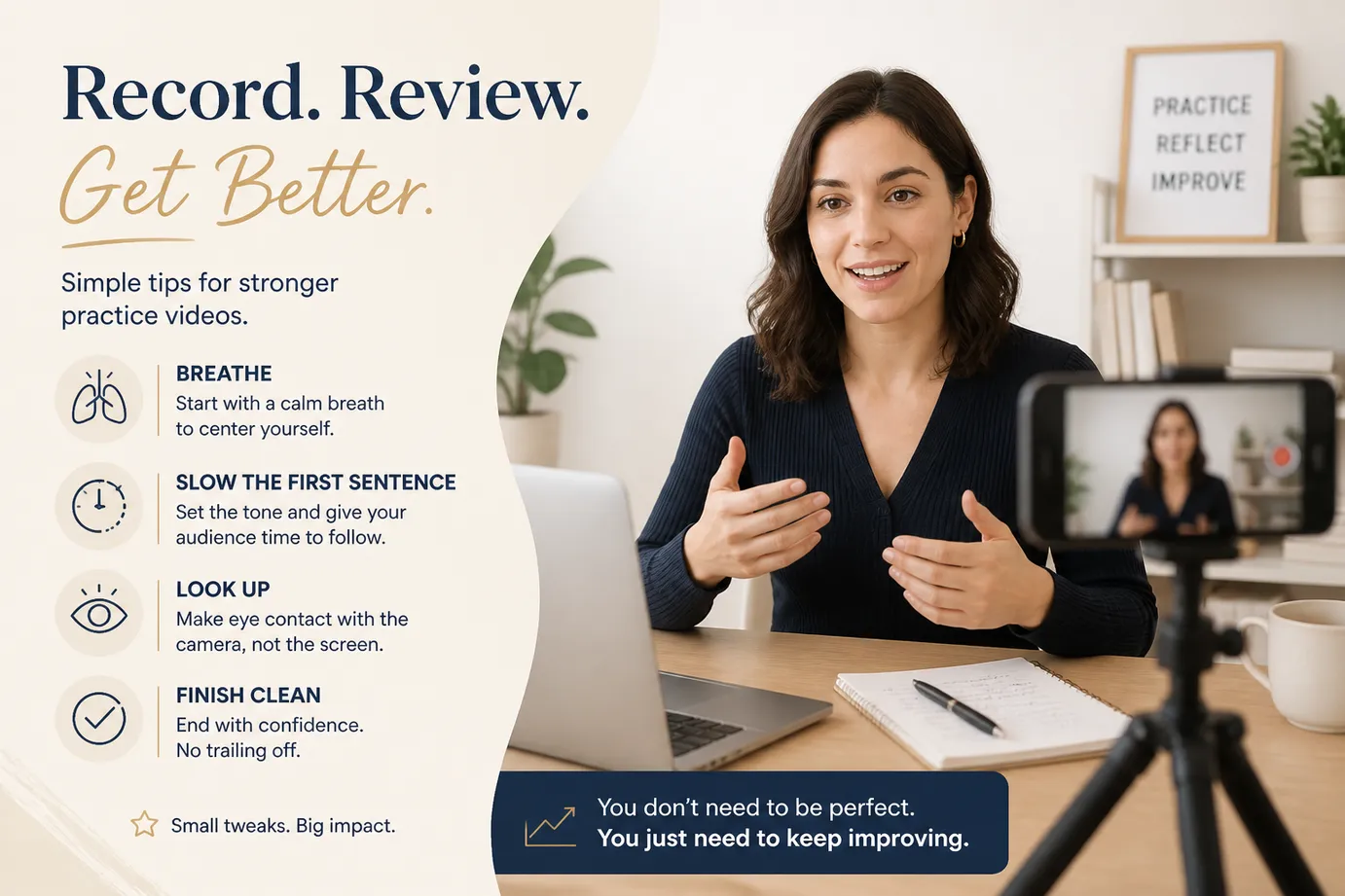
Presence is not magic. It is attention, breath, and pace.
Build a streak that actually helps
Streaks are powerful when they support the skill.
They are annoying when they become the whole game.
The point is not to worship a number. The point is to make practice automatic.
Make the streak tiny
Your minimum daily rep should be easy:
- One prompt
- One minute
- One note
That is your baseline.
On a good day, do more.
On a chaotic day, protect the streak with the minimum.
The identity shift matters:
I am someone who practices speaking every day.
That sentence changes how you show up.
Use weekly themes
A streak gets stronger when each week has a focus.
Try this four-week cycle:
Week 1: Finish the minute
No restarts. No judgment. Just complete reps.
Week 2: Reduce filler words
Track your top filler. Replace it with a pause.
Week 3: Structure faster
Use Point, Reason, Example, Close every day.
Week 4: Add presence
Slow the opening. Improve eye contact. End with confidence.
Repeat the cycle.
You will not be the same speaker after two rounds.
Privacy matters when you practice speaking
Speaking practice is personal.
Your first recordings may include awkward pauses, half-formed thoughts, strange tangents, and at least one sentence that starts confidently and ends in a ditch.
That is normal.
It should also feel safe.
When using any speech practice tool, look for clear privacy expectations:
- Do you control your recordings?
- Is it clear how your data is used?
- Can you practice without broadcasting your work?
- Are progress metrics presented for your improvement, not public judgment?
Private practice creates honest practice.
If you feel watched, you perform. If you feel safe, you experiment.
Experimentation is where the improvement happens.
Random topics make you faster
Practicing the same speech over and over improves that speech.
Practicing random topics improves you.
Random prompts train flexible thinking. They force you to build a structure on the fly, retrieve examples quickly, and keep speaking when the perfect sentence is not available.
That is the real-world skill.
Use topic categories
Rotate through categories so your brain does not get too comfortable:
- Work and leadership
- Technology
- Personal stories
- Debate topics
- Everyday opinions
- Explaining concepts simply
- Creative nonsense
Yes, creative nonsense counts.
If you can explain why umbrellas need loyalty programs, you can probably handle a meeting question.
The 3-second start drill
This one is simple and spicy.
- Reveal a random prompt.
- Count down from three.
- Start speaking.
- Do not apologize.
No saying, I have not really thought about this.
No saying, This is probably a bad answer.
No verbal escape hatches.
Start with a point.
Confidence often sounds like beginning cleanly.
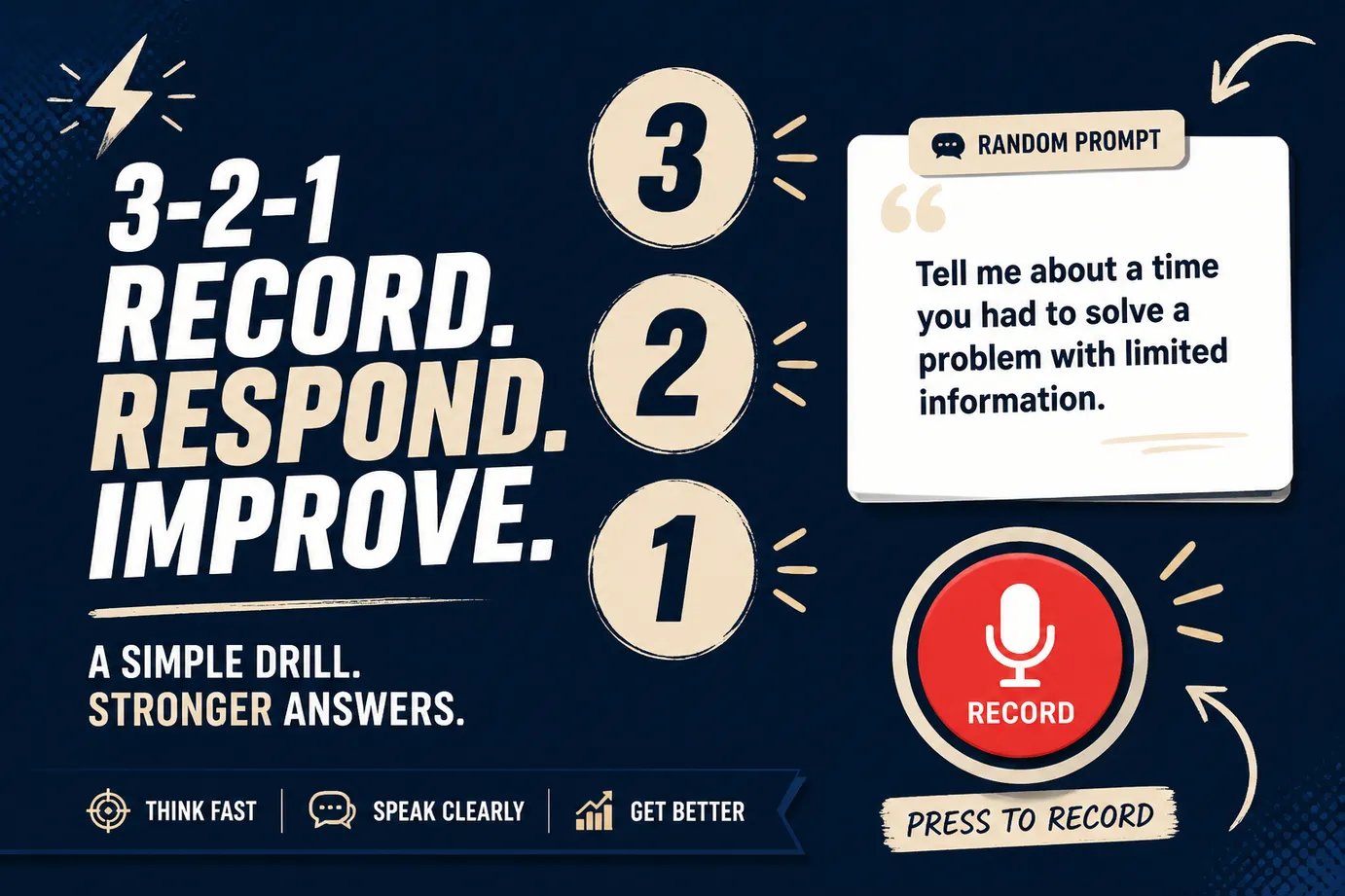
Start clean. No apologies. No escape hatches.
How to measure progress
You cannot improve what you never review.
But you also do not need a spreadsheet with 47 tabs and conditional formatting. Easy, tiger.
Track a few simple metrics:
Filler count
Count your main filler word per recording.
If you used like 14 times on Monday and 8 times on Friday, that is progress.
Not perfect. Progress.
Clear opening
Score your opening from 1 to 5.
Did you start with a point? Did you sound steady? Did the first sentence help the listener?
Structure
Check whether your answer had a beginning, middle, and end.
A messy middle is survivable. No ending is what makes people drift.
Pace
Notice if you rushed.
Many speakers speed up because they want the discomfort to end. Slow down and the listener trusts you more.
One takeaway
After listening, write one sentence:
Next time, I will...
That sentence is the bridge between today’s rep and tomorrow’s improvement.
A 7-day Off the Cuff challenge
Want to start now? Good.
Here is a simple one-week challenge you can run with Off the Cuff or your own timer.
Day 1: Just finish
Prompt: What makes a great teammate?
Goal: Speak for one minute without restarting.
Review: Did you finish?
Win.
Day 2: Filler focus
Prompt: Should people schedule thinking time?
Goal: Notice your top filler word.
Review: Count it once. No shame spiral.
Day 3: Headline first
Prompt: Is curiosity more important than expertise?
Goal: Start with your answer in the first sentence.
Review: Was your point clear immediately?
Day 4: Three-point structure
Prompt: What should every new manager learn first?
Goal: Give three short points.
Review: Did you avoid adding point number 9 because your brain got excited?
Day 5: Better pause
Prompt: Are deadlines helpful or harmful?
Goal: Replace fillers with pauses.
Review: Did any pause feel scary but sound fine?
Day 6: Story mode
Prompt: Tell a story about a time you learned something the hard way.
Goal: Use setup, moment, lesson.
Review: Did the story land?
Day 7: Presence check
Prompt: What is one belief you changed recently?
Goal: Slow the first sentence and finish with a clear takeaway.
Review: Compare Day 1 and Day 7.
You will hear a difference.
Maybe small. Maybe huge.
Either way, it is yours.
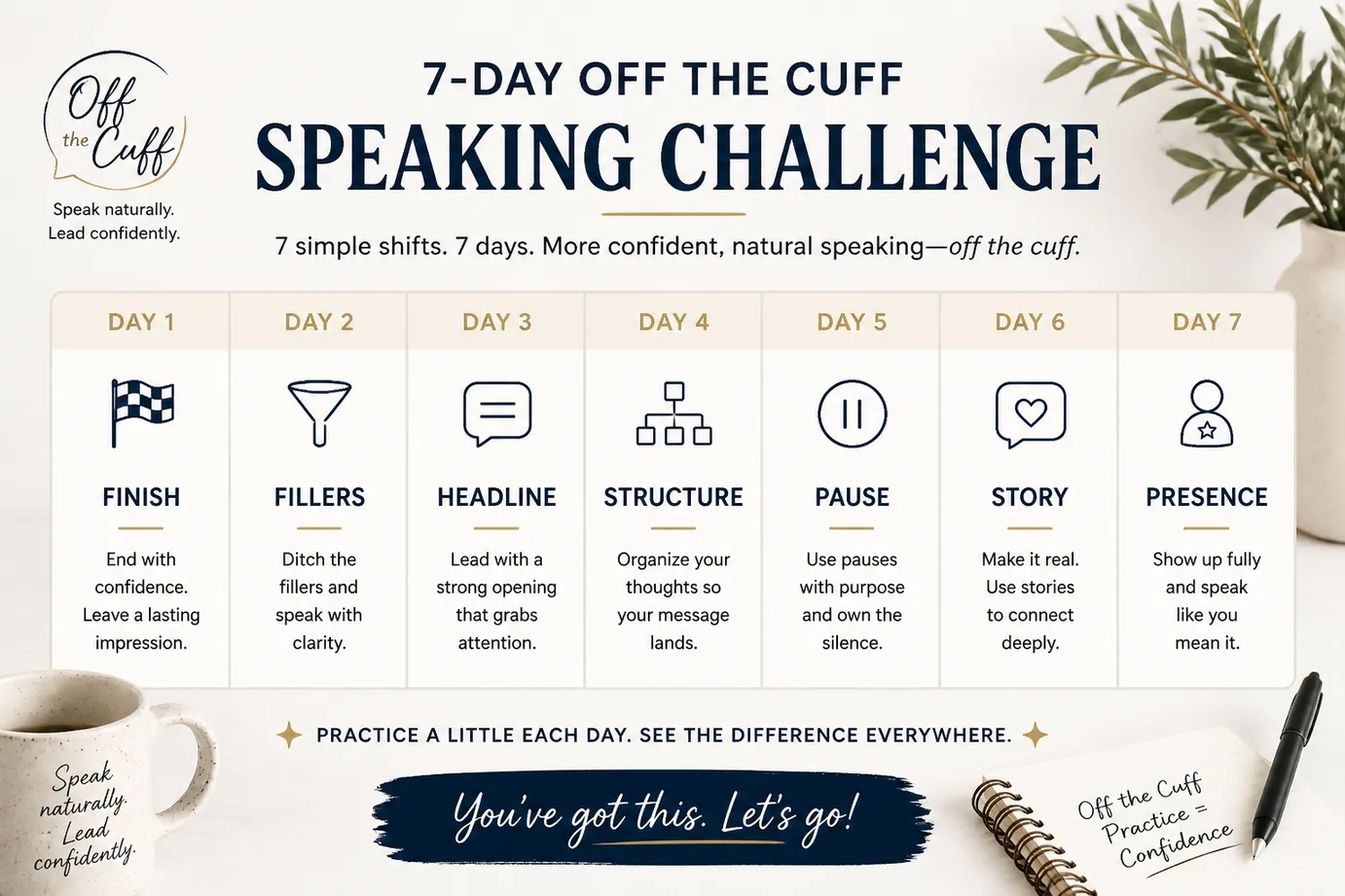
Seven days. Seven reps. One better speaker.
Want accountability? Join a speaking challenge and turn the week into a streak.
Common mistakes to avoid
Trying to sound perfect
Perfect is a trap. Clear is better. Real is better. Finished is better.
Practicing only in your head
Thinking about speaking is not speaking.
Record yourself. Your mouth needs reps too.
Reviewing too harshly
You are not grading a final exam. You are coaching the next rep.
Ignoring endings
A strong ending makes the whole answer feel more confident.
Try:
- That is the main reason I would choose speed here.
- So the takeaway is simple: clarity first, polish second.
- In short, I think the best answer is the one people can act on.
Overloading the listener
One minute is not a documentary.
Pick one main idea. Support it. Stop.
Off the Cuff vs traditional public speaking practice
Traditional public speaking often focuses on prepared performance.
Off-the-cuff practice focuses on everyday readiness.
Both matter. They just train different skills.
Prepared speaking helps you refine a known message. Impromptu speaking helps you respond in the moment.
Prepared speaking asks: How polished can you make this?
Off-the-cuff practice asks: How clearly can you think out loud right now?
That second question shows up constantly.
In meetings. Interviews. Sales calls. Reviews. Pitches. Classrooms. Podcasts. First dates. Family dinners where someone asks about your career and you suddenly forget every job you have ever had.
Reps help.
Try your first one-minute recording
Here is your prompt:
What is one small habit that can change someone’s life?
Set a timer for one minute.
Use this structure:
- Point: Name the habit.
- Reason: Explain why it matters.
- Example: Make it concrete.
- Close: End with a takeaway.
Then listen once.
Write one note:
Next time, I will...
That is your first rep.
Not someday. Not after you feel ready.
Now.
Final take
If you want to get better at impromptu speaking, stop waiting for confidence to arrive fully formed.
Confidence is usually the receipt.
The rep comes first.
Visit Off the Cuff, grab a random topic, and record one minute. Build the streak. Track one small metric. Reduce one filler. Sharpen one opening. Land one cleaner ending.
Tomorrow, do it again.
You do not need a stage.
You need sixty seconds.
And yes, you have sixty seconds.
Ready to practice?
Spin a random topic, speak for 60 seconds, and listen back - free while we're in early access.