Public Speaking: Daily Practice to Speak Confidently
Build public speaking confidence with small daily reps, impromptu prompts, recording and review, AI feedback, and a 30-day improvement plan.
Public speaking is not a talent reserved for a few lucky people. It is a skill. Skills improve with reps.
Not giant, stressful, once-a-month reps. Small daily reps.
One minute today. Two minutes tomorrow. A quick impromptu answer before lunch. A recorded practice session after work. A self-review that takes less time than scrolling your phone.
That is how confident speakers are built.
Whether you are a student preparing for class, a professional leading meetings, an interview candidate trying to sound sharp, or a nervous speaker who wants to stop freezing, this guide gives you a practical system. No fluff. No stage-personality makeover. Just clear steps you can use today.
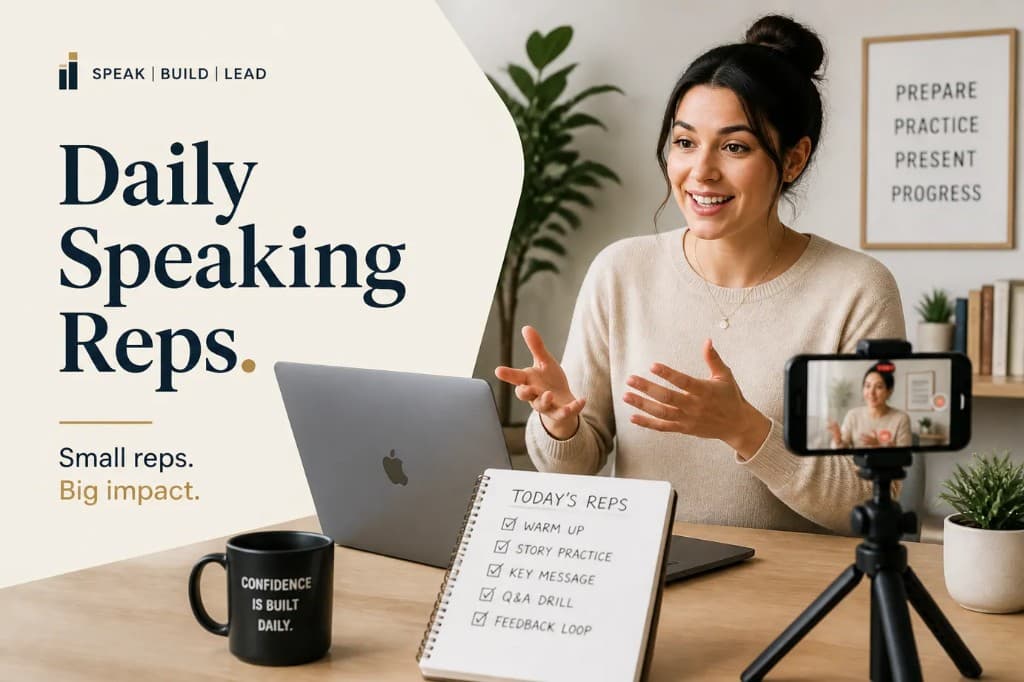
Small daily speaking reps build confidence faster than waiting for big presentations.
What Is Public Speaking?
Public speaking is the act of delivering a message to an audience. That audience can be one person, ten teammates, a classroom, a hiring panel, a webinar room, or a conference hall.
It includes:
- Class presentations
- Team updates
- Job interviews
- Sales pitches
- Toasts and speeches
- Panel answers
- Video introductions
- Meeting comments
- Impromptu answers
- Recorded presentations
The key word is message. Public speaking is not about sounding perfect. It is about making an idea clear enough that someone else can understand it, remember it, and act on it.
Good public speaking does three things:
- It gives the audience a reason to listen.
- It organizes ideas so they are easy to follow.
- It delivers those ideas with enough confidence to be trusted.
That is the game.
Why Public Speaking Feels So Hard
Public speaking feels intense because it combines thinking, talking, body language, memory, timing, and social pressure all at once.
Your brain is doing a lot:
- What should I say next?
- Am I talking too fast?
- Do I look nervous?
- Are they judging me?
- Did I forget something?
- How do I end this?
That mental traffic causes common speaking problems:
- Filler words like um, like, you know, and basically
- Rushed pacing
- Long, tangled answers
- Weak openings
- Awkward endings
- Flat voice
- No clear point
- Avoiding eye contact
- Freezing when asked a question
The fix is not to shame yourself. The fix is to reduce the load through practice.
When you practice often, your brain stops treating speaking as a threat. It becomes a familiar task. Familiar is calmer. Calmer is clearer. Clearer is more confident.
The Fastest Way to Improve: Small Daily Speaking Reps
If you want to get better at public speaking, stop waiting for big events to practice.
Practice before the event. Practice in tiny slices. Practice when there are no stakes.
A daily speaking rep can be as short as 60 seconds.
Here is the simple format:
- Pick a prompt.
- Speak out loud for 60 to 120 seconds.
- Record it.
- Watch or listen once.
- Pick one thing to improve tomorrow.
That is it.
Small reps work because they build speaking muscle without overwhelming you. You do not need a stage. You do not need an audience. You do not need a perfect script.
You need consistency.
The 1 Percent Rule for Public Speaking
Do not try to fix everything at once. That is how people quit.
Instead, improve one small thing per session.
Today: slow down the first sentence.
Tomorrow: remove three filler words.
Next day: end with a stronger final line.
By the end of a month, those tiny fixes stack up. You sound different. You feel different. You recover faster when you stumble.
That is measurable improvement.
Build a Simple Public Speaking Practice Routine
You do not need an elaborate training plan. You need a repeatable one.
Use this 10-minute routine five days a week.
Minute 1: Warm Up Your Voice
Your voice is part of your body. Warm it up.
Try this:
- Take three slow breaths.
- Roll your shoulders back.
- Read one paragraph out loud.
- Say your first sentence three times, slower each time.
Keep it light. The goal is to wake up your voice, not perform a Broadway audition.
Minutes 2-3: Pick a Prompt
Use a prompt that makes you think quickly.
Examples:
- Explain your favorite app to a grandparent.
- Give a one-minute update on a project.
- Argue for or against remote work.
- Describe a book, movie, or podcast you recommend.
- Answer: What is one skill everyone should learn?
- Explain a mistake that taught you something.
- Pitch a weekend plan to a friend.
Do not overthink the prompt. The point is to start speaking.
Minutes 4-6: Speak and Record
Press record on your phone, laptop, or practice tool. Speak for two minutes.
No restarting.
If you mess up, keep going. Real public speaking does not come with a delete key. Practicing recovery is part of the work.
Minutes 7-9: Review One Thing
Watch the recording once. Only once.
Look for one improvement area:
- Did I have a clear point?
- Did I ramble?
- Did I speak too fast?
- Did I use filler words?
- Did my ending land?
- Did my face look tense?
- Did I sound interested in my own idea?
Pick one thing. Write it down.
Minute 10: Repeat the Best Line
End with a win. Choose the strongest sentence from your practice and say it again with better pacing and energy.
This trains your brain to leave practice feeling capable, not embarrassed.
Use Impromptu Prompts to Think Faster
Impromptu speaking is one of the best ways to build real confidence.
Why? Because life is impromptu.
Meetings, interviews, networking events, class discussions, client calls, and Q&A sessions all require you to answer without a script.
You do not need to be brilliant on the spot. You need a simple structure.
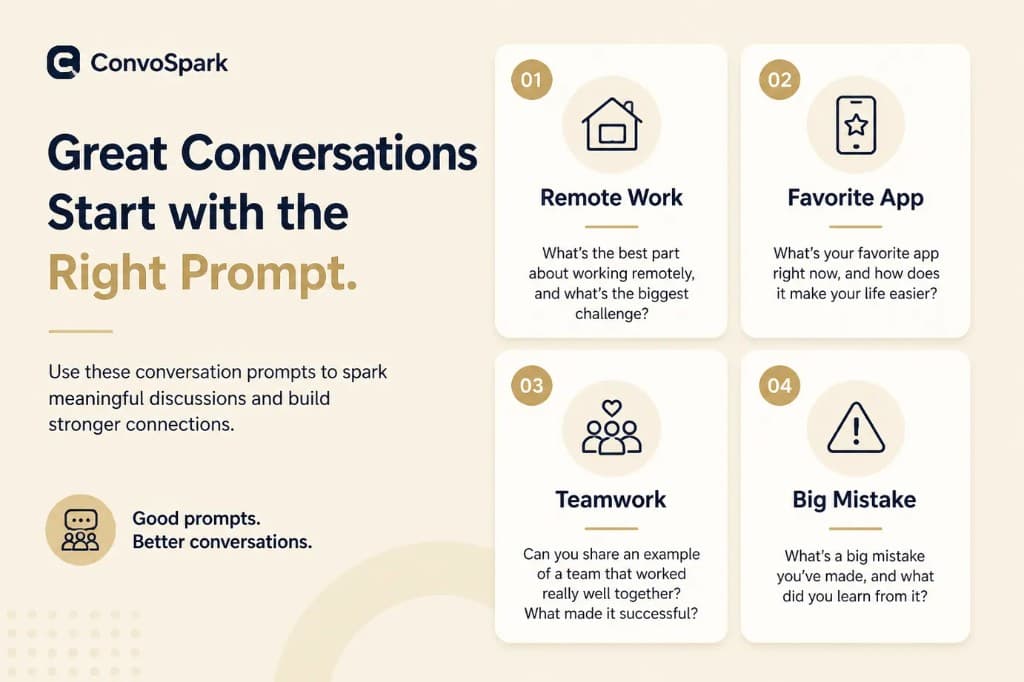
Impromptu prompts help you think faster and answer with structure.
The PREP Framework
PREP stands for Point, Reason, Example, Point.
Use it when you need a clear answer fast.
- Point: State your answer.
- Reason: Explain why.
- Example: Give a quick example.
- Point: Repeat the main idea.
Prompt: Should students learn public speaking?
Answer structure:
- Point: Yes, students should learn public speaking early.
- Reason: It helps them explain ideas clearly and build confidence.
- Example: A student who can present a project well is better prepared for interviews and group work.
- Point: Public speaking is not just for speeches. It is a life skill.
Simple. Clean. Strong.
The Past, Present, Future Framework
Use this when talking about progress, projects, or personal stories.
- Past: What was happening before?
- Present: What is happening now?
- Future: What comes next?
Prompt: Tell us about your experience with teamwork.
Answer:
- Past: In my first group project, I waited too long to speak up.
- Present: Now I try to clarify roles early and give updates before problems grow.
- Future: I want to keep building that habit in larger teams.
This structure is great for interviews and work updates.
The Problem, Action, Result Framework
Use this for stories and examples.
- Problem: What was the challenge?
- Action: What did you do?
- Result: What changed?
Prompt: Describe a time you handled pressure.
Answer:
- Problem: A presentation file broke ten minutes before class.
- Action: I used my notes, simplified the talk, and focused on the key points.
- Result: The presentation was not perfect, but the audience understood the message and I learned to prepare backups.
Strong answers are not long. They are structured.
Record Yourself Without Making It Weird
Recording yourself is one of the fastest ways to improve public speaking. It is also the practice people avoid the most.
The first few recordings may feel uncomfortable. That is normal.
Most people are not used to seeing or hearing themselves. Your voice may sound different. Your facial expressions may surprise you. You may notice filler words you never heard before.
Good. That is data.
Data helps you improve.
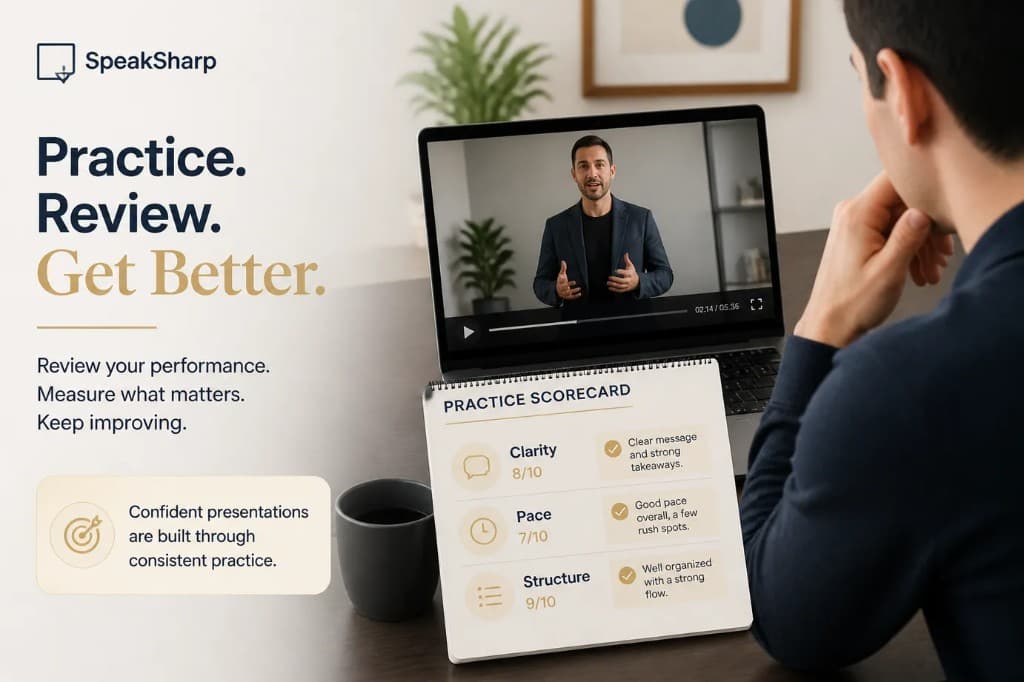
Recording turns vague nerves into useful data you can improve.
What to Look For in a Recording
Do not review like a critic. Review like a coach.
Use this checklist:
Clarity
- Can I explain my main point in one sentence?
- Did I stay on topic?
- Did I use examples?
- Did I avoid over-explaining?
Pace
- Did I rush the beginning?
- Did I pause after important points?
- Did my words run together?
- Could a listener take notes easily?
Voice
- Did I sound engaged?
- Did my tone change naturally?
- Did I end sentences with confidence?
- Did I trail off?
Body Language
- Was my posture open?
- Did I look at the camera or audience?
- Did I fidget too much?
- Did my face match the message?
Structure
- Did I have an opening?
- Did I use signposts like first, next, and finally?
- Did I close clearly?
- Did the ending feel finished?
The One-Watch Rule
Watch your recording once for learning. Not five times for punishment.
Write down:
- One thing that worked
- One thing to improve
- One next action
Example:
- Worked: My example was clear.
- Improve: I rushed the opening.
- Next action: Pause after the first sentence tomorrow.
This keeps practice healthy. It also protects your confidence.
Get Better Feedback With AI
Feedback matters. But not everyone has a coach, teacher, manager, or friend available every day.
AI feedback can help fill that gap.
You can practice privately, get quick notes, and track patterns over time. That makes public speaking practice easier to start and easier to stick with.
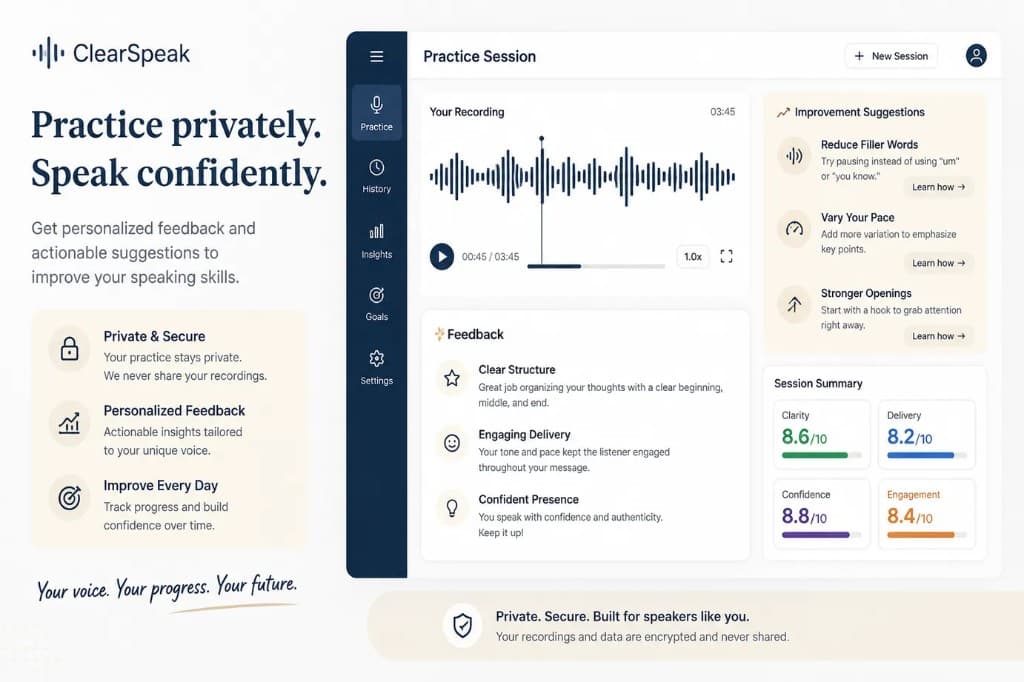
AI feedback can help you spot patterns, tighten answers, and practice privately.
What AI Feedback Can Help With
AI can help you spot practical speaking patterns, such as:
- Filler word frequency
- Speaking pace
- Repeated phrases
- Long or unclear sentences
- Weak structure
- Missing examples
- Vague endings
- Tone and confidence signals
- Interview answer strength
It can also suggest better versions of your answer.
For example, if your response is too long, AI can help tighten it. If your opening is weak, AI can suggest a stronger hook. If your answer lacks structure, AI can recommend PREP or Problem, Action, Result.
Keep Your Practice Private
Privacy matters, especially when you are practicing sensitive topics like interviews, work presentations, school assignments, or personal stories.
Choose tools and habits that help you stay in control:
- Practice in a quiet space.
- Avoid sharing recordings publicly unless you choose to.
- Review privacy settings before uploading video or audio.
- Delete practice files you no longer need.
- Use private drafts for rough answers.
The best practice space is one where you feel safe enough to sound messy.
Messy practice creates polished performance.
How to Structure Any Speech
A strong speech does not need to be complicated. Most good talks follow a simple path.
Opening. Main points. Examples. Close.
That is enough.
Step 1: Start With the Main Idea
Do not warm up for too long. Say what the talk is about.
Weak opening:
Hi, my name is Alex, and today I am going to talk about a few things related to time management and productivity.
Stronger opening:
Most people do not need more time. They need fewer distractions.
That second version gives the audience a reason to listen.
Step 2: Give the Audience a Map
Tell people where you are going.
Example:
I will cover three habits: planning tomorrow today, protecting focus time, and ending the day with a quick review.
Now the audience can follow you.
Step 3: Use One Example Per Point
Examples make ideas stick.
If your point is protect focus time, give a concrete example:
Every morning from 9 to 10, I turn off notifications and work on the hardest task first. That one hour usually creates more progress than three distracted hours later.
That is memorable because it is specific.
Step 4: Close With a Clear Final Line
Do not fade out with so yeah or that is all.
End strong.
Examples:
- Start with one focused hour tomorrow.
- Confidence does not come before practice. It comes from practice.
- If you want clearer answers, give yourself a structure before you speak.
- The goal is not to be perfect. The goal is to be understood.
A final line tells the audience the message is complete.
Voice, Pace, and Presence: Small Fixes That Work
You do not need a dramatic speaking voice. You need a voice people can follow.
Slow Down the First 10 Seconds
Nervous speakers often rush the opening. That makes the whole talk feel out of control.
Fix it with a simple rule: say the first sentence 20 percent slower than normal.
This gives your brain time to settle. It also makes you sound more confident immediately.
Pause After Important Points
A pause is not a mistake. It is a tool.
Pause after:
- Your opening line
- A key statistic
- A personal story moment
- A transition
- Your final sentence
Pauses help the audience absorb your message. They also help you breathe.
Use Energy, Not Speed
Many speakers confuse energy with talking fast.
Energy comes from vocal variety, clear emphasis, and caring about the message.
Try saying this sentence three ways:
Public speaking improves when you practice every day.
Emphasize public speaking. Then practice. Then every day.
Same sentence. Different meaning. Better control.
Stand or Sit Like You Mean It
Your body sends signals before your words land.
Quick fixes:
- Put both feet on the floor.
- Relax your shoulders.
- Keep your chest open.
- Unclench your jaw.
- Look at one person or the camera lens.
- Let your hands reset at your sides or on the table.
You are not trying to look perfect. You are trying to look present.

Calm presence starts before the first word.
Public Speaking for Different Situations
Public speaking shows up in different forms. Each one needs a slightly different strategy.
For Students
Focus on clarity and preparation.
Practice:
- Explaining your topic in 60 seconds
- Defining key terms simply
- Giving one example for each main point
- Answering likely teacher questions
- Ending without saying you are done
Student prompt:
Explain why your project matters to someone who has never studied the topic.
For Professionals
Focus on being concise and useful.
Practice:
- Giving a 30-second project update
- Summarizing a problem and next step
- Asking a clear question in a meeting
- Presenting one recommendation with evidence
- Handling follow-up questions calmly
Work prompt:
Give your manager a one-minute update on a project that is behind schedule.
Use this structure:
- What changed
- What you are doing
- What support you need
For Interview Candidates
Focus on structured stories.
Practice common prompts:
- Tell me about yourself.
- Why do you want this role?
- Describe a challenge you handled.
- Tell me about a time you worked with a difficult person.
- What is your biggest strength?
Use Problem, Action, Result for experience questions. Keep answers under two minutes unless asked for more detail.
Interview answer rule: answer the question first, then add the story.
For Nervous Speakers
Focus on safety and repetition.
Start private. Start short. Start easy.
Try these low-pressure reps:
- Read a paragraph out loud.
- Record a 30-second opinion.
- Explain your morning routine.
- Summarize a video you watched.
- Practice one introduction five times.
You are not behind. You are training your nervous system to learn that speaking is survivable.
That takes reps, not judgment.
How to Stop Rambling
Rambling happens when your mouth starts before your structure does.
Use a quick pause before answering. Then choose a frame.
The 3-Point Rule
If you have a lot to say, limit yourself to three points.
Example:
There are three reasons I recommend this approach: it is faster, easier to measure, and less stressful for the team.
Now you have a path.
The Headline First Rule
Start with the headline, then explain.
Instead of:
Well, there are a lot of factors, and I guess one thing is the timeline, but also the budget...
Say:
My recommendation is to delay the launch by one week so we can fix the onboarding issue.
Then explain why.
Clear first. Details second.
The Stop Signal
Prepare a closing phrase so you know when to stop.
Examples:
- That is the main reason I would choose this option.
- So my recommendation is to move forward with the smaller test.
- That is the lesson I took from the experience.
- In short, the next step is to practice daily and review one thing at a time.
A stop signal prevents nervous over-talking.
A 30-Day Public Speaking Improvement Plan
Here is a simple plan you can follow for one month.
No complicated setup. Just daily reps.
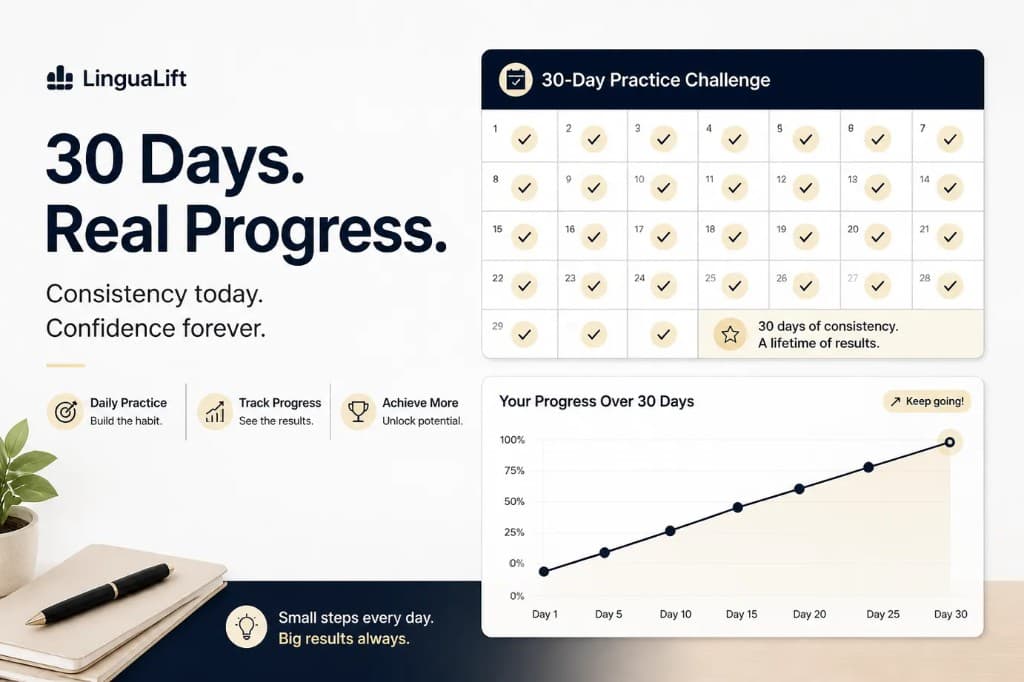
Track reps, review one thing, and watch confidence grow over 30 days.
Week 1: Get Comfortable Hearing Yourself
Goal: reduce awkwardness and build consistency.
Daily practice:
- Record 60 seconds.
- Use easy prompts.
- Watch once.
- Write one win and one fix.
Prompts:
- What is your favorite way to learn?
- Describe your ideal weekend.
- Explain a tool you use often.
- What is one habit you want to build?
- Summarize your day in one minute.
Metric to track: Did you practice today? Yes or no.
Week 2: Build Structure
Goal: make answers easier to follow.
Daily practice:
- Use PREP or Problem, Action, Result.
- Speak for 90 seconds.
- Record and review structure.
Prompts:
- Should meetings be shorter?
- Tell me about a time you solved a problem.
- What makes a good teammate?
- Explain a recent decision you made.
- What is one thing schools should teach more often?
Metric to track: Did your answer have a clear opening, example, and ending?
Week 3: Improve Delivery
Goal: sound calmer and more confident.
Daily practice:
- Speak for two minutes.
- Slow the first sentence.
- Add three intentional pauses.
- Review pace and voice.
Prompts:
- Teach a beginner how to start exercising.
- Give a project update.
- Recommend a book, movie, or podcast.
- Explain a mistake that helped you grow.
- Pitch an idea for improving your workplace or school.
Metric to track: Did you pause after key points?
Week 4: Practice Real-World Scenarios
Goal: transfer practice into life.
Daily practice:
- Choose a real situation.
- Record a full answer or mini-presentation.
- Ask for AI feedback or self-review.
- Repeat the improved version once.
Scenarios:
- A job interview answer
- A meeting update
- A class presentation opening
- A networking introduction
- A tough question from an audience
Metric to track: What improved from take one to take two?
By day 30, you will have dozens of reps. That matters. Confidence grows when you can point to proof.
How to Measure Public Speaking Progress
If you cannot measure it, it feels vague. If it feels vague, it is easy to quit.
Track simple signals.
Speaking Metrics That Matter
Use a basic score from 1 to 5 for each category:
- Clarity: Was my main point easy to understand?
- Structure: Did my answer have a beginning, middle, and end?
- Pace: Was I easy to follow?
- Confidence: Did I sound steady?
- Concision: Did I avoid rambling?
Do not obsess over the number. Watch the trend.
If your clarity moves from 2 to 4 over a month, that is real progress.
Track Reps, Not Feelings
Some days you will feel confident. Some days you will not.
Practice anyway.
The most important metric is completed reps.
A speaker who practices 20 short sessions will usually improve faster than a speaker who waits for one perfect three-hour practice block.
Reps win.
Common Public Speaking Mistakes to Avoid
Memorizing Every Word
Memorizing can make you sound robotic. It can also cause panic if you forget one line.
Instead, memorize your structure:
- Opening
- Three points
- Key examples
- Closing line
Know the path, not every step.
Starting With an Apology
Avoid openings like:
- Sorry, I am nervous.
- I did not have much time.
- This might not be very good.
You may think it lowers expectations. It actually lowers trust.
Start with the message.
Practicing Only in Your Head
Thinking about speaking is not the same as speaking.
You need to say the words out loud. Your mouth, breath, and brain need the reps together.
Ignoring the Ending
Many speakers practice the beginning and forget the close.
Your ending is the last thing the audience hears. Make it count.
Prepare one strong final sentence.
Quick Public Speaking Exercises You Can Do Today
Here are fast exercises that work.
The 60-Second Explain It Drill
Pick any object near you. Explain why it is useful in one minute.
Examples:
- A notebook
- A water bottle
- A calendar app
- A backpack
- A pair of headphones
Goal: make a simple topic clear and interesting.
The No Filler Challenge
Speak for one minute without using filler words.
If you need time, pause instead.
Goal: replace filler with silence.
The Strong Opening Drill
Write three openings for the same topic.
Topic: daily exercise
Openings:
- Ten minutes of movement can change the rest of your day.
- Most people make exercise too complicated.
- You do not need more motivation. You need a smaller starting point.
Goal: start with energy.
The Two-Take Upgrade
Record an answer once. Review it. Record it again immediately.
Goal: prove that feedback works fast.
This is one of the best confidence builders because improvement is visible in minutes.
Final Thoughts: Confidence Comes From Proof
Public speaking confidence is not magic. It is evidence.
Evidence that you can start.
Evidence that you can recover.
Evidence that you can explain an idea clearly.
Evidence that one imperfect rep does not define you.
You build that evidence through small daily practice, impromptu prompts, recording, self-review, and smart feedback.
Keep it private when you need to. Keep it simple when you feel nervous. Keep it measurable so you can see progress.
One prompt. One recording. One improvement.
Do that today.
Then do it again tomorrow.
That is how public speaking gets easier.
Ready to practice?
Spin a random topic, speak for 60 seconds, and listen back - free while we're in early access.