Public Speaking: A Practical Guide to Speaking Clearly, Confidently, and On Demand
Improve public speaking with one-minute daily practice, record-review-repeat, speech structure, filler-word fixes, interview answers, and a 7-day plan.
Public speaking is not a talent you either have or do not have.
It is a trainable skill.
You get better the same way you get better at fitness, writing, or sales calls. You repeat the basics. You track what improves. You stop waiting until the big moment to practice.
Most people only practice speaking when the pressure is high. A presentation. A job interview. A team meeting. A wedding toast. A hard conversation.
That is why it feels scary.
The fix is simple. Not always easy. But simple.
Practice in low-pressure reps. Record yourself. Review one thing. Repeat tomorrow.
This guide gives you a practical system for improving public speaking, impromptu answers, confidence, filler words, structure, and delivery. No fluff. No theory marathon. Just clear steps you can use today.
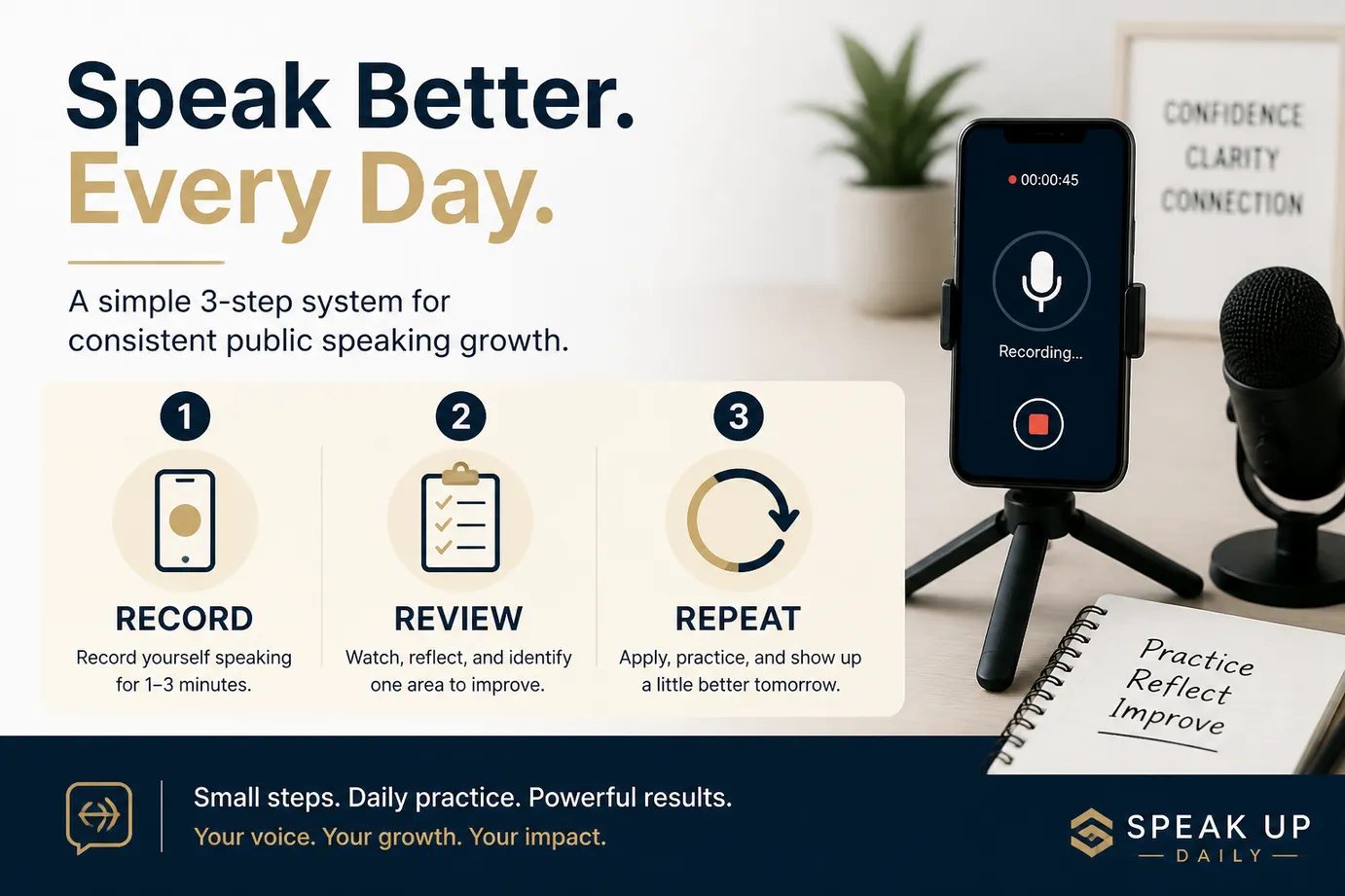
The fastest improvement comes from a simple loop: record, review, repeat.
What Is Public Speaking?
Public speaking is the act of communicating a message to an audience.
That audience might be 500 people in a conference hall. It might be five teammates on a video call. It might be one interviewer asking, Tell me about yourself.
Public speaking includes:
- Presentations
- Meetings
- Interviews
- Pitches
- Toasts
- Panels
- Training sessions
- Sales calls
- Video updates
- Impromptu answers
- Leadership communication
The format changes. The core skill stays the same.
You need to think clearly, structure fast, speak with energy, and land the point.
That is public speaking.
Why Public Speaking Feels Hard
Public speaking feels hard because it combines three pressures at once.
First, you have to think. What am I trying to say?
Second, you have to perform. How do I sound? How do I look? Are people judging me?
Third, you have to adapt. Are they engaged? Did that answer work? Should I keep going?
Your brain treats this like danger. Your heart rate rises. Your breathing changes. Your voice tightens. Your thoughts speed up.
Then the filler words arrive.
Um. Like. You know. So. Basically. Kind of.
This does not mean you are bad at speaking. It means your system is overloaded.
Good public speakers are not people who feel zero nerves. They are people who have practiced enough that the basics stay online under pressure.
That is the goal.
The Public Speaking Skill Stack
If you want to improve fast, do not try to fix everything at once.
Build the skill stack.
1. Clarity
Can you explain your idea in one sentence?
If not, your speech will wander.
Clarity comes before confidence. A clear point makes delivery easier.
Use this prompt:
- My main point is...
- The audience should remember...
- I want them to do...
Example:
Weak: I want to talk about productivity and meetings and how we can work better.
Strong: Our team should replace status meetings with written updates so we can save three hours per week.
2. Structure
Structure keeps you calm.
When you know the path, you stop guessing mid-sentence.
A simple structure is better than a clever one.
Use one of these:
- Point, reason, example, point
- Problem, solution, next step
- Past, present, future
- What, so what, now what
- Answer, evidence, action
3. Delivery
Delivery is how your message feels.
It includes pace, pauses, volume, facial expression, posture, and emphasis.
Strong delivery does not mean acting fake. It means removing friction so people can hear the point.
4. Presence
Presence is attention.
You are not trapped inside your head. You are with the audience.
Presence improves when you breathe, pause, make eye contact, and stop rushing.
5. Repetition
One great practice session will not change your speaking.
Small daily reps will.
One minute a day is enough to start. Especially if you record it.
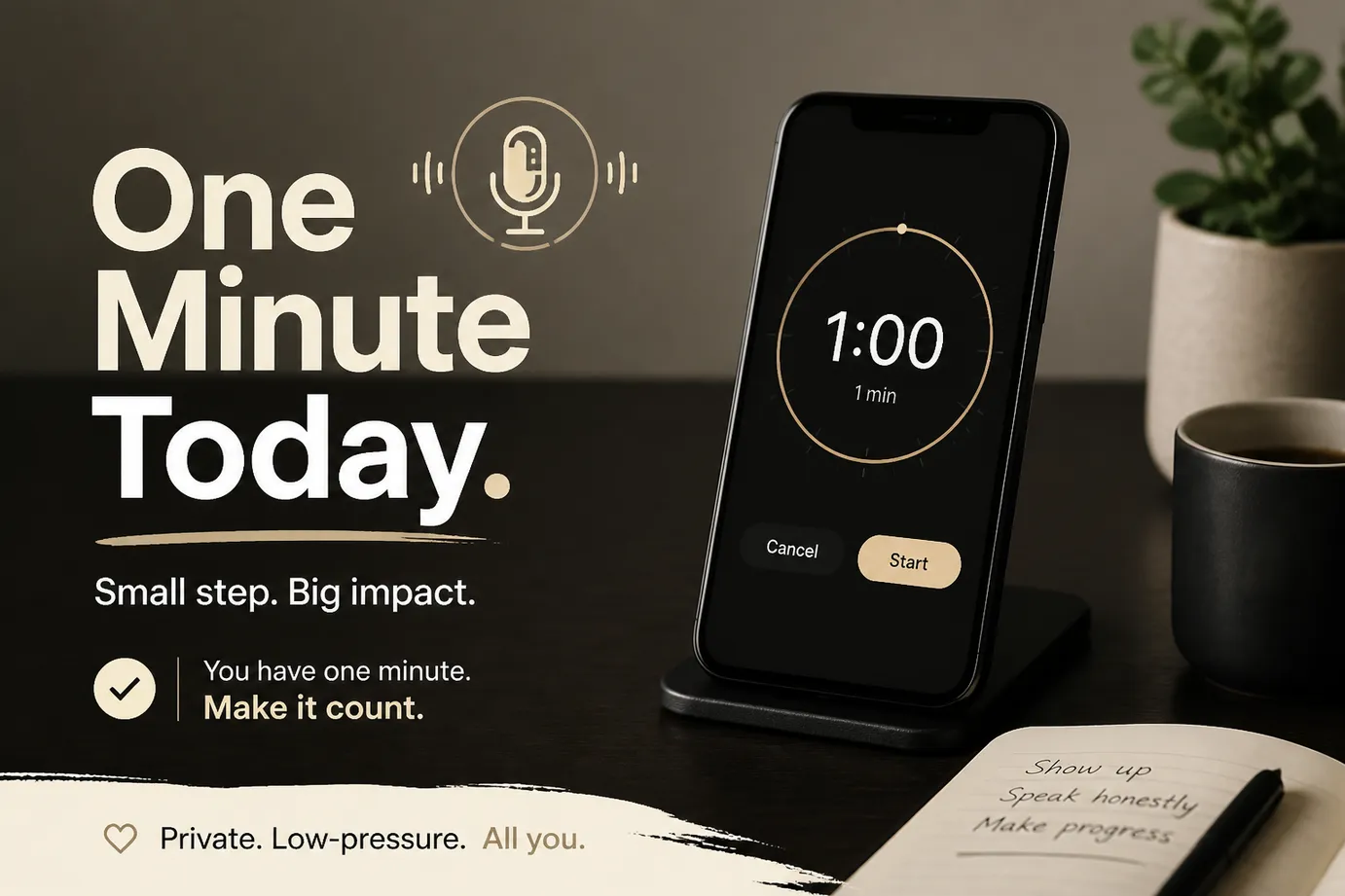
One minute a day is enough to build momentum.
The Fastest Way to Improve Public Speaking
Record yourself.
That is the move.
Not because you need to become obsessed with your face or voice. You do not.
You record because memory lies.
You may think you rambled for five minutes. The video says it was 68 seconds.
You may think you sounded awkward. The recording says you sounded clear but rushed.
You may think you used filler words constantly. The recording says you used 12 in one minute, mostly when switching ideas.
Now you have data.
Data beats anxiety.
The Record, Review, Repeat Method
Use this simple loop.
Step 1: Record a short answer
Pick one prompt. Speak for 60 seconds.
Examples:
- Introduce yourself.
- Explain a project you are proud of.
- Share one lesson from this week.
- Answer: Why are you interested in this role?
- Explain a complex idea simply.
- Give your opinion on remote work.
Step 2: Review only one thing
Do not review everything. That creates overload.
Pick one focus:
- Did I have a clear point?
- Did I pause instead of saying um?
- Did I speak too fast?
- Did I end with confidence?
- Did I give a concrete example?
Step 3: Repeat the same prompt
Do it again immediately.
This is where improvement happens.
The second version is almost always better. Cleaner. Shorter. Calmer.
Step 4: Track one metric
Keep it simple.
Track one of these:
- Filler words per minute
- Number of pauses
- Answer length
- Clarity score from 1 to 5
- Energy score from 1 to 5
- Whether you used a structure
You do not need a studio. You do not need an audience. You need a phone, a quiet minute, and the honesty to watch yourself once.
Privacy matters here. Practice should feel safe. Keep recordings private. Delete them after review if you want. The goal is growth, not performance for the internet.
How to Structure Any Speech
A strong speech has a spine.
Without a spine, even good ideas collapse.
Use this basic structure for almost anything.
Opening: Say the point early
Do not warm up forever.
Start with the message.
Example:
Today I want to show why our onboarding process needs to be shorter, clearer, and more hands-on.
That opening works because it tells people what to listen for.
Middle: Support the point
Give reasons, examples, or stories.
A good middle answers: Why should they believe me?
Example:
Right now, new hires spend their first week reading documents. But they do not meet customers until week three. That slows learning. It also makes the work feel abstract. If we pair each new hire with a customer call in week one, they will understand the product faster.
End: Land the plane
Do not fade out.
End with a clear final sentence.
Examples:
- My recommendation is simple: pilot this for 30 days and measure ramp time.
- If we want better meetings, we need fewer updates and more decisions.
- That is why I believe this role is a strong fit for my skills and goals.
A strong ending makes you sound prepared, even when the answer was spontaneous.
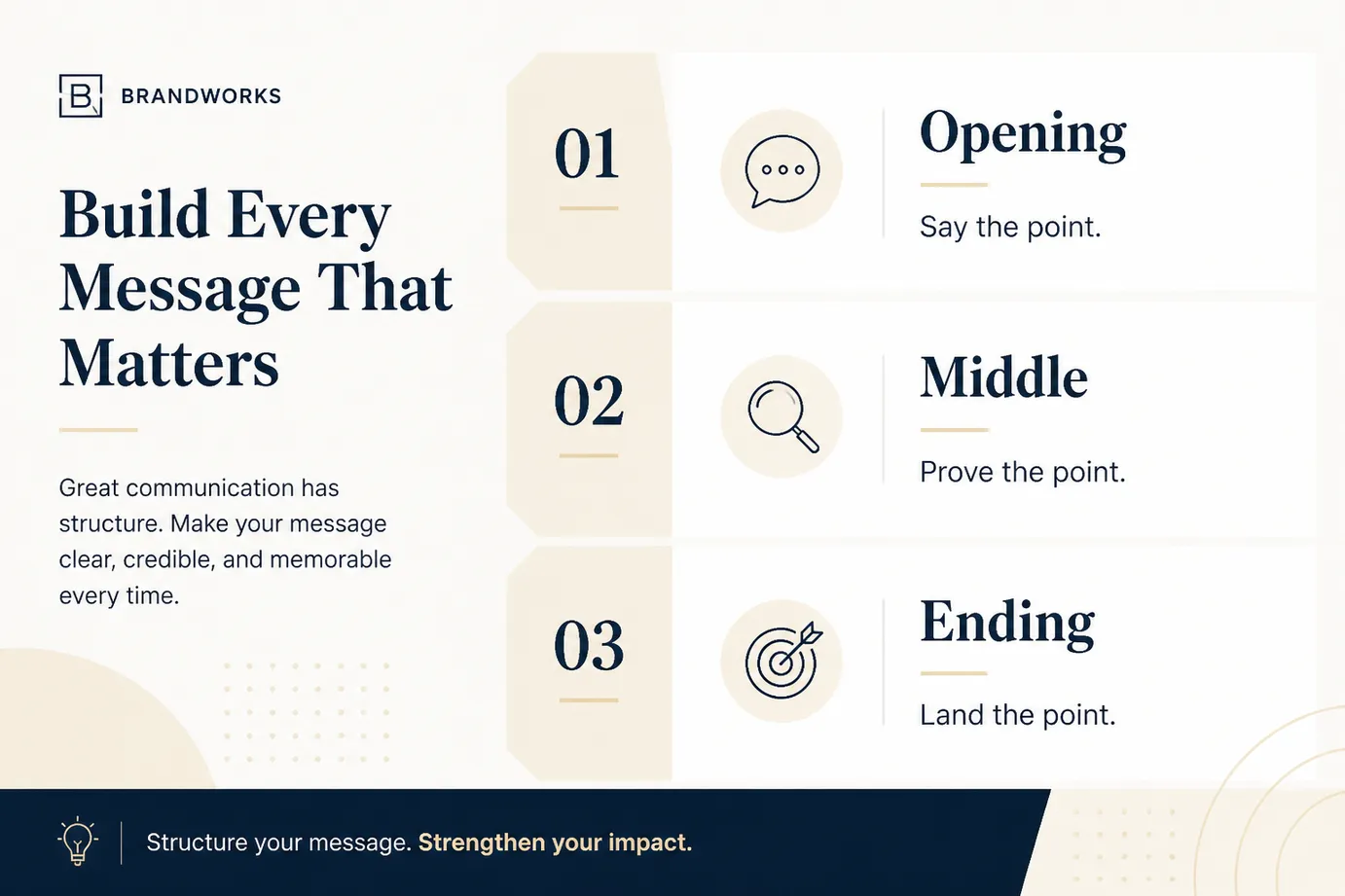
A simple structure keeps your message clear under pressure.
How to Speak Impromptu Without Rambling
Impromptu speaking is where many people panic.
A question comes at you. Your brain jumps in five directions. You start talking before you know the point. Then you chase the sentence.
Stop.
Use a framework.
The PREP Framework
PREP stands for:
- Point
- Reason
- Example
- Point
It is simple. It works everywhere.
Question: Should companies use more asynchronous communication?
Answer:
Point: Yes, I think most teams should use more asynchronous communication.
Reason: It protects focus and reduces unnecessary meetings.
Example: On one project, we replaced daily status calls with written updates. The team saved time and still caught blockers early.
Point: So I would not remove meetings completely, but I would make async the default for updates.
That is a complete answer. Clear. Short. Strong.
The 3-Part Opinion Framework
Use this when someone asks what you think.
- My view is...
- The main reason is...
- A good next step would be...
Example:
My view is that our pricing page needs to be simpler. The main reason is that buyers should understand the plan difference in under 30 seconds. A good next step would be testing a shorter version with three clear comparison points.
The Past, Present, Future Framework
Use this for progress updates, career stories, and change topics.
Example:
In the past, our support process was reactive. Today, we have better tagging and faster routing. Next, I would focus on preventing repeat issues through better help content.
Frameworks do not make you robotic. They make you reliable.
How to Reduce Filler Words
Filler words are not evil.
A few are normal. Humans use them.
But too many fillers weaken your message. They make you sound unsure. They also hide the real issue: you need a pause.
Most filler words are failed pauses.
Step 1: Find your filler pattern
Record one minute. Count your fillers.
Common fillers include:
- Um
- Uh
- Like
- You know
- So
- Basically
- Actually
- I mean
- Kind of
- Sort of
Do not judge yourself. Count them.
Step 2: Replace fillers with silence
Silence feels longer to you than it does to the listener.
A one-second pause sounds confident.
Practice this:
Say one sentence. Pause. Say the next sentence.
Example:
Weak: So I think we should basically move the launch because we kind of need more time.
Strong: I think we should move the launch. Pause. We need more time to test the checkout flow.
The second version is shorter and stronger.
Step 3: Slow the transition points
Fillers often appear when you switch ideas.
Use transition phrases instead:
- The main reason is...
- For example...
- Here is the tradeoff...
- My recommendation is...
- The next step is...
These phrases buy time and add structure.
Step 4: Practice with a filler-word target
Set a realistic goal.
If you use 20 fillers per minute, aim for 15. Then 10. Then 5.
Progress beats perfection.
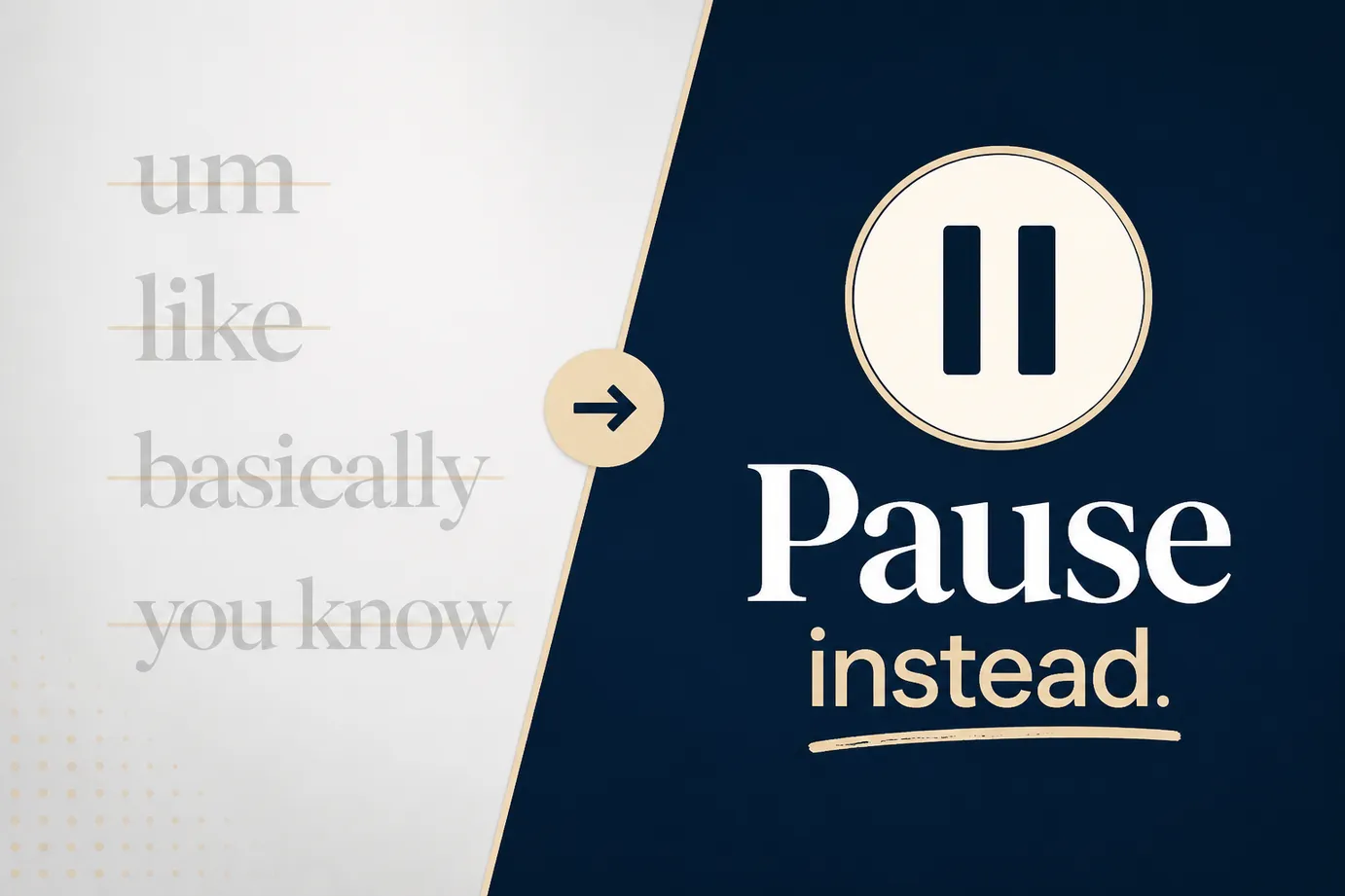
Most filler words are failed pauses. Practice silence.
How to Build Confidence in Public Speaking
Confidence is not a mood.
Confidence is evidence.
You build it by proving to yourself that you can handle the moment.
Keep promises small
Do not start with a 20-minute speech.
Start with one minute.
Say: I will record one answer today.
Then do it.
Small kept promises build self-trust.
Practice before you feel ready
Readiness usually comes after action.
If you wait until you feel confident, you will practice less. If you practice daily, confidence starts to catch up.
Use private reps
Low-pressure practice matters.
You can improve without posting online, joining a club immediately, or asking coworkers for feedback before you are ready.
Private practice gives you room to be bad safely. That is important.
Bad first drafts are part of the process.
Make improvement visible
Save one recording from this week. Save one from next week.
Compare them.
You will hear the difference.
Maybe your pace is better. Maybe your answer has a clearer opening. Maybe you smile more. Maybe you stop apologizing before your point.
Visible progress creates confidence.
Public Speaking for Job Interviews
Interviews are public speaking in disguise.
You need clear answers, strong examples, and calm delivery.
The best interview answers do three things:
- Answer the question directly.
- Prove the answer with a specific example.
- Connect back to the role.
Use the STAR-L framework
STAR is useful. Add L for lesson.
- Situation
- Task
- Action
- Result
- Lesson
Question: Tell me about a time you handled conflict.
Answer:
Situation: In my last role, two teams disagreed about launch priorities.
Task: I needed to help us make a decision without slowing the release.
Action: I gathered the key risks, set up a 30-minute decision meeting, and asked each team to bring one recommendation.
Result: We chose a smaller launch scope and shipped on time.
Lesson: I learned that conflict gets easier when you make the decision criteria clear.
That answer is structured. It gives proof. It does not ramble.
Practice common interview prompts
Record 60 to 90 second answers to these:
- Tell me about yourself.
- Why this company?
- Why this role?
- What is a strength you bring?
- Tell me about a failure.
- Describe a time you led a project.
- What are you working to improve?
Do not memorize scripts word for word.
Memorized answers break under pressure.
Instead, memorize the structure and key points.
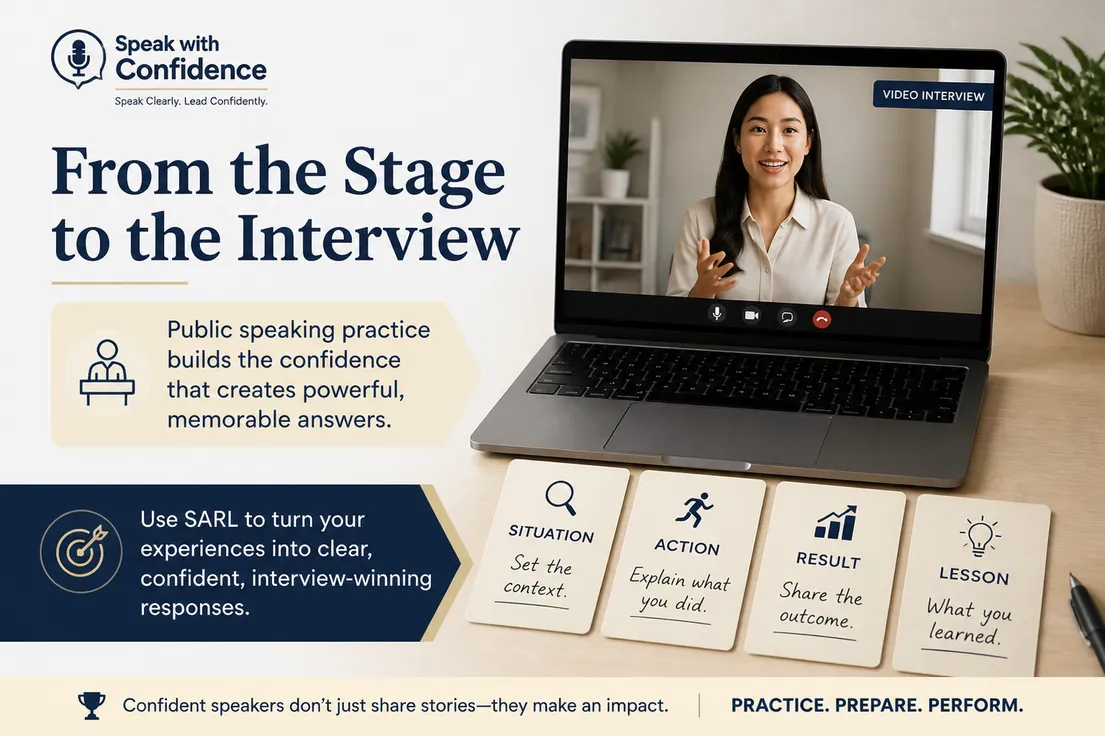
Strong interview answers are structured, specific, and role-focused.
Public Speaking for Meetings
Meetings reward concise speakers.
The person who can state the issue, name the decision, and recommend the next step becomes valuable fast.
Use this meeting update format:
- Here is the status.
- Here is the risk.
- Here is the decision or next step.
Example:
The redesign is on track for Friday. The main risk is that legal has not approved the new claims section. My recommendation is that we send them a shorter version today and ask for approval by tomorrow noon.
That is useful.
No rambling. No hiding. No vague update.
Speak earlier
If you wait too long, pressure builds.
Say one useful thing in the first 10 minutes.
Ask a clarifying question. Summarize a decision. Offer a next step.
Early reps reduce anxiety.
Prepare one sentence before the meeting
Before any meeting, write one sentence:
The most useful thing I can contribute is...
Now you have a target.
How to Practice Public Speaking in One Minute a Day
You do not need a perfect routine.
You need a repeatable one.
Here is a seven-day plan.
Day 1: Introduce yourself
Prompt: Tell me who you are and what you do.
Focus: Clear opening.
Day 2: Explain one idea
Prompt: Explain a tool, habit, or concept you use often.
Focus: Simple language.
Day 3: Share a win
Prompt: Talk about something that went well recently.
Focus: Specific example.
Day 4: Give an opinion
Prompt: What is one work habit more people should adopt?
Focus: PREP structure.
Day 5: Answer an interview question
Prompt: Tell me about a challenge you handled.
Focus: STAR-L structure.
Day 6: Reduce fillers
Prompt: Repeat any earlier prompt.
Focus: Pause instead of using filler words.
Day 7: Compare and repeat
Prompt: Repeat Day 1.
Focus: Notice improvement.
This plan is small on purpose.
Small gets done.
Done compounds.
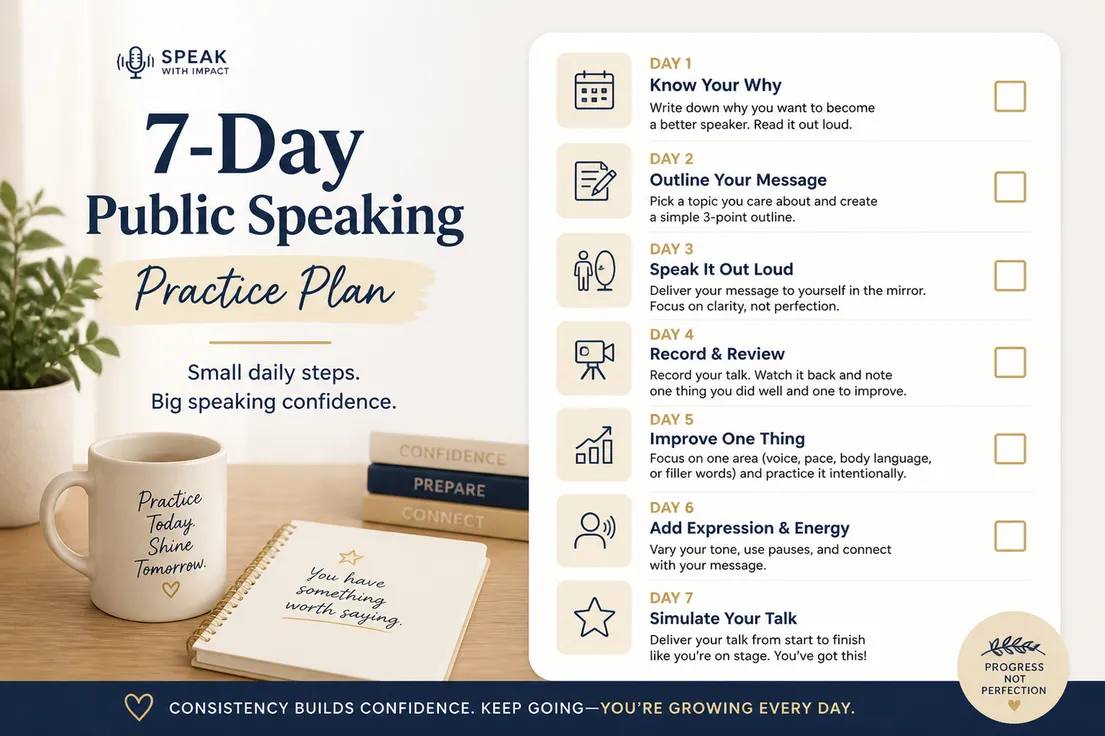
Small daily reps compound into visible speaking improvement.
Common Public Speaking Mistakes
Most speaking mistakes are fixable once you can see them.
Mistake 1: Starting before you know the point
Take two seconds.
Think: What is my answer in one sentence?
Then speak.
Mistake 2: Trying to sound smart
Clear beats fancy.
Use plain words. Short sentences. Concrete examples.
Mistake 3: Over-apologizing
Do not start with:
- Sorry, this might be wrong.
- I am not an expert, but...
- This may not make sense.
You can be humble without weakening your point.
Try:
- My current view is...
- One option is...
- Based on what I have seen...
Mistake 4: Ending weakly
Avoid trailing off with:
- So yeah...
- That is it, I guess.
- Does that make sense?
Use a closing line:
- That is the recommendation.
- That is the main reason I would choose option two.
- The next step is to test this with five users.
Mistake 5: Practicing only in your head
Thinking is not speaking.
You need reps out loud.
Your mouth, breath, and pacing need practice too.
A Simple Public Speaking Practice Template
Use this template for your next practice session.
Prompt
What question am I answering?
Structure
Which framework will I use?
First take
Record 60 seconds.
Review
Score yourself from 1 to 5:
- Clear point
- Strong structure
- Calm pace
- Low fillers
- Confident ending
Second take
Record again.
Note
Write one sentence:
Tomorrow I will improve...
That is enough.
You do not need a long journal. You need a feedback loop.
Advanced Tips for Stronger Delivery
Once your structure improves, refine delivery.
Use pauses for power
Pause before important points.
Pause after important points.
People need time to absorb what you said.
Vary your pace
Slow down for key ideas. Speed up slightly for lighter context.
A flat pace makes even good content feel dull.
Emphasize the final words
Do not let your volume drop at the end of sentences.
Land the last word.
Example:
Weak: I think this will help us reduce churn.
Strong: I think this will help us reduce churn.
Same words. Better finish.
Use your face
If you look bored by your own message, the audience will follow.
You do not need fake enthusiasm. Just let your face match the point.
Stand or sit with intention
Plant your feet. Relax your shoulders. Keep your chest open.
Posture affects breath. Breath affects voice. Voice affects confidence.
How Long Does It Take to Get Better at Public Speaking?
You can feel improvement in one session.
You can hear improvement in one week.
You can become noticeably stronger in 30 days.
But only if you practice consistently.
A realistic 30-day goal:
- Record 20 one-minute answers.
- Reduce fillers by 30 percent.
- Use a clear structure in most answers.
- Build three strong interview stories.
- Deliver one meeting update with confidence.
That is real progress.
Not magic. Not talent. Reps.
Your 10-Minute Public Speaking Reset
Use this before a presentation, interview, or important meeting.
Minute 1: Breathe
Inhale for four. Exhale for six. Repeat.
Longer exhales calm your system.
Minutes 2-3: Define the point
Write your main message in one sentence.
Minutes 4-5: Choose the structure
Pick the framework. Do not overthink it.
Minutes 6-7: Speak once out loud
Record if possible.
Minutes 8-9: Fix one thing
Maybe the opening. Maybe the ending. Maybe one example.
Minute 10: Repeat the first 30 seconds
The opening matters most. Nail the start and your nerves drop.
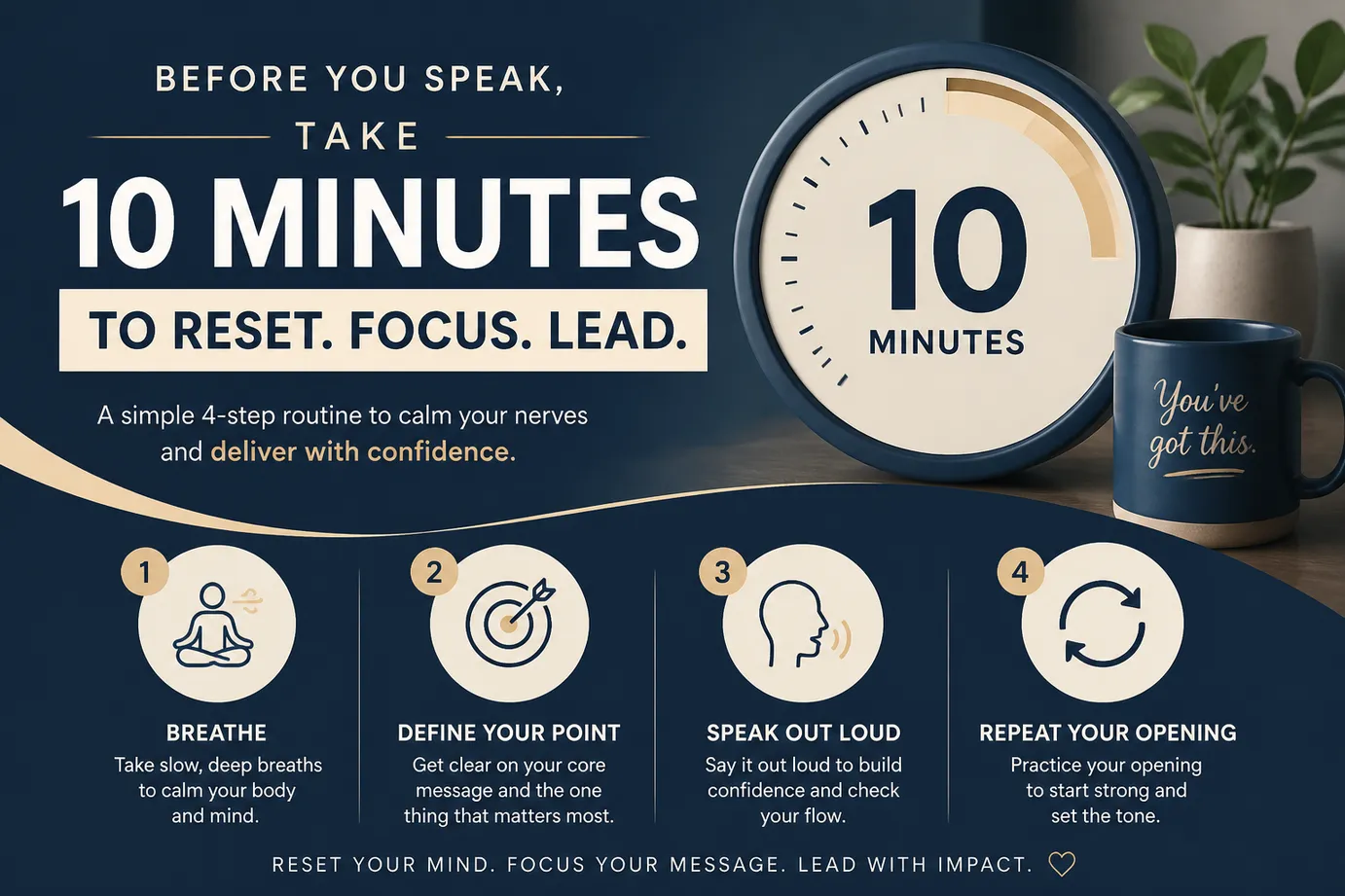
Use a quick reset before high-pressure speaking moments.
Final Takeaway: Public Speaking Gets Better When You Do It Daily
Public speaking is not reserved for natural performers.
It belongs to people who practice.
You do not need to become loud. You do not need to become perfect. You do not need to copy someone else.
You need to become clear.
Clear in your point. Clear in your structure. Clear in your delivery. Clear in your next step.
Start with one minute today.
Pick a prompt. Record your answer. Review one thing. Repeat it once.
Then do it again tomorrow.
That is how confidence grows.
Quietly. Privately. Measurably.
One rep at a time.
Ready to practice?
Spin a random topic, speak for 60 seconds, and listen back - free while we're in early access.