Public Speaking Practice: Daily Reps That Actually Work
A practical public speaking practice plan: one-minute daily reps, random topics, filler-word drills, simple structures, presence cues, streak tracking, and a 7-day starter plan.
Public speaking practice does not need a podium, a slide deck, or a terrified audience staring at you over stale conference coffee.
It needs reps.
Short ones. Daily ones. Slightly uncomfortable ones.
If you want to speak clearly in meetings, answer questions without rambling, pitch ideas with presence, or stop saying um every seven seconds, you do not need to become a different person. You need a simple practice system you can repeat when life is busy.
That is the whole game.
One minute. One topic. One small improvement.
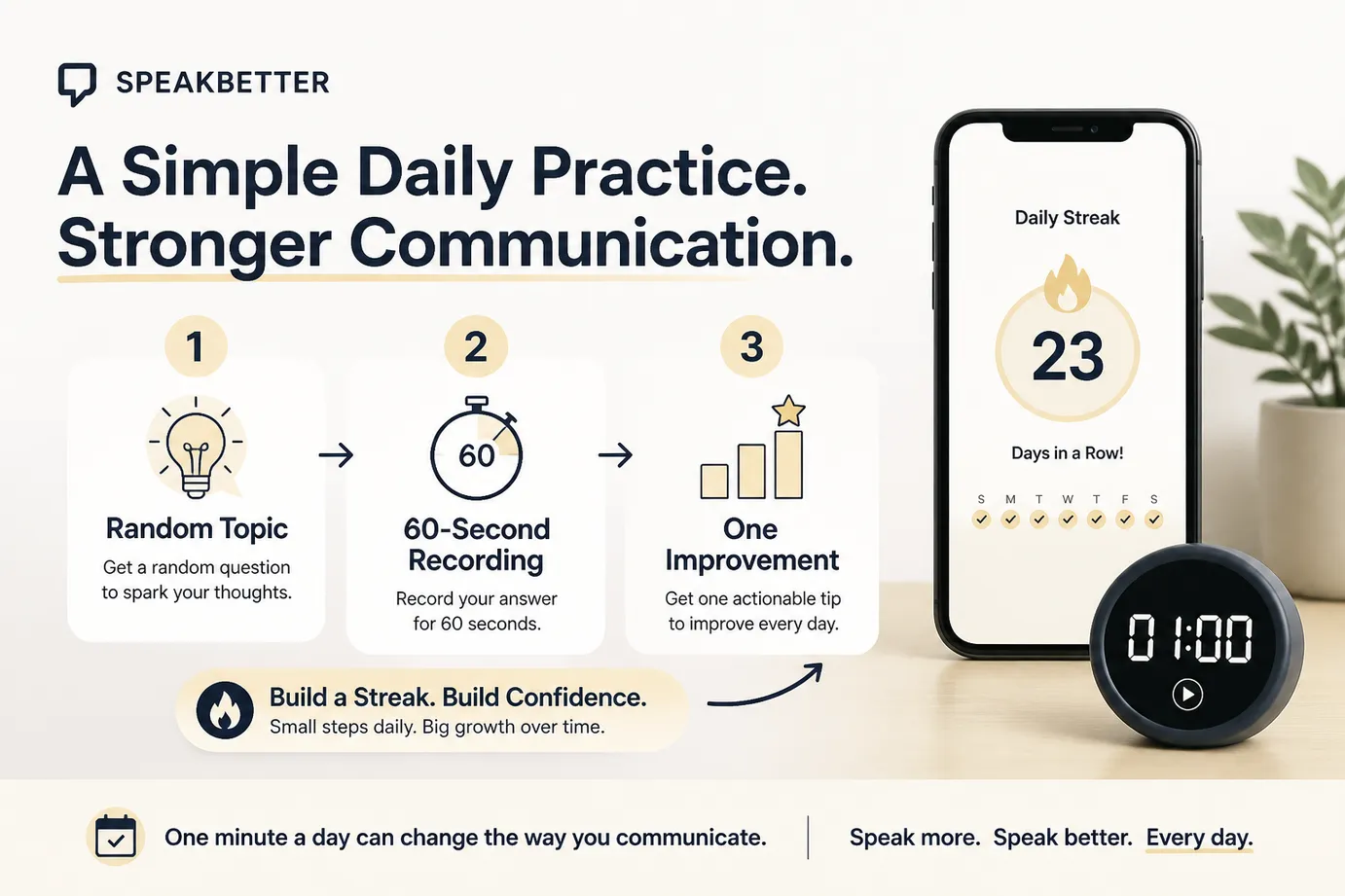
One minute a day is enough to build the speaking habit.
This guide gives you a practical plan for public speaking practice that builds confidence where it counts: in real-time, no-prep moments. You will learn how to practice impromptu speaking, reduce filler words, structure answers fast, sound more present, track progress, and build a streak without turning your calendar into a TED Talk bootcamp.
Let us get your reps in.
Why public speaking practice works
Public speaking confidence is not magic.
It is familiarity.
The more often you hear yourself think out loud, organize an idea, pause without panicking, and finish cleanly, the less your brain treats speaking as a threat.
Most people only practice when the stakes are already high:
- The presentation is tomorrow.
- The interview starts in ten minutes.
- The team meeting is already happening.
- Someone just said, what do you think?
That is like training for a marathon by sprinting after the starting gun.
Daily public speaking practice flips the script. You build the skill before you need it. You get comfortable with the awkward middle. You learn to recover when your words wobble.
And they will wobble.
Good. That is the rep.
Practice changes three things
1. Your nerves. You stop treating every speaking moment like a surprise attack.
2. Your clarity. You learn to find the point faster and stay with it.
3. Your presence. You sound more grounded because you are not chasing every thought down a hallway.
The goal is not to sound scripted. It is to sound ready.
The best practice is short, frequent, and honest
Here is the mistake: practicing public speaking only by rehearsing long speeches.
Long-form rehearsal has a place. If you have a keynote, wedding toast, investor pitch, or big presentation, rehearse it. Please. Your future self and everyone in row three will thank you.
But most speaking is not scripted.
It is improvised:
- Explaining a decision.
- Answering a question.
- Introducing yourself.
- Giving feedback.
- Summarizing a meeting.
- Making a recommendation.
- Speaking up before the moment passes.
So your practice should include no-prep speaking.
That means random topics, quick recordings, time limits, and immediate feedback. Not because you are trying to become a debate champion. Because real life does not hand you a polished outline.
The one-minute public speaking practice method
You can get better in one minute a day.
Not masterful overnight. Better.
And better compounds.
Here is the simplest version:
- Pick a random topic.
- Record yourself for 60 seconds.
- Listen once.
- Note one thing to improve.
- Repeat tomorrow.
That is it.
No slides. No mirror monologue. No motivational montage required.
Why one minute works
A one-minute speech is long enough to reveal your habits and short enough that you will actually do it.
In 60 seconds, you will notice:
- Whether you start with a point or a warm-up lap.
- How often you use filler words.
- Whether your voice trails off.
- If your answer has structure.
- If you finish or just evaporate.
A short recording gives you proof. Not vibes. Not dread. Data.
You are not asking, am I good at public speaking?
You are asking, what is one thing I can improve today?
That question is much more useful.
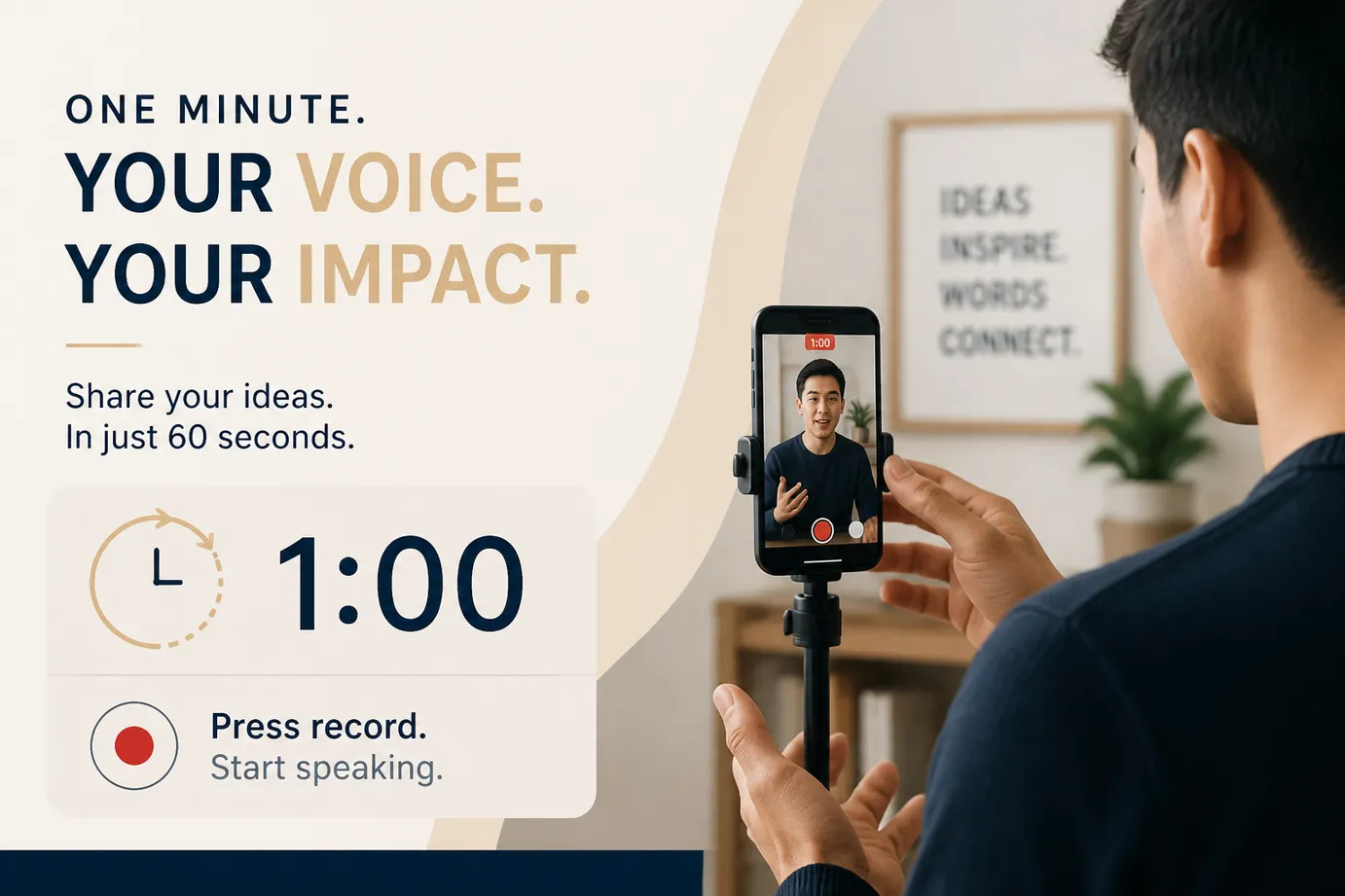
Record short answers to build real no-prep confidence.
Start with random topics
Random topics are the gym equipment of impromptu speaking.
They remove the biggest crutch: preparation.
That sounds mean. It is not. It is freeing.
When the topic is random, you are not trying to deliver a perfect speech. You are training your brain to create order quickly.
Try prompts like:
- Should meetings have a default time limit?
- What is one skill everyone should learn?
- Explain your favorite app to a grandparent.
- What makes a great teammate?
- Defend the idea that lunch breaks are sacred.
- What is one thing you changed your mind about?
- Describe a boring object like it is revolutionary.
- Should people practice public speaking every day?
That last one is not a trick. The answer is yes. Moving on.
Use the 3-second start rule
Pick your topic. Count down from three. Start.
Do not research. Do not outline for five minutes. Do not negotiate with your inner committee.
Three seconds is enough time to breathe and choose a first sentence. That is the muscle.
In real conversations, you often need to start before you feel perfectly ready. Practice that.
Use simple structures so you do not ramble
Structure is the seatbelt.
It keeps your ideas from flying through the windshield.
When people ramble, it is usually not because they have nothing to say. It is because they have too much to say and no container.
Use tiny structures. They should be easy to remember under pressure.
Structure 1: Point, reason, example, close
This is your everyday workhorse.
Point: Say what you think.
Reason: Explain why.
Example: Make it concrete.
Close: Land the plane.
Example topic: Should companies use fewer meetings?
- Point: Yes, most teams would benefit from fewer meetings.
- Reason: Meetings interrupt deep work and often replace clear written updates.
- Example: A 15-minute async update can save five people an hour.
- Close: Keep the meetings that create decisions. Cut the ones that create calendar confetti.
Clean. Useful. Done.
Structure 2: Past, present, future
Great for updates, stories, lessons, and progress reports.
- Past: Where things started.
- Present: What is happening now.
- Future: What comes next.
Example: Give a project update.
Past: Last week, we were blocked by unclear requirements.
Present: We clarified the main user flow and built the first version.
Future: Next, we need feedback from support before we ship.
No drama. Just direction.
Structure 3: Problem, impact, solution
Use this when you need to sound strategic.
- Problem: What is wrong?
- Impact: Why does it matter?
- Solution: What should we do?
Example: Our onboarding emails are too long.
Problem: New users are getting too much information at once.
Impact: They are not taking the first action that leads to activation.
Solution: Send one clear next step per email for the first week.
This structure makes you sound like someone who thinks in outcomes, not fog.
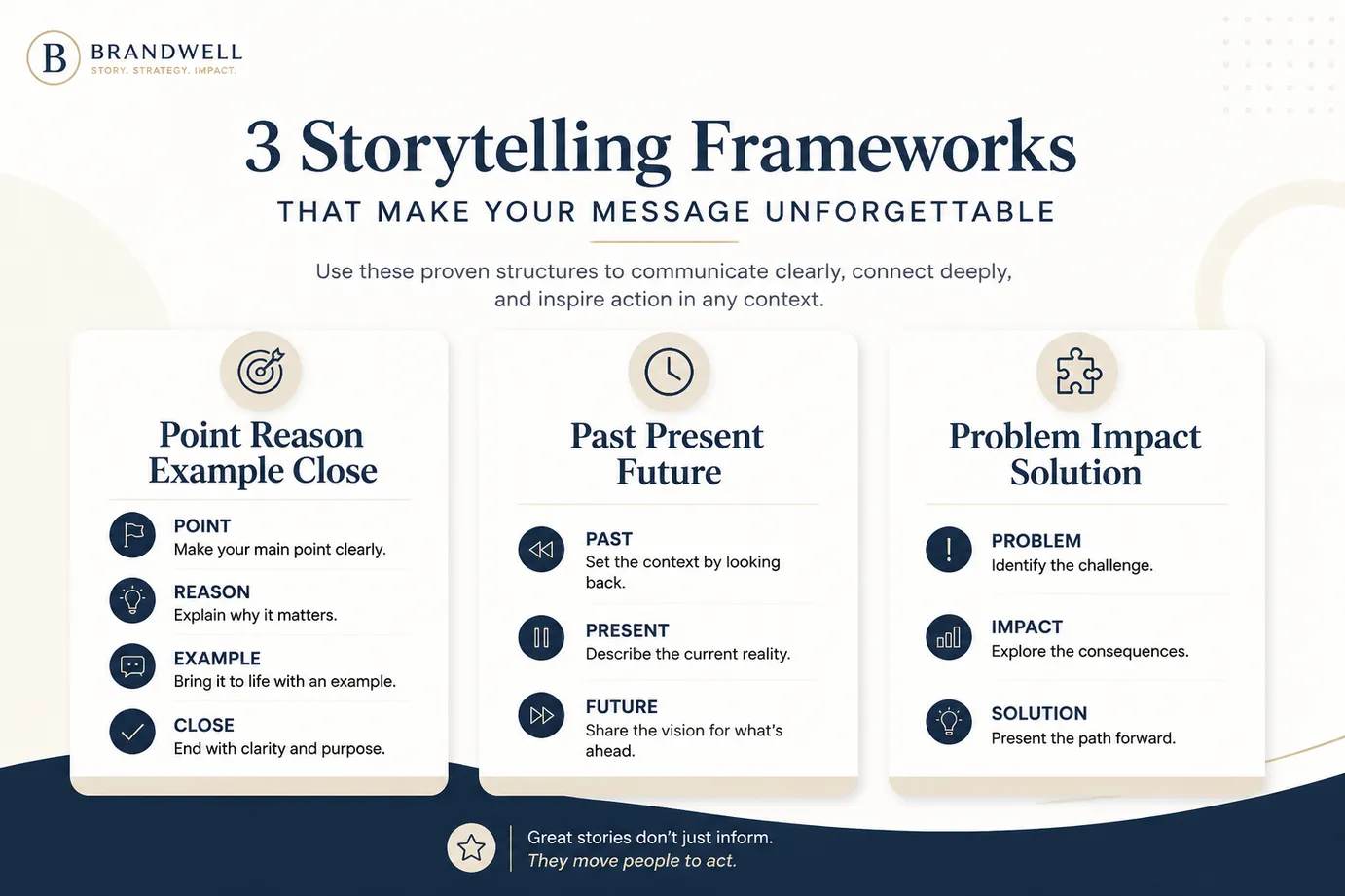
Structure keeps your answer from turning into a scenic route.
Reduce filler words without sounding robotic
Filler words are not a moral failure.
They are usually a signal that your mouth is moving while your brain is still loading.
Common fillers include:
- Um
- Uh
- Like
- You know
- Kind of
- Sort of
- Basically
- I mean
- Soooo
You do not need to eliminate every filler word. Normal speech has texture. But too many fillers can make you sound unsure, rushed, or unprepared.
The fix is not to clamp down and speak like a legal disclaimer.
The fix is to pause.
Practice the silent pause
A pause feels much longer to you than it does to the listener.
To you, it feels like a dramatic lunar eclipse.
To everyone else, it sounds like thinking.
Try this drill:
- Record a one-minute answer.
- Every time you feel an um coming, pause instead.
- Keep your face relaxed.
- Continue with the next sentence.
At first, it will feel weird. Then it will feel powerful.
Silence gives your words more room. It also makes you look calm, even when your brain is doing parkour.
Track one filler at a time
Do not try to fix every verbal habit at once.
Pick one filler word for the week.
Maybe it is like. Maybe it is basically. Maybe it is that one phrase you use so often it should start paying rent.
After each recording, count it. Write the number down. Try to reduce it by one next time.
Measurable progress beats vague shame.
Build clarity with the headline drill
Before you explain anything, find the headline.
The headline is the one sentence version of your message.
If your listener remembers only one thing, what should it be?
Practice this with any topic:
- Topic: Remote work
- Weak start: There are a lot of different opinions about remote work and it really depends...
- Strong headline: Remote work works best when teams are intentional about communication.
See the difference?
The strong version gives your listener a handle. Now they can follow you.
The 10-second headline drill
Use this before your one-minute recording:
- Read the topic.
- Give yourself 10 seconds.
- Write or say one headline sentence.
- Start your recording with that sentence.
This is one of the fastest ways to sound clearer.
You are not warming up in public. You are beginning with direction.
Practice presence, not performance
Presence is not theater.
It is attention.
You sound more present when you are connected to the message, the listener, and the moment. You sound less present when you are trapped inside your own head asking whether your hands look weird.
They probably look fine.
Public speaking practice should include delivery, but not in a fake way. You are not trying to become a motivational poster with cheekbones. You are trying to communicate like a human people can trust.
Three presence cues
1. Look up. If you are recording on your phone, look at the camera lens, not your own face.
2. Slow the first sentence. Your first line sets the pace. If you rush it, your whole answer may sprint.
3. Finish downward. Let your final sentence land. Avoid turning every ending into a question.
Try saying this two ways:
- I think we should launch the test next week?
- I think we should launch the test next week.
Tiny change. Big difference.
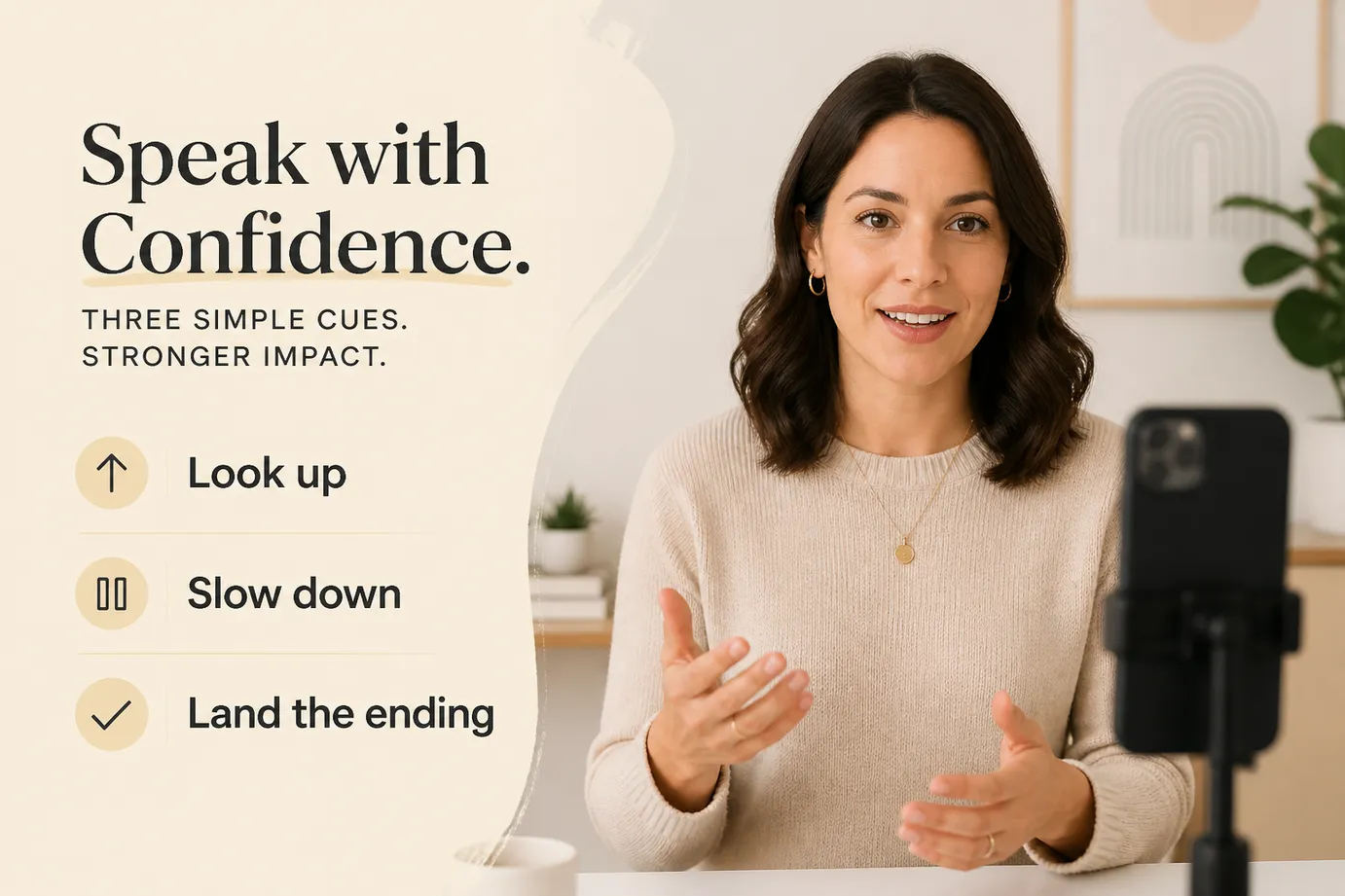
Presence is attention, not performance.
Make practice private enough to be honest
A lot of people avoid public speaking practice because they imagine an audience too soon.
Start private.
Record for yourself. Listen for yourself. Improve for yourself.
Privacy matters because it lowers the stakes. When the stakes are low, you practice more often. When you practice more often, your confidence stops depending on luck.
You do not need to post your practice clips. You do not need to send them to your manager. You do not need to become a personal brand before breakfast.
Just do the rep.
How to review without cringing into dust
Listening to yourself can be uncomfortable. Everyone thinks they sound strange at first.
Use a review checklist so you do not spiral.
Ask:
- Did I make a clear point?
- Did I use a structure?
- Did I pause instead of filling space?
- Did I finish cleanly?
- What is one thing I would improve tomorrow?
That is enough.
Do not review yourself like an enemy. Review yourself like a coach.
Create a public speaking practice routine
The perfect routine is the one you repeat.
Here are three options. Pick the one that fits your life.
The 3-minute daily routine
Best for busy people who still want progress.
- 30 seconds: Pick a random topic.
- 60 seconds: Record your answer.
- 60 seconds: Listen back.
- 30 seconds: Note one improvement.
Done.
This is the minimum effective dose. It works because it is small enough to survive a messy day.
The 10-minute skill routine
Best if you want faster improvement.
- 1 minute: Choose a topic and headline.
- 2 minutes: Record twice.
- 2 minutes: Listen and count fillers.
- 2 minutes: Practice one structure.
- 2 minutes: Record a final version.
- 1 minute: Log your score and streak.
This gives you enough repetition to feel the difference in the same session.
The weekly challenge routine
Best if you like goals.
Pick one focus for the week:
- Week 1: Start with a strong headline.
- Week 2: Reduce one filler word.
- Week 3: Use point, reason, example, close.
- Week 4: Improve eye contact and pauses.
- Week 5: End with a confident final sentence.
One focus. Seven reps. Clear progress.
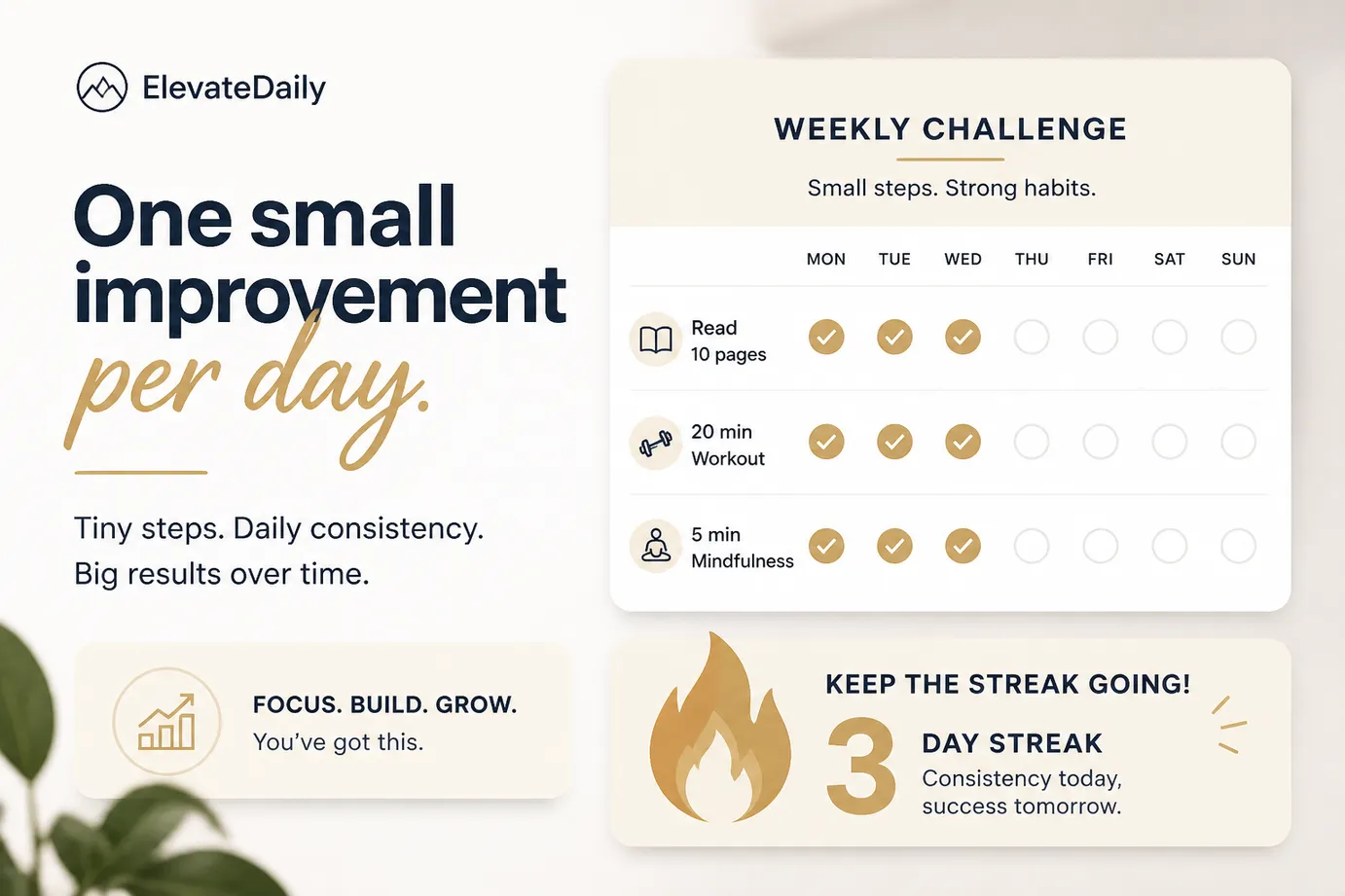
Track your streak so confidence has receipts.
Track progress so confidence has evidence
Confidence grows faster when you can see proof.
Do not rely on the feeling of improvement. Feelings are dramatic. Track something.
Useful metrics include:
| Metric | What to track | Why it helps |
|---|---|---|
| Streak | Days practiced | Builds consistency |
| Filler count | Number of target fillers | Makes fluency visible |
| Clear opening | Yes or no | Improves first impressions |
| Structure used | Which structure | Reduces rambling |
| Clean ending | Yes or no | Builds authority |
| Energy | 1 to 5 | Improves presence |
You do not need a spreadsheet with conditional formatting and a tiny trophy icon. Unless that delights you. In which case, live your truth.
A simple note works:
Day 6. Topic: better meetings. Used problem, impact, solution. Said basically 4 times. Tomorrow: pause before examples.
That is progress.
Practice for common real-life moments
Public speaking practice gets more useful when it matches your actual life.
Do not only practice abstract topics. Practice the moments you want to handle better.
Meeting updates
Prompt: Give a 60-second update on a project.
Structure: Past, present, future.
Goal: Be clear, brief, and decision-oriented.
Try ending with: The decision we need is...
Introductions
Prompt: Introduce yourself to a new team.
Structure: Who you are, what you do, what you are excited about.
Goal: Sound human, not like a résumé wearing shoes.
Example:
I am Maya, a product designer focused on onboarding. I spend most of my time making complicated first steps feel simple. I am excited to learn where users are getting stuck and help the team smooth that path.
Q&A answers
Prompt: Answer a tough question.
Structure: Acknowledge, answer, bridge.
Example:
That is a fair concern. The risk is that we move too fast and miss edge cases. My recommendation is to launch to a small group first, learn quickly, and expand only when the data looks stable.
Persuasive recommendations
Prompt: Recommend a change at work.
Structure: Problem, impact, solution.
Goal: Sound confident without sounding pushy.
Storytelling
Prompt: Tell a story about a time you learned something.
Structure: Situation, tension, lesson.
Goal: Keep it tight. A story is not a documentary series.
What to do when you blank
Blanking is normal.
Your brain is not broken. It is overloaded.
The fix is to give yourself a recovery move.
Use a reset phrase
Keep a few phrases ready:
- Let me frame it this way.
- The main point is this.
- There are two parts to that.
- Here is the short version.
- I would start with the outcome.
These phrases buy you a second and create structure.
They are not filler. They are signposts.
Return to the question
If you wander, come back with:
So to answer the question directly...
Then answer in one sentence.
This is a powerful habit. It tells the listener you know where you are going, even if you took a scenic route past three unrelated thoughts.
Solo practice vs. group practice
Both are useful.
Solo practice gives you privacy, frequency, and honest reps. Group practice gives you audience energy and feedback.
Start solo if you are nervous. Add group practice when you want more pressure.
Solo practice is best for
- Building a daily habit.
- Reducing filler words.
- Practicing impromptu topics.
- Reviewing recordings privately.
- Trying new structures without embarrassment.
Group practice is best for
- Handling real audience reactions.
- Getting feedback from others.
- Practicing longer talks.
- Building comfort with attention.
If possible, use both. But do not wait for a group to begin. Your phone is enough for day one.
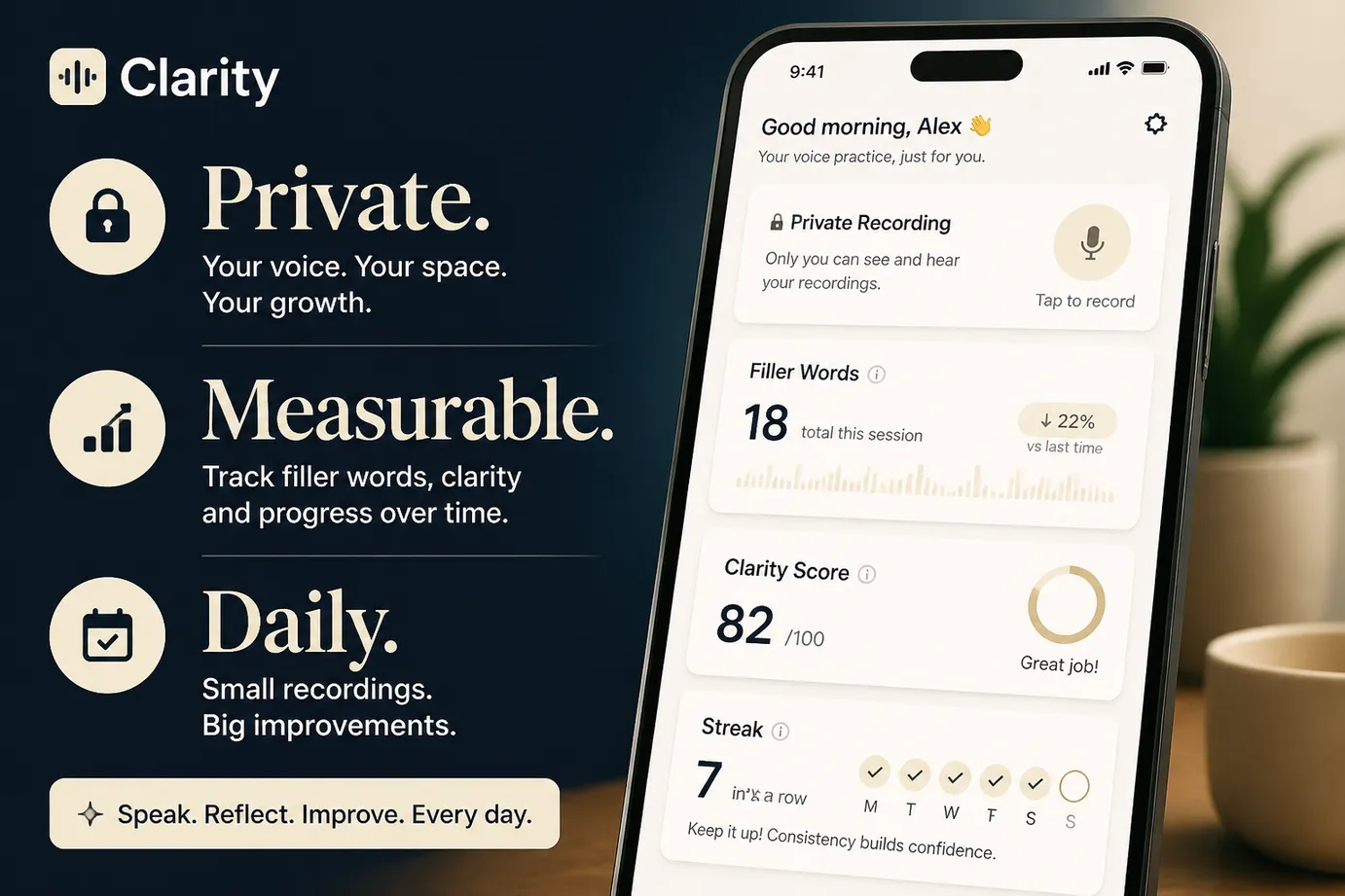
Private reps make honest improvement easier.
How Off the Cuff helps you practice
Off the Cuff is built for the kind of speaking life actually demands: quick, clear, no-prep answers.
Not perfect speeches. Real reps.
You get random topics, one-minute practice, private recordings, streaks, and measurable progress. You can focus on filler-word reduction, clarity, structure, and presence without turning practice into a second job.
It is public speaking practice for people who have meetings in eight minutes and would still like to sound sharp.
Try a challenge. Take your first one-minute recording. Pick a random topic and start before your brain invents seven reasons not to.
That is the rep.
A 7-day public speaking practice plan
Want a simple starting point? Use this plan.
Day 1: Record your baseline
Pick any random topic. Speak for one minute. Do not try to be impressive.
Just get the baseline.
Afterward, write down:
- Did I finish?
- Did I have a clear point?
- What filler word showed up most?
Day 2: Start with a headline
Use the 10-second headline drill.
Your only goal is to begin with one clear sentence.
Day 3: Use a structure
Pick point, reason, example, close.
Do not add five bonus points. Stay in the lane.
Day 4: Pause instead of filling
Choose one filler word. When it wants to appear, pause.
Count how many times it still appears. No judgment. Just data.
Day 5: Practice presence
Look at the camera. Slow your first sentence. Finish with a period.
Yes, you can hear punctuation.
Day 6: Answer a work-style prompt
Try one of these:
- Give a project update.
- Recommend a process change.
- Explain a decision.
- Answer a tough question.
Make it practical.
Day 7: Re-record your Day 1 topic
Same topic. Same time limit. New version.
Compare the two recordings.
You will probably hear a difference. Maybe it is small. Small counts.
That is how confidence gets built: not in one giant leap, but in proof after proof.
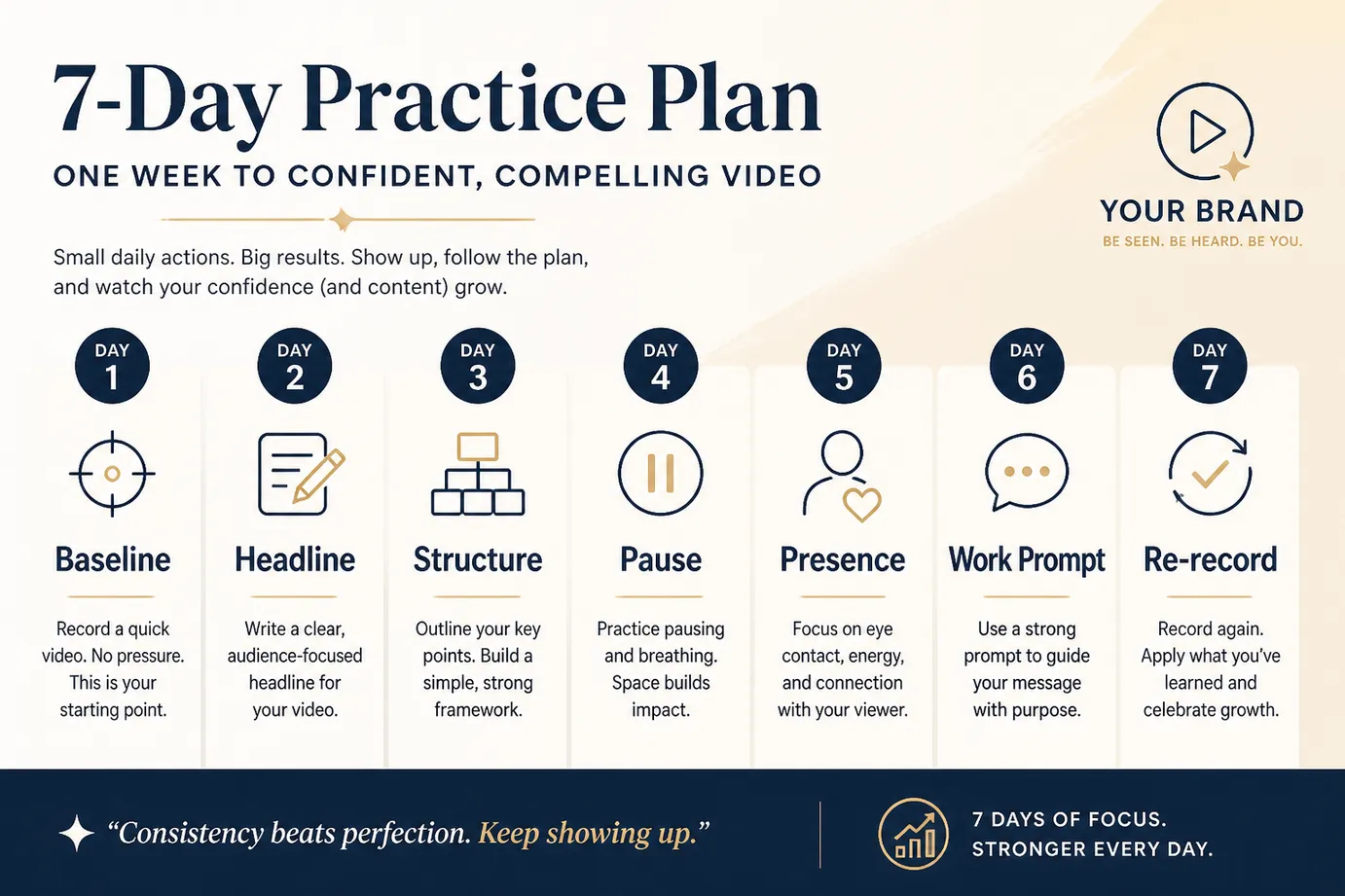
Seven days. Seven reps. Noticeable progress.
Advanced drills for faster improvement
Once you have the daily habit, add variety.
The no-filler sprint
Speak for 30 seconds with one goal: no target filler word.
Short. Intense. Surprisingly hard.
The clean ending drill
Record only the final 15 seconds of an answer.
Practice landing with confidence:
- That is why I recommend starting small.
- The next step is to test it with five users.
- In short, clarity beats more information.
The explain-it-simple drill
Explain a complex idea to a beginner.
This builds clarity fast because jargon has nowhere to hide.
The one-breath opening
Take one breath. Say your first sentence slowly and clearly.
This trains calm starts, which often determine the whole answer.
The two-version drill
Answer the same prompt twice:
- Version 1: Casual and conversational.
- Version 2: Executive and concise.
This helps you adjust tone for different rooms.
Common mistakes to avoid
Practicing only in your head
Thinking about speaking is not speaking.
Record out loud. Your mouth needs reps too.
Trying to fix everything at once
Clarity, fillers, pacing, gestures, eye contact, structure, confidence... too much.
Pick one focus per session.
Starting over every time you stumble
Do not restart.
Recover.
Real speaking does not come with a reset button. Practice continuing after a mistake.
Measuring confidence by comfort
You can be nervous and still speak well.
The goal is not zero nerves. The goal is useful action while nerves are present.
Waiting until you have time
You have one minute.
Use it.
Your first rep starts now
Here is your prompt:
What is one small habit that makes a big difference?
Set a timer for 60 seconds. Hit record. Start with a headline. Use one structure. Pause once on purpose. Finish cleanly.
Then listen back and choose one improvement for tomorrow.
That is public speaking practice that works.
Not someday. Not when you feel ready. Not after you buy a ring light and develop a personal philosophy on hand gestures.
Today.
One minute. One rep. One small improvement.
Go off the cuff.
Ready to practice?
Spin a random topic, speak for 60 seconds, and listen back - free while we're in early access.